Tech education

Updated on December 15, 2025
December 15, 2025
9 mins read

James Balmont
Freelance journalist
The Collectors is a new series that celebrates the intimate communities that congregate around tech and how these alternative families help spark friendships and keep devices relevant. For Part 1, James Balmont visited London’s first-ever Tamagotchi club, where he found a community of e-pet obsessives, who claim this hobby has been transformational.
In the residential suburbs of London’s bucolic Crouch Hill, inside an unassuming church backroom usually reserved for piano lessons, a retro tech revival is taking place among a clutch of enthusiastic hobbyists. United by nostalgia, a passion for design, and an instinct to collect, this growing community shares a passionate admiration for tiny digital pets that, for many, remain figments of a ‘90s childhood imagination. I personally thought that Tamagotchis had gone the way of the Furby and sea monkeys. Yet here at the London Tamagotchi Club, they have never been more alive.
“It’s a way to meet people and make friends with a purpose,” says Freya, the club’s 27-year-old founder. “It’s such an honour to bring people together and create a space for them to share their love and enjoy their hobbies with others.” For co-founder Sara, 36, the feeling is mutual: “When I found Freya’s [Instagram] page, I texted her straight away. Once you discover people who enjoy the same hobbies as you, you really feel at home.”
Originally conceived by action figure manufacturer Bandai in 1996, the pocket virtual pet device was named by combining the Japanese words for ‘egg’ (tamago) and ‘watch’ (uotchi). Gameplay was simple: users birthed a tiny, pixellated creature from an egg on the device’s monochrome LCD screen, and cared for the blocky hatchling using three squishy buttons on the front of the device. Regular bleeping prompts reminded users that the critters required constant feeding and cleaning.
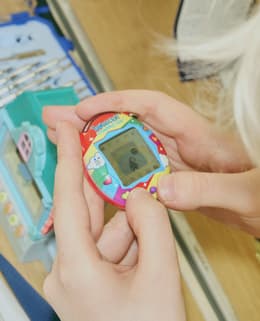
The Tamagotchi device first launched back in 1996.
If treated well, they would evolve through various ever-so-slightly different iterations. Neglected, however, and the Tamagotchi would die altogether — leaving an angel, ghost or grave behind. Young purveyors were taught a painful early lesson about the concept of mortality through these tiny plastic devices — at least until they pressed the reset button to start the cycle of life all over again.
It took less than a year for Tamagotchi to become a global phenomenon. When it did take off, Bandai employees in Japan were barred from carrying branded bags for fear of theft, while UK schools banned Tamagotchi from classrooms due to disruption (without regular attention, the digital pets could perish in just a few hours). Neither measure halted the sale of over 40 million units worldwide by Spring 1998, concluding what BBC’s Tomorrow’s World show had declared “the year of the virtual pet” just a few months prior.
But by 1999 the craze had crashed, with waning demand for Tamagotchis forcing Bandai to restructure as a business. For many of us that was it for Tamagotchi. But the regenerative, pixellated critters did mount an unexpected comeback in the new millennium, remaining in the cultural conversation… even if the noise was a little less buzzy than it was in the late 90s. From 2004 onwards, gamers could meet, play, marry and even breed via the infrared compatibility of the ‘Tamagotchi Connection’ devices. Meanwhile, over in Japan, Nintendo DS game ‘Tamagotchi Connection: Corner Shop’ sold over a million copies.

Emily is a proud member of London's first ever Tamagotchi social club.
Two movies followed in 2008 and 2009, before the Tamagotchi! anime series spawned an initial 143 episodes between 2009 and 2012. By 2021, there were Tamagotchi devices with built-in cameras, colour LCD displays, smartwatch functionality, and also collaborations with established franchises including Star Wars, Sonic the Hedgehog, and Jurassic World. After global sales doubled between 2022 and 2023, the BBC made another bold declaration in 2024: “Tamagotchi is having a moment — again.”
London Tamagotchi Club was founded in 2024 after Hackney-based Freya discovered the Toronto Tamagotchi Club online. Today, the Canadian “flagship” boasts 3,500 Instagram followers, with its meet-ups drawing around 50 attendees a pop. “I was like ‘wow, imagine if there were that many people in London that needed a place to go to connect their Tamagotchis,” Freya tells BackMarket. From there, she began hosting free, bi-monthly events, attracting collectors of all ages and backgrounds from across the UK.
With a broad scope of shell designs, colour-ways, and varieties today, collectability — much like with stamps, football shirts or even sneakers — remains a key draw for the community. “All the colours and designs are gorgeous,” Freya continues, listing off black-and-white cow print, green four-leaf clover, sunflowers, peacocks and stained glass versions among her collection. Elsewhere, rare models like Vicky’s Japan-only collaboration between Bandai and a “hexagon-based game show” sit alongside Mark’s £300 ‘Devilgotchi’. The latter is a limited edition 1998 device that’s “got legendary status” today. “It’s half aesthetics and half gameplay for me,” says Lila. “There’s a model for everyone, and I really enjoy collecting the shells.”
The small group gathered today has brought a true arsenal with them — from vintage first-wave relics to brightly-coloured Tamagotchi Paradise models, and spin-off devices like Digimon (fighting virtual pets originally marketed as Tamagotchi for boys) and Littlest Pet Shop (LPS). One attendee has even brought along a repurposed Nokia N73 phone — utilised, I’m told, for its infra-red capabilities. Co-founder Sara is absent today — and perhaps for good reason. The pizzeria owner, now based in Italy, has “over 200 devices”, she says via video call. “I don’t even have space to lay them all down and count.”
So, what is it that makes Tamagotchi so enduring for these fanatics? Unsurprisingly, a big factor is nostalgia: most patrons first encountered these toys when they were kids. Emily has brought along her first model — a pink-shelled device gifted by her father on her fifth birthday. In a way, it’s almost her own inner child – present today in material form.

Vicky owns a rare Tamagotchi, which she says is a collaboration between Bandai and a Japanese TV game show
Other members are united by childhood traumas: Vicky, an animation graduate now working for brands like Ferrari and Adidas, lost her first Tamagotchi in the garage when she was a child. Newcomer Lila, a 22-year-old student from Finland, meanwhile, describes being scarred after dropping one in a lake and leaving it “screaming” beneath the water. There’s more to the fandom, though, than just the link back to a time of comfort and innocence.
For many, the primitive gameplay and graphics sparked an early fascination with technology, and still provide a crucial stepping stone to understanding contemporary interactive media. Both Mark and Emily teach game design at schools and universities, and value the devices for their simplicity. “A lot of the students are into old tech like PlayStations and 16-bit Sega Genesis consoles,” explains the latter. “We’ll play a game and explore the graphics and gameplay, and see how it engages audiences.”
Freya, too, finds the original series’ designs inspiring: “They’re just black and green [displays], and the character is all pixellated, so you have to use your imagination as to what they really looked like.” She’s not the only admirer. Former Nintendo top dog Shigeru Miyamoto once testified to the incredible draw Tamagotchi devices had had on the gaming market (indeed, Nintendo’s own portable pocket monster games Pokémon Red and Green debuted the same year as Tamagotchi – with the Game Boy games selling one million copies in their first six months). “When we were stuck on talk of the spectacular 3D graphics of [N64 game] Mario 64, we saw a huge hit in the form of Tamagotchi — a tiny key chain boasting pictures made up of no more than 10 or 20 dots,” he said during a 1999 keynote speech in California. “At that time, I thought that Mario 64 had lost to Tamagotchi. I'm serious.”

This social club's tables are filled with various Tamagotchi paraphernalia.
Elsewhere, one patron mentions a device being kept “alive” for a staggering 900 days — highlighting a passion for nurturing that’s shared among the collectors. “I’ve always loved animals and taking care of things, so Tamagotchi appealed to my caring side,” says Freya, who today works as a midwife for the NHS. “It’s nice to have something dependent on me to keep it fed and happy without the responsibility. If I skip a meal for it when I’m on a night shift, or if my schedule is too hectic, it doesn’t have real-world consequences.” Indeed, as Tamagotchi “poop” becomes a talking point at the table, I’m grateful for the distinct lack of bad smells or messy clean-ups.
In any case, there’s another bonus to having a tangible digital pet in the present day. Not only does Tamagotchi make for a fun physical accessory, as Vicky points out to a table adorned with Tamagotchi pin-badges, lanyards, stickers, and customised bags — it also helps users reduce their social media or console gaming screen-time. “I was on Pokémon Go for a long time,” says Mark, “but I wanted to get away from my phone. I felt like I was just killing brain cells.” The in-person meet-ups, too, highlight a valuable real-world social aspect to the fandom and how technology can be a springboard for manifesting community spirit.
“Loneliness is a big issue in London,” says Freya. “And neurodivergent individuals like myself find socialising quite difficult. To be able to come together with people who are not only interested in the same thing as you, but are equally socially awkward, is really nice.” Sara feels the same: “At every meet-up, even beyond Tamagotchi, you feel like you’ve found people similar to you. And it’s all thanks to this little toy.”

All photos taken by Sam Dearden.
As London Tamagotchi Club descends into a cacophony of bleeps and bloops, I notice more and more heads inquisitively popping in from the room next door. The curiosity is appropriate. On Instagram, dozens of like-minded Tamagotchi Clubs have now opened up — from New York City and Chile to Poland and Singapore — while the Tamagotchi Subreddit boasts nearly 100,000 followers. Even K-Pop idols like LISA are posting Tamagotchi content online — a hint that a mainstream breakout could be just around the corner.
In the world of Tamagotchi and its Collectors, the circle of life is ever-repeating. Yet the culture surrounding them is similarly exponential. Just as the patrons at Crouch Hill have amassed dozens of oddly-shaped and intricately-detailed devices, these tiny pocket pets are forging connections between disparate individuals from entirely different walks of life, just as they did in school playgrounds nearly three decades ago. It seems even the most ephemeral “living” thing can be the source of enduring and meaningful impact. Don’t be surprised, then, if this trend refuses to die — indeed, why should it?
James Balmont is a London-based freelance journalist who specialises in arthouse cinema, alternative music, and contemporary arts and culture reporting. He's the person you want in your corner if there's any Studio Ghibli questions during a quiz.