


Back Market’s Slow Tech Summit was born in 2025 to make consumers question how technology shapes our lives. And this year, it was open to the public with a day packed with conversations from leading voices within tech, culture and activism, as well as eye-opening exhibits and hands-on workshops. Here, journalist Alice Pfeiffer shares her view from the ground.
I arrived at La Grande Menuiserie in Paris on Thursday with my phone running low on battery and a slightly guilty conscience. Joining tech industry experts and enthusiasts, I was about to mingle at Back Market’s Slow Tech summit, thinking how much better life would be with a new device. The charge would last longer, my Instagram photos would look better, and most important of all, I could get a new case.
Like anyone, I love shiny new gadgets, particularly phones, which are now almost permanently attached to us. Never mind that mine was barely a year old.
After fifteen years of writing about fashion and its endless cycle of collections, I've seen firsthand how desire is created and cultivated. Function and necessity have little to do with it. Instead, trends create new needs, making perfectly good products suddenly seem inadequate. Tech follows the same logic as fashion: we replace rather than repair; old models disappear from sight, and new ones seem to materialize out of thin air. Rarely do we question where they come from or where they end up.
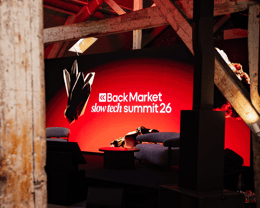
Your phone is heavier than you think
On October 15, Back Market challenged this cult of newness. For its second Slow Tech Summit, its team brought together scientists, activists, journalists, artists and visitors of all ages for a free day of talks, exhibitions and workshops.
The gathering coincided with France’s Journées nationales de la réparation (France’s national day of repair), with one idea at heart: making smartphones last ten years. A decade seems reasonable for a fridge or a washing machine, but for a phone, it feels practically archaeological. And, as I was to find out, getting there involves rethinking how our devices are designed, but also manufactured, sold, repaired and discarded.

Back Market co-founder Thibaud Hug de Larauze
Look who's talking
Back Market co-founder Thibaud Hug de Larauze opened with a quick quiz: how much does a smartphone weigh? Around 200 grams in your pocket – but producing it requires the extraction of 266 kilograms of raw materials, and 80% of its carbon footprint is generated before its first use.
To shed light on these invisible costs – the environmental, geopolitical and human consequences of mineral extraction – the venue was transformed into a multimedia space, with immersive film projections, giant displays, soldering stations, dismantled smartphones, vintage video cameras and even potatoes powering LEDs.
Part science fair, part cultural happening, the summit made technology physical again. We tend to imagine the digital world as weightless: a world of clouds, with wireless connections and invisible data, one synonymous with freedom, mobility and a digital nomad lifestyle. And while we’ve learned to ask where our food comes from and what goes into it, we still behave as though our phones have fallen from the sky. I won’t be insufferable enough to quote Marx, but his idea of commodity fetishism comes to mind – the finished product appearing almost magical, disconnected from the labour and social relations that produced it. Here, the smartphone’s sleek exterior gives little away about the messy realities behind it.


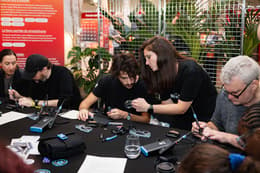
I explored these issues in a discussion I moderated with American journalist Vince Beiser, author of Power Metal, Congolese environmental activist David Maenda Kithoko, founder of Génération Lumière, and chemist Dr Marie Perrin, co-founder of REEcover. Between them, they revealed just how many stories – and layers of damage – are contained in a single device. Beiser investigates the global race for the metals powering modern technology; Kithoko documents the consequences of extraction for communities in his native Congo; and Perrin develops ways to recover rare-earth elements from existing materials. Together, they exposed the power dynamics behind the extractions: who benefits, who pays the price, and who is held accountable.
Back Market’s Head of Sustainability and Public Affairs, Marie Castelli, also took to the stage to discuss how through conversations with policymakers, manufacturers, telcos and other industry heavyweights, Back Market is pushing for a future where people keep their phones in use for 10 years. That means challenging the systems and incentives that drive people to upgrade every two or three years, and building a market where devices can last longer and serve more people over time. Fundamentally, it’s not just about changing consumer behavior, but the systems that fuel it.
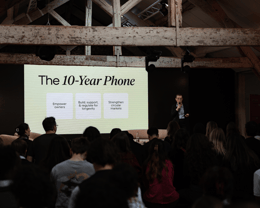
Back Market’s Head of Sustainability and Public Affairs, Marie Castelli
Workshops shaping the future of slow tech
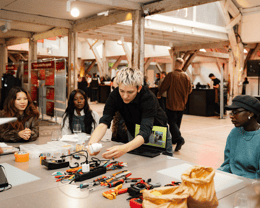
Elsewhere, visitors could get their hands dirty: soldering flashlights, turning potatoes, lemons and salt into makeshift batteries, or dismantling smartphones with iFixit engineers.
Self-proclaimed “analog explorer” Davide Bonetti aka @lecronachedidave led a workshop where he showcased his retrotech inventions, from color-correcting magic TVs, to portable CCTV cameras and custom PSPs, encouraging audiences to bring life to tech they may already own.
That same DIY spirit carried into a masterclass I moderated with London-based creator Annike Tan, aka Ube Boobey. Entirely self-taught, she makes cyberdecks (think customized portable computers made from salvaged parts.) She brought two along to show the audience, one resembling a mermaid's shell, the other built inside a jewelry box – both miles away from classical, sterile mass-market electronics. We discussed gender stereotypes in tech, her approach to “ethical hacking”, and why she refuses to use AI. The audience was full of practical questions: how did she learn, and how could they follow suit?

The summit ended with writer and digital-rights activist Cory Doctorow, who coined the term “enshittification” – describing how online platforms deteriorate as companies increasingly put profits before users. Imagining a “post-American internet”, he shifted the focus from the devices themselves to the digital systems and companies behind them.
From day to night
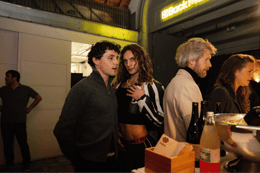
Like any exclusive party, as night fell, a line started to form around the block. Cohorts of Parisian influencers and intrigued passersby gathered outside the venue, ready to continue the festivities. Inside, drinks started flowing, as did new conversations. For those still looking to get involved in activities, there was T-shirt screenprinting from RO Studio, who were pumping out iconic slogans like: “Anti-upgrade club” and “Hot people buy Back Market”.
Cyber trinket designer Liso.exe showed attendees how to make their own jewellery using e-waste and artists including Mayou Picchu, Andy 4000 and indie pop duo Kids Return, soundtracked the night.




The day highlighted the contradictions of our relations to our smartphones: we trust them with our private lives but know nothing about their inner workings; we pay luxury prices for them yet get a new one every two years; we fill them with memories, yet treat the objects themselves as disposable.
Ultimately, nobody at La Grande Menuiserie was suggesting we abandon our smartphones and return to carrier pigeons. Slow tech isn't anti-technology, nor is it nostalgic. Its ambitions are more modest: keeping what we own, repairing what breaks and resisting the urge to upgrade.
I went home with the same phone, still running low on battery. The new cases could wait.