Press releases

Updated on June 16, 2026
June 16, 2026
7 mins read

Francisco Dominguez
Freelance journalist
Although Nintendo's focus might be on the Switch 2 nowadays, it hasn't stopped artists from continuing to embrace the Nintendo DS and 3DS to aide with their creations. Francisco Dominguez speaks to some of these artists.
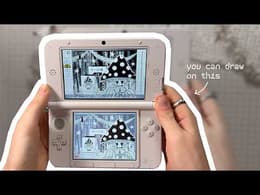
Even though Nintendo had stopped production of both its popular DS and 3DS handheld consoles by 2020, their impact on artists has only continued to grow in the years since. And thanks to the dual screens and stylus-led touch controls, these two obsolete handhelds are a helpful yet unlikely tool for digital creators.
Colors! 3D, a free drawing and painting program that first launched on the Nintendo DS in 2007 (and is still used by thousands of DS and 3DS fans today via firmware hacks), has since become the driving force behind many popular amateur artworks shared on platforms like TikTok, while even pop star Billie Eilish has recently been sharing her DS snaps online.
Animators also use tools like Flipnote Studio on the 3DS to make inventive cartoons, while – with its charmingly grainy 0.3-megapixel camera – the 3DS has consistently been a conduit for Y2K-coded snaps. There isn’t a week that goes by on X without someone trending for sharing a viral photo of a stranger recording via the DS at a pop concert; concrete proof these handhelds remain culturally relevant and sought after.
Perhaps one of the reasons the DS entered the art realm at all is due to Tancred Dyke-Wells, the director behind the popular Art Academy game series. These DS and 3DS games taught millions how to apply traditional art techniques like acrylics and charcoal pencils digitally, while the stylus-equipped consoles were tailor-made for the game’s binding concept around using the upper screen for teaching and the lower screen for ranking pupils' own artworks.
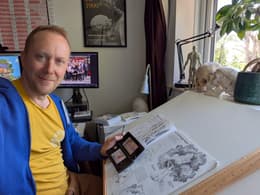
Tancred Dyke-Wells helped cement the DS and 3DS as artsy devices.
“I remember the producer at Nintendo was so impressed and excited by what we made, he went running to show other members of his family!” Dyke-Wells tells Back Market of Art Academy, which started out life as a simple fruit painting demo. “I’ve lost count of the amount of people who told me they got into real-life painting and art after playing our game on the DS or 3DS.”
One artist who has made a career out of the Nintendo DS/3DS is UK-based photographer, Marquee Moon Jr. Each time he shoots live music, he brings his 3DS along for the ride. Despite his much higher-grade main camera rig, the Nintendo DS photography remains a surprisingly prized add-on. He says his clients can’t get enough of his wigglegrams, which use web tools to transform 3DS photos into lo-fi GIFs.
"When you are making art, there are no distractions on the 3DS. The work feels more raw" - Marquee Moon Jr, professional photographer
“Every time I show somebody a GIF from a 3DS, they love it,” Moon Jr chuckles during our video call. “They often love it more than my professional work! We're getting too used to this airbrushed reality with smartphone photography, and you just don't get that with the 3DS.” His daily carry is a 2DS XL signed by Sarah Bonito, lead singer of the British indie pop band Kero Kero Bonito.
Marquee Moon Jr. rates his wigglegram of Bonito during her show at Headrow House in Leeds as his best work. Leaning back in her swirling wedding dress, this could only ever really work in lo-fi. “If you took that shot on a professional camera, you'd get too many crowd details,” he continues. “You might go ‘oh that guy's spilling his drink,’ and that'd ruin the shot. But there are no distractions on the 3DS, only the main feature: Bonito raising her hands and everybody leaning into the stage in anticipation.”
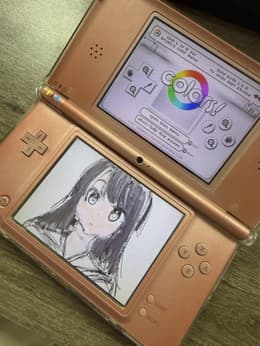
Colors! is a popular painting application for the DS and 3DS.
One Monash University’ art student, who only goes by the moniker “Squall”, is inseparable from the DSi XL they take to every class every day. For them the multifunctional console serves as a camera in shopping centres; a storyboard tool for animation assignments; and a sketchpad for character models and fan art. “This device is perfect for artsy assignments!” Squall says, full of admiration for its playfully nostalgic artistic output.
Compared to professional design tools taught on their course, using the DS is much more of a breeze. “Most animation software tends to have a convoluted user interface,” they say, “but not the DS.”
It’s the device’s refreshing pick-up-and-play nature that stands out. Compared to an iPad or modern camera, these pocketable consoles don’t get snared in endless menu settings. Instead, creators can easily explore Nintendo’s accidental artistic medium from the moment its clamshell case clicks open, continuing in a lineage the company perhaps started in the late 1990s with the Game Boy Camera.
This was part of the charm for Matt Nava, previously the art director at the popular indie gaming developer, thatgamecompany. In 2009, while developing PlayStation 3 indie hit Journey, a game about an apparition that floats across the desert, Nava packed his DS and stylus and set out to California’s Pismo Dunes for inspiration. Nava argues that traditional cameras were incapable of replicating the Pismo Dunes’ vibrant colours, intense brightness, and subtle sand movements.
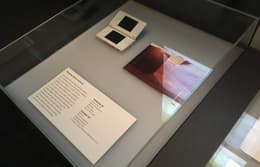
Matt Nava's art made on a Nintendo DS Lite was displayed at an exhibition in London's V&A Museum.
“The only problem with the Nintendo DS for painting outdoors is that the screen is too dim,” laughs Nava. “You can't see the dang thing out there in the bright sun on a desert dune!” Yet armed with cardboard, velcro, a craft knife, and some trial and error, Nava built a sunshade to more easily sketch the scene out in the California glare.
"The fact that the Nintendo DS and 3DS continue to prompt viral artwork is proof that great technology doesn’t live and die by how long it’s stocked in shops"
The result was arguably the most notable DS artwork made so far, helping directly shape one of the PlayStation 3’s most visually arresting games with Journey. Later on, Nava’s DS art, and its sand-weathered canvas, both went on to be displayed at London’s V&A Museum’s Design/Play/Disrupt video games exhibition in 2018—further validating the idea of serious artworks being created on a handheld console.
Nava is now the co-founder of indie game developer Giant Squid, which released the desert-surfing Sword of the Sea last year. He’s still drawn to the DS’s pocketable hardware, and Colors! 3D’s immediacy and gamified UI. “I've always been trying to replicate the simplicity and purpose-built nature of that little program on the DS,” Nava says.

“Yes, the iPad is great, but it's almost got too much power. When you're in the field, you become unfocused; you spend so much time thinking about what brush to use, instead of using what’s available to you. If you use the DS or 3DS to make art, there’s no confusion and it’s straight to the point.”
Art Academy can still draw over one million Instagram views today, and its enduring ability to inspire artists remains the highlight of Dyke-Wells’ career. “So many people said: ‘I didn't think I could draw, but I got into real-world painting and drawing through the series.’ They can carve this one on my tombstone!”
The fact that the Nintendo DS and 3DS continue to prompt viral artwork, and are both so visible online, is proof that great technology doesn’t live and die by how long it’s stocked in shops, but rather how long people are inspired by it. Yes, Nintendo is more focused on the Switch 2 right now, but so long as there are budding artists in need of a pick-up-and-create device, the Nintendo DS and 3DS will continue to be passionately used.
As the student Squall concludes: “The DS/3DS feels more like a drawing toy than a modern device. This means artists will always love it.”
Francisco Dominguez is a freelance journalist who specialises in video game culture.