Refurbished price:$50.00
Versus $56.24 new

Updated on August 27, 2026
August 27, 2026
9 mins read
Courtney Davison
Freelance technology journalist
The Collectors celebrates the intimate communities that congregate around tech and how these alternative families help spark friendships and keep devices relevant. For Part 3, Courtney Davison joins the LA Field Recording Club, a growing community of sound enthusiasts who are discovering new ways to collect, listen to, and document the city they love.
The smog hanging over the Los Angeles basin is thin on this August afternoon. From up on Mount Wilson, you can see all the way to the ocean. But the people around me are more interested in what they can hear. Headphones on, they meander the mulch trails, angling microphones like antennae.
A decaying tree stump catches one woman’s attention. She dangles her palm-sized digital recorder by its cord and gently lowers it into the hollow. Nearby, a man presses a microphone against a "Welcome to Mount Wilson Observatory" sign, his eyes downcast as though listening for a heartbeat. A California gray fox trots by, unbothered. The Los Angeles Field Recording Club has gathered here, where legendary astronomer Edwin Hubble once looked to the stars, to listen to the earth.
Since forming last year, this club has ventured out together to collect sounds from across LA—bird sanctuaries, scrapyards, a maybe-haunted mansion in Beverly Hills. "I like taking people to places they've never been," says LAFRC founder George Jensen, who's been exploring the city through his ears for more than a decade now. "There are so many random spots around LA that we just drive by and don't look into."
Jensen's own field-recording practice began in 2013 in a cove in Big Sur, a six-hour drive up the coast. Waves were breaking on the rocks in front of him, while behind him a waterfall spilled freshwater into the ocean. "I was just sitting there going, 'Damn!'" he recalls. He wanted his landlocked friends in Dallas, where he's originally from, to experience what he was hearing. So he decided to bring the cove to them.
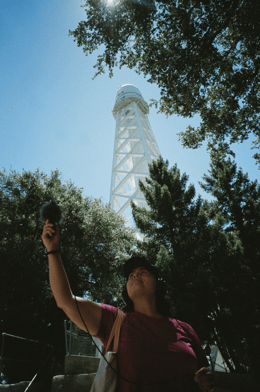
Mary Galindo collects birdsong by a telescope tower at the Mount Wilson Observatory. Credit: Danielle Criqui.
He invested in a Zoom H6 and two stereo Audio-Technica microphones for quadraphonic recording, finally returning to the cove. Once he got everything set up and pressed “Record” something dawned on him: "I had to shut up and just sit there."
Over the course of an hour, he slipped into a meditative state, noticing whales in the distance and birds around him. "A whole world opens up when you just sit and listen."
From that point on, recording became part of Jensen's daily life. He began carrying a recorder with him wherever he went, alert and awake to anything that Los Angeles might offer up sonically. In time, he got to know other field recordists, and they would talk about getting together to share their recordings. Then, last year, his girlfriend asked if he knew of any field-recording clubs in Los Angeles. He didn’t. Maybe, he thought, he should start one.
Jensen subsequently envisioned a club for anybody: “Anyone can come and learn how to field record if they want, but also people who know what they’re doing can come and record, too.” In June 2025, he held the first meeting at a record store in Highland Park, expecting maybe one or two people to show up. Instead, the place was packed, with the crowd spilling out onto the sidewalk. "I was like, 'Oh my god. This is real. I have to actually do something now.'"
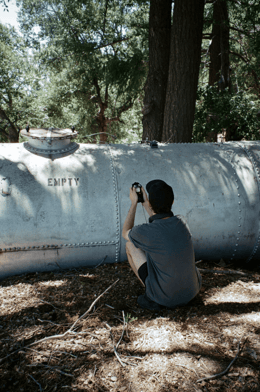
An LAFRC member records the sound of a tank at the Mount Wilson Observatory. Credit: Danielle Criqui
A year in, 20 or so people show up for the monthly meetings, which alternate between recording outings (where members gather new material) and listening sessions (where they get a chance to hear what others have found). Experimental musician Matt Johnson has been coming since the kickoff last June. The club has added a social dimension to a practice that "always sort of lived in a vacuum for him," he says. "Seeing where people are going or what kind of results they're getting—it does open up a lot of ideas."
Outings begin with members circling up for a gear show-and-tell. Johnson pairs a Zoom H6 with omnidirectional condenser microphones, which he likes for their sensitivity and wide pickup. Archivist Sandy Olagues, meanwhile, prefers the all-in-one Zoom H1 Essential Handy Recorder, because "it's super low-key" and easy to stash in her purse. At the Mount Wilson outing, one member pulls out a Marantz tape recorder they’re using for the first time. Another unveils her custom-made microphone, drawing plenty of oohs and aahs. There’s an obvious affection for the electronic tools that let them listen more closely. Before everyone disperses to actually start recording something, Jensen offers some advice for newbies: “If you hear an interesting sound that disappears before you can catch it, just wait—it might come back.”
"When you're sitting there recording, listening to the sunset, even the freeways start to sound like rivers, and you notice all these things you hadn't noticed before"
Jensen says the outings have gone smoothly, for the most part. One of the early trips was to a scrap-metal recycling center in the San Fernando Valley. Jensen had seen what he gleefully describes as "mountains of just fucking metal nonsense" and thought it would make for rich material for the club. When the group showed up, the workers weren't quite sure what to make of them. "They were like, 'Why are y'all here? You can't be here.'"
Once Jensen explained that they were just a bunch of people who liked recording sounds, though, the workers warmed up to the concept. "They really got into it," Jensen says. “They gave us all hard hats and were performing by throwing around old washing machines."
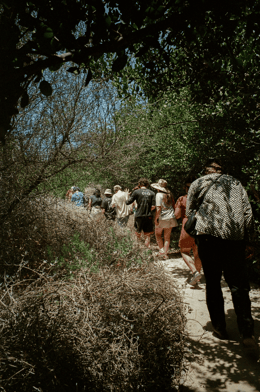
LAFRC members hike a trail in search of ambient sounds. Credit: Danielle Criqui.
Whatever the location, LAFRC members find something worth recording. At the outings I attended, I witnessed recordists excitedly capturing the sounds of a drinking fountain, a jangling lock, a rusty pump. At one point while I was taking notes, LAFRC member Mary Galindo approached me to ask if she could record the sound of my pen moving across the page.
Galindo came to LAFRC through her interest in birding. As a birder, she says, “you’re constantly tuned in to birds, obviously, but you’re also listening to the other sounds around you.” She bought a handheld digital recorder and soon found herself capturing not just birds, but other things that caught her ear.
Since joining LAFRC last fall, documentary editor Oscar Vazquez has amassed “an uncontrollable archive of city sounds”—bits he records on his phone or a borrowed Tascam while walking the streets or hanging out on his rooftop. A native Angeleno, he says the practice has given him “an excuse to get to know the city a little bit more”, making him feel more tethered to this environment. "I live in Boyle Heights," Vazquez says. "It's extremely polluted, and there are freeways everywhere. But when you’re sitting there, listening to the sunset, the freeways start to sound like rivers, and you notice all these things you hadn’t noticed before.”
Refurbished price:$50.00
Versus $56.24 new
Refurbished price:$60.00
Versus $250.00 new
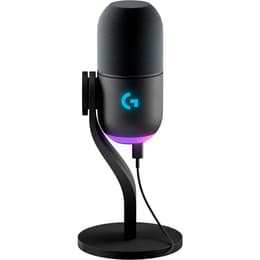
Refurbished price:$19.99
Versus $64.59 new
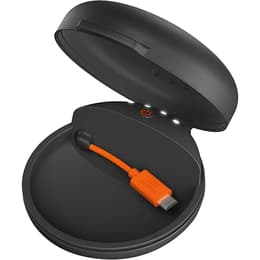
Refurbished price:$46.00
Versus $89.00 new
Refurbished price:$50.00
Versus $107.26 new
Refurbished price:$50.00
Versus $184.24 new

Refurbished price:$54.00
Refurbished price:$55.00
Refurbished price:$56.00
Versus $70.00 new
Refurbished price:$56.00
Versus $70.00 new
Refurbished price:$56.00
Versus $70.00 new

Refurbished price:$62.00
Versus $99.99 new
Refurbished price:$67.00
Versus $165.00 new
Refurbished price:$69.00
Versus $73.38 new
Refurbished price:$69.00
Versus $184.06 new
Soon, recordings like Vazquez’s will have somewhere to live beyond their creators’ personal archives. LAFRC is developing an interactive online sound map of Los Angeles, which will allow members to upload and geotag recordings they've collected from around the city.
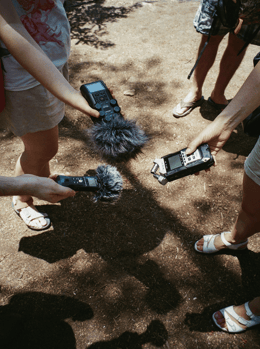
LAFRC members show off their recording gear at an outing to Debs Park in Los Angeles. Credit: Danielle Criqui.
Over time, Jensen hopes this map will provide a record of how the city is changing. He points to the LA River, which flows (or trickles, depending on the year) through the heart of the city. Along its concrete banks in Northeast LA, historically working-class neighborhoods are being gentrified, and Jensen hears the change in recordings he's made there over the last 10 years. "It used to be a lot quieter there," he says. "The gentrification of the river has added all sorts of new sounds." Jensen views the project as a natural evolution of LAFRC. "Ultimately, I want the club to serve as a document of what Los Angeles is."
"The people who go out and collect natural sounds, well, they're practising a kind of sonic care for their neighbourhood"
Cathy Lane, co-author of In the Field: The Art of Field Recording and professor of sound arts at University of the Arts London, says sonic mapping could provide valuable data for future researchers in a range of fields, from botany to urban studies. "It's an amazing record of a place that is always in a state of flux," Lane says. “And I don't just mean the landscape. I mean the people, everyone in it, as well.”
To Lane, LAFRC reflects a broader shift in field recording itself—a practice with roots in a tradition of privileged outsiders traveling the world to capture sounds they considered exotic. "There's still an element of trophy bagging" for some field recordists, she says, "but I think that's on its way out." Lane is heartened to hear of locally rooted field-recording communities like LAFRC: "They’re practicing a kind of sonic care for their neighbourhood.”
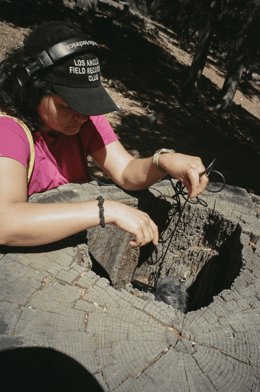
Mary Galindo gathers sound from inside a tree stump at Mount Wilson Observatory. Credit: Danielle Criqui.
Red-tailed hawks glide through a cloudless summer sky over the Los Angeles Audubon Center. In the patchy shade of a Peruvian pepper tree, dozens of people are spread out on blankets and in beach chairs. A few talk in hushed tones. Dead leaves crunch underfoot as latecomers wander in. They have all come here at high noon, during a heat advisory, just to sit and listen.
They listen to church bells clanging at Echo Park Lake.
They listen to crawfish clamoring in a bucket beside the LA River.
They listen, intently, to a chicken clucking. ("That chicken's got a great voice," a woman next to me murmurs, and others nod.)
It's the LAFRC's first anniversary party, and members have gathered to share the recordings they’ve each made. Contributors come to the front and introduce their pieces: "These are some coyotes I heard outside my house the other night." "Here's a convertible roof unfolding." "This is a drain pipe I contact mic'd and sort of dragged around." After each recording, the crowd applauds—sheepishly, at first, then somewhat louder.
"To be around people who are as enthused about a sound that you captured is really fun," Galindo says. "I've shared some with my friends, but they're just like, 'Oh, OK, Mary.'"
In a lull between presentations, the PA system hums. Hot wind rustles the peppercorn boughs, and somewhere down the hillside, the 110 freeway whooshes. Eyes close; heads tilt. The collectors in the crowd receive it all like a gift.
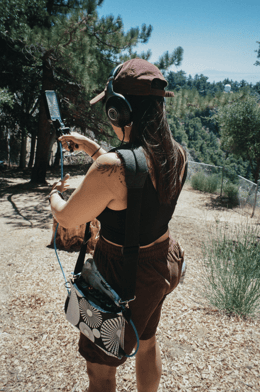
LAFRC member Char Gibbs uses a custom-built microphone at the Mount Wilson summit. Credit: Danielle Criqui. You can find out more about the Los Angeles Field Recording Club on their Instagram page and website.
Courtney Davison is a freelance technology journalist based in California. She has written for titles such as Caltech, M+ Magazine, and Forks Over Knives.