Tech education

Updated on April 16, 2026
April 16, 2026
8 mins read

Christine Ochefu
Journalist
Despite production stopping in 2013, the Mini Disc Player remains relevant, with artists selling their latest albums on this obsolete musical format and avid collectors insisting it sounds far better than streaming. Christine Ochefu speaks to some of the Mini Disc Player community to learn why their obsession for this device remains so feverish.
“With MiniDisc there's just so much choice and self-expression!”
Back Market is speaking to a passionate but anonymous collector based in Laramie, Wyoming, who only goes by the web alias Gunner5. He is someone you might describe as a MiniDisc enthusiast. Gunner5 has around 300 plus discs in his personal collection and passionately believes that the MiniDisc Player offers a freedom other contemporary music services simply can’t replicate.
“We have no self-expression and individuality in our entertainment nowadays, and we have no possession – it's all gone,” he claims. “[But if] you buy the CD, rip it, you put it on Mini Disc and then it’s yours forever. There's just so much choice. And with every choice you’re offered, there's self-expression. That is something so lacking and a void in our streaming world."
The MiniDisc audio device, which was first released by Sony back in 1992, might be one of the most enduring things ever created by the legendary Japanese tech giant. Sony sold about 22 million MiniDisc players worldwide before it discontinued them in 2013. The player was costly ($600-$900), which negatively impacted its popularity. In the very early years, sales were modest; only about 50,000 units sold in the U.S. during the first year. Yet the format saw great popularity in Japan: the native release made it favourable to a market where CDs could often be as high as $30 in conversion price, while the format benefitted from a media push including surreal TV adverts featuring pop superstars like Jamiroquai.
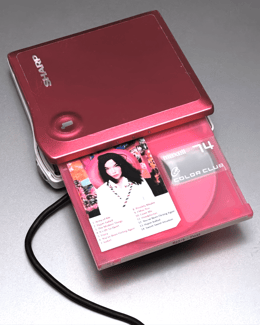
A custom MiniDisc release by Bjork, created by the Instagram page @minidscovery
Its discs were typically available in three lengths, holding up to 80 minutes of audio. With this software, well, the clue is in the name: the devices resemble a small floppy disc, of which use is straightforward. You slide the cartridge into the player, hear the mechanism engage, and the music begins. Alongside their players, these bitesized floppy discs allowed their users to let loose with great customisability. One could edit tracks directly on the device via their PC disc drive in a manner much easier than other physical media counterparts of the time. The discs themselves were rewritable thousands of times, something near impossible with cassette tapes, and far less common with CDs.
Superior sound quality remains central to the format’s appeal. MiniDiscs stored audio using Sony’s ATRAC compression system (Adaptive Transform Acoustic Coding), which reduced the size of audio data by removing sounds the human ear is less likely to notice. The result was a device able to hold roughly over an hour of music, while maintaining sound quality closer to a compact disc.
MiniDisc was once just another format that artists released their new albums on (with these releases going for big money on the second-hand market today), while also allowing customers to make their own home-made mini discs packed full of songs. But even though Sony officially stopped manufacturing MiniDisc Players and recorders in March 2013, they have retained a stubborn grip over pop culture and remained cool among collectors in the years since then.


You might have seen a MiniDisc on Kanye West’s boldly minimalist Yeezus cover artwork (designed by the late Virgil Abloh, no less) back in 2013. In fact, the original audio files of Radiohead’s classic AI-parodying OK Computer LP were stored by Thom Yorke on a MiniDisc, while just last year the rising Geordie rock star Sam Fender published his latest album on the format (which sold out almost instantly). Over on Bandcamp, there are 100s of artists currently selling their latest album on Mini Disc.
Then there’s the MiniDisc’s presence in prescient 90s imagery, particularly the fact they were used by Neo in The Matrix. It means the aesthetic of the MiniDisc is linked forever with themes of the alternative: futurism, dystopian imagery, and escapism. A broader yearning for physical media has brought a newfound appreciation for the devices themselves, with many fans rediscovering old MiniDisc collections during the pandemic.
For Michael Yan, a family physician based in Canada, his MiniDisc collection unintentionally spawned during the last decade. It now nears up to three hundred. “In 2014 one of my units started to fail, and so I said to my wife that I needed to go on eBay and buy another one for backup,” he recalls. “It started with, ‘okay, I'm just gonna buy one so I have some redundancy.’ And then, ‘oh maybe I'll buy another to make sure.” At home with nothing to do during the pandemic, he started capturing his collection for a dedicated Instagram account, @minidscovery, which has now amassed over 24,000 followers.
“I thought this would be a niche thing and I'd get like 12 followers. But it really just ballooned from there,” he says. A browse on his page shows the plethora of new MiniDiscs that he’s recorded, hand-printed with labels – from The Doors, to Lauryn Hill, even a MiniDisc pressing of Rosalía’s Lux, released in 2025. “The vintage audio corner of the internet seemed to be the happiest part of the web. Sometimes the artists will actually message me, saying, ‘thanks for featuring my work. There’s an active community of people who are keen to keep the technology alive, and they’re finding people that can support them.”
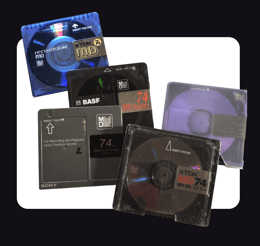
Despite being obsolete, Sony's MiniDisc Player has retained a cult following
Gunner5, meanwhile, has started MDCon, a cross-state travelling convention dedicated to the device. Beginning with just one US show, it has since expanded to 10 dates across America and three international stops in Coventry, Antwerp and near Zurich — with hundreds of MiniDisc enthusiasts passing through the doors. The focus at MDCon isn’t on selling, much to the chagrin of avid collectors, he recalls. Rather a place to bring the love for the device offline, where fans can meet other creators, peer over rare formats and devices brought by avid collectors, and watch lectures about the current state of the device.
"I think what all physical media has in common is the aspect of ownership,” Berlin-based techno and electronic producer Remute says to Back Market. “Even if I only have 50 MiniDiscs, I think I have more connection to these 50 discs than to the 100 million tracks on Spotify that I don't know, because I proactively decided to buy them. For me, a physical item is more profound than a digital‑only release."
He started out releasing music in the early 2000s on the likes of Tresor Records, since building a reputation for experimenting with retro technology; republishing much of his music on archive tech devices like the Nintendo Gameboy and Sega Megadrive. Remute got into MiniDisc around 2019 after spotting it on a trip to the thrift market, releasing previous albums on MiniDisc over Bandcamp as a bit of a joke – until the releases sold out instantly.
As previously mentioned, Bandcamp has become a burgeoning community for MiniDisc releases, and maybe it’s now symbiotic with the device itself. The numbers remain modest; they are not formally catalogued, but roughly 162 MiniDisc releases currently appear on the streaming platform. Regardless, the site provides a rare space for artists willing to experiment with the format.
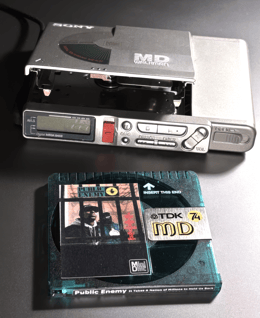
A custom MiniDisc release by Public Enemy, created by the Instagram page @minidscovery
There are even designers releasing new MiniDisc Players in 2026. Eddie Chan is a 47-year-old Canada-based product designer who rediscovered a love for MiniDisc during the pandemic. In 2025, he went above and beyond Sony’s creations; Chan launched a MiniDisc Kickstarter to build the Billet Aluminum MD, a device that reimagined the MiniDisc. It was inspired by a rare alloy model from the past (the snazzy MD 2000, the only MiniDisc in production made from a metal alloy).
“Even after acquiring it, I thought that it still feels a little on the cheap side,” he says of the rare device. “So I thought, ‘okay, I think I can do better.’ Be a nice challenge, you know?” Chan’s version leans heavily into the physical qualities of the device, focusing on the "tactile experience” while giving it a boost. Built with aluminium and metal components, the player is deliberately more weighty and cool to the touch, a contrast to the light plastics that dominate most modern electronics. And with only a limited initial run of 100 units, the Billet Aluminum MD has the added novelty of being a collector’s item in itself.
Chan’s project quickly resonated with collectors and enthusiasts and was fully funded in just six days. “I think for a lot of the people who grew up with it from the very beginning, it is a different way of interacting with audio,” Eddie says of its popularity. “Maybe Gen Alphas and millennials probably won't fully understand unless they really experienced it. But at the same time, [it’s like] using a camera and audio from 2005; it's quite amazing to understand where everything kind of started from.”
Where the MiniDisc player will live beyond 2026 is a mystery, but current trends seem to suggest it’s going nowhere. For many fans of this early 90s tech that refuses to die, it seems the perfect bridge between analogue ritual and digital convenience — and may have been too good for a world that wasn’t quite ready for it yet. “There's no more supply coming. The supply is diminishing; everything's only going to get more expensive,” Gunner5 concludes. “MiniDiscs are only going to get more and precious with time, trust me.”

The MiniDisc Player collector known as Gunner5 shows off his vast collection.
Christine Ochefu is a London-based freelance journalist and copywriter who specialises in UX, SEO and content marketing. She's an expert in tech, finance, and travel topics, and writes for brands like Squarespace, WeTransfer, reMarkable and many more.