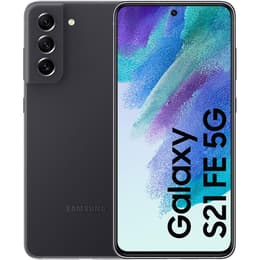
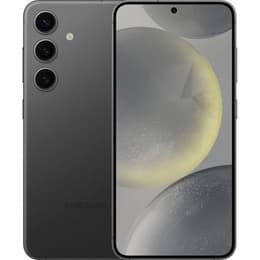
Galaxy S21 FE 5G • Unlocked vs Galaxy S24 • Locked T-Mobile

Galaxy S21 FE 5G • Unlocked
Starting at

Refurbished price:$133.00

Versus $699.99 new

See options
Galaxy S24 • Locked T-Mobile
Starting at

Refurbished price:$277.00

Versus $799.99 new

See options

Ratings

The Samsung Galaxy S21 FE 5G, released in January 2022, and the Samsung Galaxy S24, launched in January 2024, are both Android smartphones from Samsung's popular Galaxy series. While the S21 FE was positioned as a 'Fan Edition' offering core flagship features, the S24 represents a more recent iteration of Samsung's main flagship line. The primary distinctions between these two devices lie in their release timelines, the underlying processing power, and the extent of their software support.

Scores

Durability

The longevity of a smartphone is influenced by its release age and the manufacturer's commitment to software updates.

  • Release Timeline: The Galaxy S21 FE 5G was released in January 2022, making it two years older than the Galaxy S24, which launched in January 2024. This age difference directly impacts the remaining period of official software support.
  • OS Support Duration: The Galaxy S24 benefits from Samsung's extended update policy, promising seven years of operating system and security updates from its release date. This means it is projected to receive updates until early 2031. In contrast, the Galaxy S21 FE 5G, under Samsung's policy at its release, typically receives four years of OS updates and five years of security updates.
  • Practical Lifespan: Users prioritizing the longest possible software support and access to the latest Android features will find the Galaxy S24 offers a significantly extended practical lifespan. Both devices feature an IP68 rating for dust and water resistance, contributing to their physical durability.

Release Year

2022

2024

Last OS Compatibility

Yes

Yes

OS

Android

Android

Foldable

No

No

Performance

The performance of these devices is largely determined by their internal components and how efficiently they handle various tasks.

  • Processing Capabilities: The Galaxy S24 features a newer generation processor, either the Qualcomm Snapdragon 8 Gen 3 for Galaxy or the Exynos 2400, depending on the region. This newer hardware generally translates to faster app loading, smoother multitasking, and more efficient handling of demanding applications and graphics-intensive games compared to the Galaxy S21 FE 5G's Snapdragon 888 or Exynos 2100 processor.
  • System Responsiveness: The Galaxy S24's more advanced processor provides a noticeable improvement in overall system responsiveness, making daily interactions feel more fluid. While the S21 FE 5G still offers capable performance for everyday use, the S24 provides more headroom for future software and applications.
  • Battery Behavior: The Galaxy S21 FE 5G is equipped with a 4500 mAh battery, while the Galaxy S24 has a 4000 mAh battery. Despite the S21 FE's larger capacity, the S24's newer, more efficient processor can lead to comparable or even better real-world battery endurance for many users, with some reports indicating the S24 can last through a full day of moderate to heavy use.

Memory (GB)

6 GB

8 GB

Screen quality

Both smartphones offer vibrant displays, but there are notable differences in their visual experience and outdoor visibility.

  • Display Technology and Clarity: Both devices feature Dynamic AMOLED 2X displays with FHD+ resolution (1080 x 2400 pixels on S21 FE, 2340 x 1080 pixels on S24), providing deep blacks and rich colors. The Galaxy S24 has a slightly smaller 6.2-inch display compared to the S21 FE 5G's 6.4-inch screen.
  • Brightness and Refresh Rate: The Galaxy S24 offers significantly higher peak brightness at 2600 nits, ensuring excellent visibility even in bright outdoor conditions, compared to the S21 FE 5G's typical 700 nits. Both phones feature a 120Hz refresh rate for smooth scrolling and animations, but the S24's display is adaptive, ranging from 1Hz to 120Hz, which can contribute to power efficiency.
  • Screen Protection: The Galaxy S24 comes with Corning Gorilla Glass Victus 2 for enhanced durability, while the S21 FE 5G uses Corning Gorilla Glass Victus.

Resolution

1080 x 2340

1080 x 2340

Screen type

Dynamic AMOLED 2X

Dynamic LTPO AMOLED 2X

Audiovisual

The camera systems on both devices are designed to capture high-quality images and videos, though the newer model introduces advancements.

  • Rear Camera System: The Galaxy S24 features a triple rear camera setup with a 50MP wide main sensor (f/1.8, OIS), a 10MP telephoto lens (f/2.4, 3x optical zoom, OIS), and a 12MP ultrawide lens (f/2.2, 120˚ FOV). The Galaxy S21 FE 5G also has a triple rear camera system, consisting of a 12MP wide main sensor (f/1.8, OIS), an 8MP telephoto lens (f/2.4, 3x optical zoom, OIS), and a 12MP ultrawide lens (f/2.2, 123˚ FOV). The S24's higher resolution main sensor can capture more detail.
  • Photography Performance: Both phones offer strong performance in good lighting conditions. The S24, with its newer image processing and higher resolution main sensor, generally provides improved detail and dynamic range, especially in challenging lighting. The S21 FE 5G also includes features like Night Mode for low-light photography.
  • Video Recording and Front Camera: The Galaxy S24 supports video recording up to 8K at 30fps, and 4K at 60fps, while the S21 FE 5G records up to 4K at 60fps. For selfies, the S24 has a 12MP front camera, while the S21 FE 5G features a 32MP front camera, both capable of capturing detailed self-portraits.

Main camera

12 megapixels

50 megapixels

Front camera

32 megapixels

12 megapixels

Miscellaneous

Beyond core specifications, several practical elements contribute to the overall user experience of these smartphones.

  • Connectivity and Ports: Both devices support 5G connectivity. The Galaxy S24 features Wi-Fi 6E and Bluetooth 5.3, offering faster and more stable wireless connections compared to the S21 FE 5G's Wi-Fi 6 and Bluetooth 5.0. Both utilize a USB-C port for charging and data transfer.
  • Biometrics and Build: The Galaxy S24 incorporates an ultrasonic in-screen fingerprint sensor, which is generally considered faster and more secure than the optical in-screen fingerprint sensor found on the S21 FE 5G. In terms of build, the S24 uses an 'Enhanced Armor Aluminum' frame and Gorilla Glass Victus 2 on the back, while the S21 FE 5G has an aluminum frame with a plastic back and Gorilla Glass Victus. Both are IP68 rated for water and dust resistance.
  • Dimensions and Handling: The Galaxy S24 is slightly more compact and lighter, measuring 147 x 70.6 x 7.6 mm and weighing 168 g. The S21 FE 5G measures 155.7 x 74.5 x 7.9 mm and weighs 177 g. This difference can make the S24 feel more manageable for users who prefer a smaller device.

Weight

7 oz

6 oz

Screen size (inches)

6.4

6.2

Network

5G

5G

SIM card

Physical SIM

Physical SIM + eSIM

Carrier compatibility

Unlocked

T-Mobile

The Samsung Galaxy S21 FE 5G and Galaxy S24 cater to slightly different user priorities, largely due to their release dates and the technological advancements introduced in the newer model. User feedback for the S21 FE often praises its balanced feature set, offering a near-flagship experience without the highest-tier specifications. Common praise points include its vibrant display and reliable camera performance for its class. Some users, however, noted that its battery life could be inconsistent depending on usage patterns and the specific processor variant.

The Galaxy S24, being a more recent release, generally receives acclaim for its enhanced performance, significantly brighter display, and the promise of extended software support. Users appreciate its compact design and the overall fluidity of the user experience. While its battery capacity is smaller than the S21 FE, its efficiency improvements often lead to satisfactory daily endurance, though heavy users might still find themselves charging daily. Some discussions around the S24 have focused on the regional differences in processors (Snapdragon vs. Exynos), with benchmarks sometimes showing slight variations, though real-world usage often minimizes these perceived differences.

Users prioritizing the longest possible software longevity, cutting-edge performance for demanding tasks, and superior outdoor screen visibility may find the Galaxy S24 better suited to their needs. Its newer processor and extended update policy offer a more future-proof experience. Conversely, individuals seeking a slightly larger display and a device that still delivers a strong overall experience for everyday tasks, potentially at a different value point, might consider the Galaxy S21 FE 5G. Both devices are available as quality-assured refurbished options, providing an eco-friendly alternative for consumers.

See all articles

Our recent comparisons