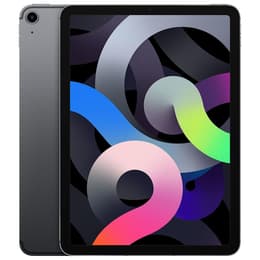

Galaxy Tab A7 Lite (8.7", 2021) vs iPad Air 4 (2020, A14 series)

Galaxy Tab A7 Lite (8.7", 2021)
Starting at

Refurbished price:$71.00

Versus $219.00 new

See options
iPad Air 4 (2020, A14 series)
Starting at

Refurbished price:$235.95

Versus $729.00 new

See options

Ratings

The Samsung Galaxy Tab A7 Lite, released in mid-2021, and the Apple iPad Air (4th generation), launched in late 2020, are two distinct tablets designed for different user needs and ecosystems. The Galaxy Tab A7 Lite operates on Android, offering a compact form factor and expandable storage, while the iPad Air runs on iPadOS, providing a larger display and a more powerful processing experience. These differences cater to users seeking either a highly portable, media-focused device or a more robust tablet capable of handling demanding tasks.

Scores

Durability

When considering the long-term usability of these tablets, their release timelines and software support policies are key differentiators.

  • Release and Updates: The Galaxy Tab A7 Lite, launched in June 2021, initially ran Android 11 and received updates up to Android 14 with One UI 6.1. However, Samsung officially ended software update support for this model in June 2025, meaning it will no longer receive major OS upgrades or security patches. In contrast, the iPad Air (2020), released in September 2020, benefits from Apple's extended software support, currently running iPadOS 26.4.1 as of April 2026 and expected to receive updates for several more years, potentially exceeding eight years from its release.
  • Repairability and Build: Both tablets feature an aluminum frame and back, contributing to a solid feel. However, the iPad Air (2020) has received a low repairability score from iFixit, indicating that repairs, especially battery replacement, are challenging due to extensive use of adhesive. Information on the Galaxy Tab A7 Lite's specific repairability score is less prominent, but budget Android tablets often present similar challenges.
  • Practical Lifespan: For users prioritizing the latest software features and security updates, the iPad Air (2020) offers a significantly longer practical lifespan due to Apple's update policy. The Galaxy Tab A7 Lite, while still functional, will gradually fall behind on new features and security protections following the cessation of its software support.

Release Year

2021

2020

Last OS Compatibility

Yes

Yes

OS

Android

iPadOS

Performance

The performance capabilities of these two tablets vary considerably, influencing their suitability for different tasks.

  • Processing Power: The iPad Air (2020) is equipped with a powerful current-generation processor that allows it to handle demanding applications, complex multitasking, and graphically intensive games with fluidity. Users will experience smooth app loading and responsive interactions even with professional-grade software. The Galaxy Tab A7 Lite, on the other hand, features a processor designed for more basic tasks. It performs adequately for web browsing, video streaming, and light applications, but users may notice slower app loading times and some sluggishness when multitasking or running more demanding games.
  • Multitasking and Responsiveness: The iPad Air (2020) offers a highly responsive user experience, making it well-suited for productivity and creative work where quick transitions between apps are common. Its system architecture and optimized software contribute to this smooth operation. The Galaxy Tab A7 Lite, with its available RAM configurations (typically 3GB or 4GB), can manage everyday multitasking, but performance may degrade if many applications are open simultaneously.
  • Storage Options: The iPad Air (2020) comes with internal storage options of 64GB or 256GB. The Galaxy Tab A7 Lite offers 32GB or 64GB of internal storage, with the notable advantage of expandable storage via a microSD card, supporting up to 1TB. This is a key consideration for users who require significant local storage for media or documents.

Memory (GB)

3 GB

4 GB

Screen quality

The visual experience on these tablets is shaped by their distinct display technologies and specifications.

  • Display Technology and Size: The iPad Air (2020) features a 10.9-inch Liquid Retina IPS LCD display, known for its accurate color reproduction and wide viewing angles. The Galaxy Tab A7 Lite has a smaller 8.7-inch TFT LCD screen. The larger screen of the iPad Air provides a more expansive canvas for content consumption and productivity.
  • Resolution and Clarity: The iPad Air (2020) offers a resolution of 2360x1640 pixels at 264 pixels per inch (PPI), resulting in sharp text and detailed images. The Galaxy Tab A7 Lite's resolution is 1340x800 pixels, with a lower pixel density of approximately 179 PPI. This difference means that fine details and small fonts may appear less sharp on the Galaxy Tab A7 Lite, particularly when viewed closely.
  • Brightness and Features: The iPad Air (2020) achieves a typical brightness of 500 nits, making it suitable for use in various lighting conditions, including outdoors, and includes features like True Tone and a wide color (P3) gamut for enhanced visual accuracy. The Galaxy Tab A7 Lite's display typically reaches around 332-360 nits of brightness, which may be less ideal for bright outdoor environments, and it lacks advanced display technologies like True Tone or wide color support. Both displays operate at a standard 60Hz refresh rate.

Resolution

800 x 1340

2360 x 1640

Screen type

TFT LCD

Liquid Retina display

Pixel density

180ppp

264ppp

Audiovisual

The camera systems on these tablets are designed for different primary uses, reflecting their overall positioning.

  • Rear Camera Performance: The iPad Air (2020) is equipped with a 12-megapixel wide rear camera with an f/1.8 aperture, capable of recording 4K video. While not on par with dedicated smartphone cameras, it performs well for document scanning, casual photography, and capturing decent quality video. The Galaxy Tab A7 Lite features an 8-megapixel autofocus rear camera. User feedback suggests its rear camera is suitable for basic snapshots but may produce images that are blurry or lack contrast, especially in challenging lighting conditions.
  • Front Camera and Video Calls: For video conferencing, the iPad Air (2020) includes a 7-megapixel front camera that offers good image quality and handles low-light situations effectively, making it well-suited for video calls. The Galaxy Tab A7 Lite has a 2-megapixel front camera, which is adequate for video calls but may not offer the same level of detail or clarity. Both tablets can record video at 1080p resolution with their front cameras, though the Galaxy Tab A7 Lite's front camera records at 720p.
  • Audio Experience: The iPad Air (2020) features stereo speakers that deliver clear audio, particularly when held in landscape orientation, enhancing the media consumption experience. The Galaxy Tab A7 Lite also includes stereo speakers with Dolby Atmos support, providing a good audio experience for its class. The iPad Air (2020) lacks a 3.5mm headphone jack, while the Galaxy Tab A7 Lite retains this traditional audio port.

Miscellaneous

Beyond core specifications, several practical features and design elements distinguish these two tablets.

  • Connectivity: The iPad Air (2020) supports Wi-Fi 6 (802.11ax) for faster wireless internet speeds, alongside Bluetooth 5.0 and optional LTE connectivity. The Galaxy Tab A7 Lite supports Wi-Fi 5 (802.11 a/b/g/n/ac) and Bluetooth 5.0, also with an optional LTE variant. Both offer reliable wireless connections for everyday use.
  • Ports and Sensors: The iPad Air (2020) utilizes a versatile USB Type-C port for charging and accessories, and features Touch ID integrated into the top button for secure authentication. It also includes a gyroscope, accelerometer, compass, and barometer. The Galaxy Tab A7 Lite uses a USB Type-C 2.0 port and retains a 3.5mm headphone jack. It includes an accelerometer, compass, and light sensor, but notably lacks a gyroscope, which may affect certain apps or games.
  • Design and Handling: The iPad Air (2020) has dimensions of 247.6 x 178.5 x 6.1 mm and weighs around 458g (Wi-Fi model), offering a sleek and relatively thin profile. The Galaxy Tab A7 Lite is more compact and lighter at 212.5 x 124.7 x 8.0 mm and 366g (Wi-Fi model), making it easier to hold with one hand and more portable. Both devices feature a glass front with an aluminum back and frame.

Weight

12 oz

16 oz

Width

4,91 in

7 in

Height

8,37 in

9.7 in

Depth

0,31 in

0.2 in

Screen size (inches)

8.7

10.9

Network

Wi-Fi + 4G

Wi-Fi + 4G

Carrier compatibility

Unlocked

Unlocked

The Samsung Galaxy Tab A7 Lite and the iPad Air (2020) cater to different segments of the tablet market, each with its own set of strengths and considerations based on user feedback.

Users often praise the Galaxy Tab A7 Lite for its compact size, making it highly portable and comfortable for single-handed use, particularly for media consumption like watching videos or reading. Its expandable storage via microSD card is a significant advantage for those who need to store a large amount of content without relying solely on internal memory. However, common criticisms revolve around its modest screen resolution, which can make text and images appear less sharp, and its performance limitations when running multiple apps or demanding games. The camera quality is generally considered basic, suitable for video calls but not for high-quality photography. The cessation of major software updates in June 2025 is also a point of concern for long-term usability.

The iPad Air (2020) is frequently lauded for its powerful processing capabilities, enabling smooth multitasking, demanding applications, and a fluid user experience. Its Liquid Retina display is appreciated for its clarity, color accuracy, and brightness, providing an excellent visual experience for a wide range of content. Users also value Apple's long-term software support, ensuring the device remains current with features and security updates for many years. Criticisms sometimes include the lack of expandable storage and its higher initial investment, though this comparison avoids price references. The repairability of the iPad Air is also noted as challenging due to its construction.

Users prioritizing a highly portable, lightweight tablet primarily for casual media consumption, web browsing, and reading, especially those who value expandable storage and the Android ecosystem, may find the Galaxy Tab A7 Lite suitable. Conversely, users who require a more powerful device for productivity, creative tasks, demanding applications, and a longer software support lifespan, within the iPadOS ecosystem, will likely find the iPad Air (2020) to be a better fit. Both devices, when considering a quality-assured refurbished option, can offer a sustainable choice for different user needs.


See all articles

Our recent comparisons