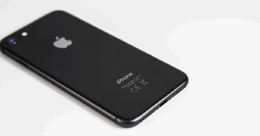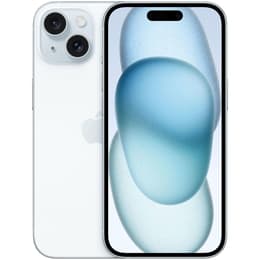
Google Pixel 8 • Unlocked vs iPhone 15 • Locked AT&T

Google Pixel 8 • Unlocked
Starting at

Refurbished price:$254.00

Versus $699.99 new

See options
iPhone 15 • Locked AT&T
Starting at

Refurbished price:$349.43

Versus $729.00 new

See options

Ratings

The Google Pixel 8, released in October 2023, and the iPhone 15, launched in September 2023, represent contemporary smartphone offerings from their respective manufacturers. Both devices operate on distinct ecosystems, with the Pixel 8 running Android and the iPhone 15 utilizing iOS. While both aim to deliver a premium smartphone experience, key differentiators lie in their approach to software longevity and display technology.

Scores

Durability

When considering the long-term usability of a smartphone, factors like software support and physical durability are important.

  • Software Longevity: The Google Pixel 8 stands out with a commitment to seven years of OS and security updates from its October 2023 release, offering an extended period of software relevance. [2, 9, 16] The iPhone 15, released in September 2023, is guaranteed a minimum of five years of software support, though Apple has historically provided updates for longer periods, often extending to 5-7 years for major OS updates and 7 years for security updates. [19, 26, 29, 30, 41]
  • Physical Durability: Both devices feature robust build materials designed for everyday resilience. The Pixel 8 incorporates Corning Gorilla Glass Victus for screen protection and an IP68 rating for dust and water resistance. [5, 14, 21] The iPhone 15 utilizes a Ceramic Shield front cover and an IP68 rating, indicating similar levels of protection against dust and water ingress. [3, 4]
  • Practical Lifespan: Users prioritizing the absolute longest guaranteed software support will find the Pixel 8's seven-year commitment appealing. For those accustomed to Apple's consistent, albeit less formally stated, long-term support, the iPhone 15 offers a comparable practical lifespan, with both devices expected to perform well for several years.

Release Year

2023

2023

Last OS Compatibility

Yes

Yes

OS

Android

iOS

Foldable

No

No

Performance

The performance of a smartphone is crucial for smooth daily operation, from launching applications to handling demanding tasks.

  • System Responsiveness: The Google Pixel 8 is powered by a current-generation processor designed to handle demanding applications and multitasking efficiently, often leveraging advanced AI capabilities for various functions. [9] The iPhone 15 features a powerful processor, carried over from the previous year's Pro models, which ensures fast and fluid performance across iOS applications and games. [36, 42]
  • Multitasking and Storage: The Pixel 8 typically comes with 8GB of RAM, contributing to smooth multitasking and app management. [9, 31] It is available with 128GB or 256GB of internal storage. [9, 18, 31] The iPhone 15 generally includes 6GB of RAM, which is optimized to work effectively with the iOS ecosystem for efficient multitasking. [6, 36] Storage options for the iPhone 15 include 128GB, 256GB, and 512GB. [3, 4, 8, 25]
  • Battery Behavior: The Pixel 8 is equipped with a 4575 mAh battery, and user experiences suggest it generally provides a full day of mixed use, with heavy users potentially needing a charge before the day ends. [23, 33, 34, 37, 38] Its Adaptive Battery feature learns usage patterns to optimize power consumption. [23] The iPhone 15, with a 3349 mAh battery, is also designed to last a full day for most users, with tests showing over 11 hours of usage on a single charge. [6, 40, 45, 46] Its efficiency is a key factor in its battery performance. [43, 46]

Memory (GB)

8 GB

6 GB

Screen quality

The display is a primary interface for smartphone interaction, influencing everything from content consumption to daily navigation.

  • Display Technology and Clarity: The Google Pixel 8 features a 6.2-inch OLED display with a resolution of 2400x1080 pixels, resulting in a pixel density of 428 ppi. [2, 5, 7] This provides clear and vibrant visuals. The iPhone 15 sports a 6.1-inch Super Retina XDR OLED display with a resolution of 2556x1179 pixels, offering a pixel density of 460 ppi for sharp and detailed imagery. [1, 3, 4, 6, 10]
  • Brightness and Smoothness: The Pixel 8's display offers a variable refresh rate between 60Hz and 120Hz, contributing to smoother scrolling and animations, and can reach up to 1400 nits for HDR content and 2000 nits peak brightness outdoors. [2, 5, 13, 15, 31] The iPhone 15 has a standard 60Hz refresh rate, providing consistent visual fluidity, and achieves up to 1600 nits peak HDR brightness and 2000 nits peak outdoor brightness. [1, 3, 4, 6]
  • Viewing Experience: Both phones offer excellent OLED panels with deep blacks and vibrant colors. The Pixel 8's higher refresh rate can provide a perceptibly smoother experience during fast-paced content or scrolling. The iPhone 15 introduces the Dynamic Island, an interactive area around the front camera cutout that displays alerts and live activities. [3, 11]

Resolution

1080 x 2400

1179 x 2556

Screen type

OLED

Super Retina XDR OLED

Audiovisual

Camera capabilities are a significant consideration for many users, and both devices offer advanced photographic and videographic features.

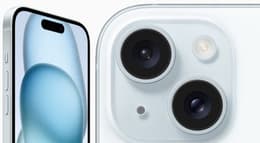
  • Rear Camera Systems: The Google Pixel 8 includes a 50MP main camera with optical image stabilization and a 12MP ultrawide camera with autofocus and macro focus capabilities. [18, 20, 21, 28, 31] It excels in computational photography, enhancing image quality. The iPhone 15 features an advanced dual-camera system with a 48MP main camera that uses sensor-shift optical image stabilization and a 12MP ultrawide camera. [3, 4, 6, 24] The main camera defaults to 24MP photos but can capture 48MP HEIF images. [24, 35]
  • Photography Performance: The Pixel 8 is known for its strong low-light performance and features like Night Sight, Magic Editor, and Real Tone for accurate skin tones. [20, 21] Its ultrawide camera also supports macro photography. [20, 21] The iPhone 15 offers improved Portrait mode with richer colors and better low-light performance, along with Smart HDR. [24] It also provides a 2x telephoto option by cropping the main sensor. [24]
  • Video Recording and Audio: Both devices are capable of recording 4K video at 60 frames per second from their main and front cameras. [21, 28] The Pixel 8 includes Dual Exposure technology for sharper videos in challenging lighting and Audio Magic Eraser for sound editing. [20, 21] The iPhone 15 supports 4K Dolby Vision video recording. [3, 4] Both offer good microphone quality for calls and recording, and provide a satisfying media consumption experience through their speakers.

Main camera

50 megapixels

48 megapixels

Front camera

10.5 megapixels

12 megapixels

Miscellaneous

Beyond core features, several practical elements contribute to the overall user experience and device utility.

  • Connectivity and Ports: Both the Google Pixel 8 and iPhone 15 support 5G cellular connectivity, along with modern Wi-Fi standards and Bluetooth for wireless connections. A notable change for the iPhone 15 is the adoption of a USB-C port, aligning it with the Pixel 8 and many other electronic devices, simplifying charging and data transfer with a single cable type. [11, 45]
  • Biometric Security and Sensors: The Pixel 8 features an in-display fingerprint scanner for secure unlocking and authentication. [13] The iPhone 15 relies on Face ID, Apple's facial recognition system, for biometric security. [3, 4] Both devices include a standard suite of sensors such as accelerometers, gyroscopes, and proximity sensors for various functionalities. [1]
  • Design and Handling: The Pixel 8 measures 150.5 x 70.8 x 8.9 mm and weighs 187g, offering a compact and comfortable feel in hand. [7, 14, 28] It features a glass rear plate and a matte aluminum frame. [14, 31] The iPhone 15 is slightly smaller and lighter at 147.6 x 71.6 x 7.8 mm and 171g, with an aluminum design and a color-infused glass back. [3, 4, 10] Both designs prioritize durability with their respective protective glass technologies.

Weight

7 oz

171 oz

Screen size (inches)

6.2

6.1

Network

5G

5G

SIM card

Physical SIM + eSIM

eSIM

Carrier compatibility

Unlocked

AT&T

Connector

USB-C

USB-C (USB 2)

The Google Pixel 8 and iPhone 15 offer distinct yet compelling smartphone experiences, each with its own set of strengths. User feedback often praises the Pixel 8 for its advanced computational photography features and the promise of extensive software support, making it a strong contender for those who value cutting-edge AI integration and long-term updates. [2, 9, 16, 21] Some users, however, have noted that its battery life, while generally good, may not always meet the demands of very heavy usage without needing a top-up. [23, 33, 34]

The iPhone 15 is frequently lauded for its consistent and fluid performance within the iOS ecosystem, its robust build quality, and the introduction of the Dynamic Island for enhanced user interaction. [3, 11, 36, 46] Its camera system is also highly regarded for producing excellent photos and videos in various conditions. [24, 35] While its 60Hz display refresh rate is a point of discussion for some, its overall display quality and outdoor brightness are well-received. [1, 3, 4, 6]

Users prioritizing the longest guaranteed software support and a highly intelligent camera system with unique AI features may find the Google Pixel 8 well-suited to their needs. Conversely, individuals who value a highly optimized and intuitive user experience, a strong ecosystem, and a slightly more compact design might lean towards the iPhone 15. Both devices represent excellent choices, and considering a quality-assured refurbished option for either model can be a sustainable choice for consumers.


See all articles

Our recent comparisons