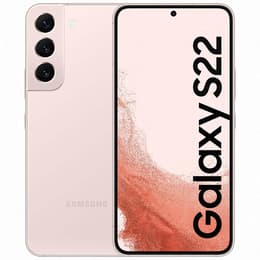
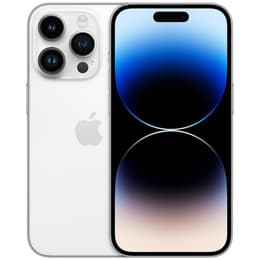

Galaxy S22 5G • Locked AT&T vs iPhone 14 Pro • Unlocked

Galaxy S22 5G • Locked AT&T
Starting at

Refurbished price:$164.99

Versus $799.99 new

See options
iPhone 14 Pro • Unlocked
Starting at

Refurbished price:$352.00

Versus $999.00 new

See options

Ratings

The Samsung Galaxy S22 5G, released in February 2022, and the iPhone 14 Pro, launched in September 2022, represent two distinct approaches to flagship smartphone design and functionality. While both devices offer premium experiences, they differ significantly in their operating systems, camera capabilities, and unique display features. The Galaxy S22 operates on Android, offering a customizable interface, whereas the iPhone 14 Pro runs on Apple's iOS, known for its integrated ecosystem and the innovative Dynamic Island.

Scores

Durability

When considering the long-term usability of these devices, several factors contribute to their expected lifespan, including software support and physical resilience.

  • Release Timeline and Software Support: The Samsung Galaxy S22 5G was released in February 2022, while the iPhone 14 Pro followed in September 2022. This difference in launch dates means the iPhone 14 Pro is likely to receive software updates for a slightly longer period, typically extending its support by about one year compared to the Galaxy S22 5G. Apple generally provides iOS updates for approximately 5-6 years from a device's release, with the iPhone 14 Pro currently running iOS 26.4 as of March 2026.
  • Physical Durability: Both smartphones carry an IP68 rating for dust and water resistance, indicating they can withstand submersion up to 1.5 meters for 30 minutes for the S22 5G and up to 6 meters for 30 minutes for the iPhone 14 Pro. The Galaxy S22 5G features Gorilla Glass Victus+ on both its front and back, complemented by an aluminum frame. The iPhone 14 Pro utilizes Apple's Ceramic Shield on the front for enhanced drop protection, a glass back, and a stainless steel frame.
  • Repairability: The repairability of both devices presents challenges. The Galaxy S22 5G received a low repairability score of 3 out of 10 from iFixit, primarily due to the extensive use of adhesive, particularly for the battery, making replacements difficult. While some sources indicate a 7.5/10 score, they still highlight the difficulty in battery removal. Similarly, modern iPhone models are not designed for easy user repair, often requiring specialized tools and expertise.

Release Year

2022

2022

Last OS Compatibility

Yes

Yes

OS

Android

iOS

Foldable

No

No

Performance

The performance of a smartphone is crucial for daily tasks, from launching applications to managing multiple processes simultaneously.

  • Storage and Memory: The Samsung Galaxy S22 5G typically comes with 8GB of RAM and storage options of 128GB or 256GB. The iPhone 14 Pro offers 6GB of RAM but provides a wider range of storage configurations, including 128GB, 256GB, 512GB, and 1TB.
  • Processing Power: The Galaxy S22 5G is powered by either the Exynos 2200 or Snapdragon 8 Gen 1 processor, depending on the region. These processors enable smooth operation for everyday applications and handle demanding tasks efficiently. The iPhone 14 Pro features Apple's A16 Bionic chip, which provides responsive performance for complex applications, intensive gaming, and seamless multitasking. Users of the iPhone 14 Pro often report very smooth app switching and overall system responsiveness.
  • Battery Performance: The Galaxy S22 5G is equipped with a 3700 mAh battery. In real-world usage, it can provide approximately 10 hours of video streaming. The iPhone 14 Pro has a 3200 mAh battery. While its battery capacity is smaller, users generally report that it can last a full day with moderate use, with some tests showing around 16 hours of video streaming or over 10 hours of web surfing. However, some users have noted battery degradation over time.

Memory (GB)

8 GB

6 GB

Screen quality

The display is a primary interface for smartphone interaction, and both devices offer high-quality viewing experiences with distinct characteristics.

  • Display Technology and Clarity: The Samsung Galaxy S22 5G features a 6.1-inch Dynamic AMOLED 2X display with a resolution of 1080 x 2340 pixels, resulting in approximately 425 pixels per inch (ppi). The iPhone 14 Pro also has a 6.1-inch Super Retina XDR OLED display, offering a higher resolution of 2556 x 1179 pixels, which translates to about 460 ppi. Both displays provide vibrant colors and deep blacks.
  • Brightness and Refresh Rate: The Galaxy S22 5G's display can reach a peak brightness of 1300 nits, and it supports a 120Hz refresh rate for smooth scrolling and animations. It also incorporates Vision Booster technology for improved outdoor visibility. The iPhone 14 Pro's display offers a typical brightness of 1000 nits, with peak brightness reaching 1600 nits for HDR content and up to 2000 nits in outdoor conditions. It features ProMotion technology, providing an adaptive refresh rate up to 120Hz, which can scale down to 1Hz for power efficiency.
  • Unique Display Features: The iPhone 14 Pro introduces the Dynamic Island, an interactive area that replaces the traditional notch and adapts to display alerts, notifications, and ongoing background activities. It also includes an Always-On display feature, which keeps essential information visible on the screen at all times.

Resolution

1080 x 2340

1179 x 2556

Screen type

Dynamic AMOLED 2X

LTPO Super Retina XDR OLED

Audiovisual

Both smartphones are equipped with advanced camera systems designed to capture high-quality photos and videos in various conditions.

  • Rear Camera System: The Samsung Galaxy S22 5G features a triple-camera setup, including a 50MP main sensor with an f/1.8 aperture and optical image stabilization (OIS), a 10MP telephoto lens with 3x optical zoom and OIS, and a 12MP ultrawide lens. The iPhone 14 Pro boasts a Pro camera system with a 48MP main sensor (f/1.78, second-generation sensor-shift OIS), a 12MP ultrawide lens (f/2.2), and a 12MP 3x telephoto lens (f/2.8, OIS). The iPhone 14 Pro's main camera uses a quad-pixel sensor, which typically outputs 12MP images but can capture 48MP ProRAW files for greater detail.
  • Photography Performance: The iPhone 14 Pro includes a Photonic Engine, which enhances low-light performance across all cameras, resulting in improved detail and color accuracy in challenging lighting conditions. Users have noted significant improvements in low-light shots and overall detail compared to previous iPhone models. The Galaxy S22 5G also offers strong performance in various lighting, with its 50MP main sensor capable of capturing detailed images.
  • Video Capabilities and Audio: The Galaxy S22 5G supports video recording up to 8K at 24fps and 4K at 30/60fps. The iPhone 14 Pro offers 4K video recording at 24, 25, 30, or 60fps, along with advanced features like Cinematic mode for shallow depth-of-field effects, Action mode for stabilized handheld footage, and ProRes video recording for professional workflows. Both devices feature stereo speakers for an immersive audio experience. The iPhone 14 Pro's front-facing camera also gained autofocus, improving selfie quality.

Main camera

50 megapixels

48 megapixels

Front camera

10 megapixels

12 megapixels

Miscellaneous

Beyond core features, several practical elements contribute to the overall user experience and device utility.

  • Connectivity and Ports: Both the Galaxy S22 5G and iPhone 14 Pro support 5G connectivity for fast mobile data speeds. The Galaxy S22 5G includes Wi-Fi 6 and Bluetooth 5.2, along with a USB-C port for charging and data transfer. The iPhone 14 Pro features Wi-Fi 6 and Bluetooth 5.3. It is notable that the iPhone 14 Pro was among the last iPhone models to utilize Apple's proprietary Lightning port, before a transition to USB-C in subsequent generations.
  • Biometric Security and Sensors: The Galaxy S22 5G incorporates an ultrasonic in-display fingerprint sensor for secure unlocking. The iPhone 14 Pro relies on Face ID, Apple's facial recognition system, for biometric authentication. The iPhone 14 Pro also includes advanced safety features such as Emergency SOS via satellite and Crash Detection.
  • Design and Handling: The Galaxy S22 5G measures 146 x 70.6 x 7.6 mm and weighs 167 grams. Its build consists of a Gorilla Glass Victus+ front and back with an aluminum frame. The iPhone 14 Pro is slightly larger and heavier at 147.5 x 71.5 x 7.9 mm and 206 grams, featuring a Ceramic Shield front, glass back, and a stainless steel frame. Some users have noted the iPhone 14 Pro's stainless steel frame can contribute to hand fatigue over extended use.

Weight

7 oz

7 oz

Width

3,43 in

2.81 in

Height

1,08 in

5.81 in

Depth

6,44 in

0.31 in

Screen size (inches)

6.1

6.1

Network

5G

5G

SIM card

Dual Physical SIM + eSIM

eSIM

Carrier compatibility

AT&T

Unlocked

Connector

USB-C

Lightning

The Samsung Galaxy S22 5G and iPhone 14 Pro each offer a compelling smartphone experience, catering to different user preferences and ecosystems. User feedback for the iPhone 14 Pro frequently highlights its excellent display, smooth performance, and significantly improved camera capabilities, particularly in low light. The Dynamic Island is often praised as an intuitive and engaging feature. However, some users have noted the device's weight and the potential for hand fatigue due to its stainless steel frame. Concerns about battery degradation over time and the slower processing of 48MP ProRAW photos, which can lead to heating, have also been mentioned.

For the Galaxy S22 5G, users generally appreciate its vibrant display and compact form factor. While it delivers a capable performance for everyday use, its battery life is sometimes cited as a point of consideration for heavy users. The repairability of the Galaxy S22 5G has also been a frequent criticism, with its design making battery replacement particularly challenging.

Users prioritizing a highly integrated ecosystem, advanced video features, and a unique interactive display experience may find the iPhone 14 Pro well-suited to their needs. Its robust camera system, especially for low-light photography, makes it a strong choice for those who frequently capture photos and videos. Conversely, users who prefer the flexibility and customization of the Android operating system, along with a slightly lighter device, might lean towards the Galaxy S22 5G. Both devices represent solid choices in the premium smartphone segment, and opting for a quality-assured refurbished option can be an eco-friendly alternative for either model.


See all articles

Our recent comparisons