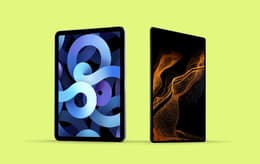
Galaxy Tab S8 (11.0", 2022) vs iPad Pro (2021, M1 series)

Galaxy Tab S8 (11.0", 2022)
Starting at

Refurbished price:$309.00

Versus $655.00 new

See options
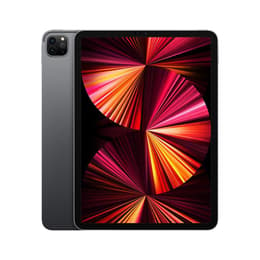
iPad Pro (2021, M1 series)
Starting at

Refurbished price:$434.00

Versus $799.00 new

See options

Ratings

The Samsung Galaxy Tab S8, released in early 2022, and the Apple iPad Pro M1 series, launched in mid-2021, represent two distinct approaches to high-performance tablets. While both offer robust capabilities for productivity and entertainment, they differ significantly in their operating systems and core hardware philosophies. The Galaxy Tab S8 operates on Android with Samsung's One UI, providing a versatile and customizable experience, whereas the iPad Pro M1 runs on Apple's iPadOS, known for its streamlined interface and powerful application ecosystem. These differences cater to varying user preferences and workflows.

Scores

Durability

When considering the long-term usability of these tablets, both devices offer substantial software support and durable designs.

  • Software Longevity: The Galaxy Tab S8 launched with Android 12 and One UI 4.1, with Samsung committing to four major Android OS updates, extending support up to Android 16, and five years of security updates, potentially ending around 2027. The iPad Pro M1, released with iPadOS 14.5, has received continuous updates, with iPadOS 26.4.1 available as of April 2026. Apple typically provides extensive software support for its devices, often spanning five to seven years.
  • Physical Durability: The Galaxy Tab S8 features an Armor Aluminum body, designed to be more resistant to scratches and bending compared to its predecessors. The iPad Pro M1 series also boasts a durable aluminum enclosure. Both devices are generally challenging to repair due to the extensive use of strong adhesives in their construction, particularly for screen and battery replacements.
  • Expected Lifespan: Given their respective software update policies and robust build quality, both tablets are designed for a practical lifespan of several years, with the iPad Pro potentially offering a slightly longer period of active software support based on Apple's historical trends.

Release Year

2022

2021

Last OS Compatibility

Yes

Yes

OS

Android

iPadOS

Performance

Both tablets deliver strong performance for a wide range of tasks, though their underlying architectures and real-world usage experiences present some distinctions.

  • Processing Power: The Galaxy Tab S8 is equipped with a current-generation octa-core processor, enabling smooth multitasking, efficient handling of demanding applications, and responsive gaming experiences. The iPad Pro M1 features a highly capable processor that provides substantial power, often exceeding the requirements of many tablet applications, making it well-suited for intensive creative work like video editing and complex graphic design.
  • Memory and Storage: The Galaxy Tab S8 offers 8GB or 12GB of RAM and storage options of 128GB or 256GB, with the added flexibility of expandable storage via a microSD card up to 1TB. The iPad Pro M1 comes with 8GB or 16GB of unified memory and a wider range of internal storage configurations, from 128GB up to 2TB, though without expandable storage.
  • Battery Behavior: The Galaxy Tab S8, with its 8000mAh battery, can provide approximately 12 hours and 52 minutes of continuous web browsing. Users generally report it can last a full day with continuous use or several days with intermittent use, though some note occasional standby battery drain. The 11-inch iPad Pro M1, with a battery capacity of approximately 7538 mAh, typically offers around 7 to 10 hours of usage, with heavy tasks leading to faster depletion.

Memory (GB)

8 GB

8 GB

Screen quality

The visual experience on both tablets is clear and responsive, with differences in display technology and brightness levels.

  • Display Technology: The Galaxy Tab S8 features an 11-inch LTPS TFT LCD panel, offering a resolution of 2560x1600 pixels and a refresh rate of up to 120Hz. The 11-inch iPad Pro M1 utilizes an 11-inch Liquid Retina IPS LCD display with a resolution of 2388 x 1668 pixels and a 120Hz ProMotion adaptive refresh rate.
  • Brightness and Clarity: The Galaxy Tab S8's display reaches a peak brightness of around 480 nits, with an average of 463 nits, providing good visibility in various lighting conditions. The 11-inch iPad Pro M1 offers a typical brightness of 600 nits, contributing to a bright and clear viewing experience. While the 12.9-inch iPad Pro M1 model features a mini-LED Liquid Retina XDR display with significantly higher peak brightness for HDR content, the 11-inch model maintains a consistent IPS LCD.
  • Viewing Experience: Both tablets provide smooth scrolling and responsive visuals due to their 120Hz refresh rates. The Galaxy Tab S8 offers vibrant colors, though it does not use an OLED panel like its larger siblings. The iPad Pro's display is known for its color accuracy and wide color support.

Resolution

1600 x 2560

2388 x 1668

Screen type

TFT LCD

Liquid Retina display

Pixel density

280ppp

264ppp

Audiovisual

Both tablets include capable camera systems and audio features designed for video calls, content creation, and media consumption.

  • Camera Systems: The Galaxy Tab S8 is equipped with a dual rear camera setup, featuring a 13MP autofocus main lens and a 6MP ultra-wide lens. Its front-facing camera is a 12MP ultra-wide sensor. The iPad Pro M1 includes a 12MP main camera, a 10MP ultra-wide camera, and a LiDAR scanner on the rear. Its front camera is also a 12MP ultra-wide sensor, enhanced with a feature that keeps the user centered during video calls.
  • Video Capabilities: The Galaxy Tab S8 supports video recording at 4K resolution at 30 frames per second. The iPad Pro M1 offers more advanced video recording, capable of 4K at 60 frames per second.
  • Audio Experience: The Galaxy Tab S8 features quad stereo speakers tuned by AKG with Dolby Atmos support, alongside three microphones for clear audio input. The iPad Pro M1 also provides a quad-speaker audio system, delivering a rich sound experience for media and calls.

Miscellaneous

Beyond core performance and display, several practical elements differentiate these two tablets in daily use.

  • Connectivity: The Galaxy Tab S8 supports Wi-Fi 6E, 5G cellular connectivity, and Bluetooth 5.2. The iPad Pro M1 offers Wi-Fi 6, 5G cellular options, and Bluetooth 5.0.
  • Ports and Biometrics: The Galaxy Tab S8 features a USB-C 3.2 port and a side-mounted fingerprint sensor for secure unlocking. The iPad Pro M1 includes a USB-C port with Thunderbolt/USB4 support, offering higher data transfer speeds and broader accessory compatibility, and uses Face ID for biometric authentication.
  • Design and Handling: The Galaxy Tab S8 (Wi-Fi model) weighs 503 grams and measures 165.3 x 253.8 x 6.3mm. The 11-inch iPad Pro M1 (Wi-Fi model) is slightly lighter at 466 grams and has dimensions of 247.6 x 178.5 x 5.9mm. Both devices feature premium build materials, typically aluminum, contributing to a solid in-hand feel.

Weight

18 oz

25 oz

Screen size (inches)

11.0

11

Network

Wi-Fi

Wi-Fi

Carrier compatibility

Without SIM Port

Without SIM Port

Both the Samsung Galaxy Tab S8 and the iPad Pro M1 series offer compelling tablet experiences, each with its own strengths that cater to different user needs. User sentiment for the Galaxy Tab S8 often highlights its versatility, the integrated S Pen experience for note-taking and drawing, and the robust multitasking capabilities offered by Samsung's One UI and DeX mode. Some users have noted occasional standby battery drain as a point of concern.

The iPad Pro M1 is frequently praised for its exceptional processing power, which remains highly capable for demanding tasks such as video editing and creative applications, and its polished app ecosystem. However, some users express that iPadOS, while refined, can sometimes limit the full potential of the powerful hardware. Battery life on the iPad Pro M1 can be variable depending on usage patterns.

Users prioritizing a more open and customizable Android ecosystem, deep S Pen integration for productivity and creativity, and expandable storage may find the Galaxy Tab S8 well-suited to their needs. Conversely, individuals who value raw processing power for professional creative workflows, a highly curated app experience, and long-term software support may lean towards the iPad Pro M1. For those considering either device, exploring quality-assured refurbished options can provide an eco-friendly alternative to new purchases.


See all articles

Our recent comparisons