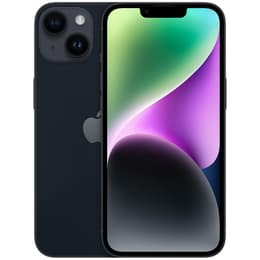
Galaxy Z Flip5 • Unlocked vs iPhone 14 • Locked AT&T

Galaxy Z Flip5 • Unlocked
Starting at

Refurbished price:$234.00

Versus $1,147.99 new

See options
iPhone 14 • Locked AT&T
Starting at

Refurbished price:$225.72

Versus $629.00 new

See options

Ratings

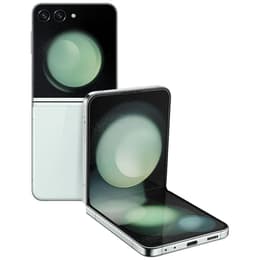
The Samsung Galaxy Z Flip5, released in August 2023, and the iPhone 14, launched in September 2022, represent distinct approaches to modern smartphone design and functionality. While the Galaxy Z Flip5 offers a unique foldable form factor running on Android, the iPhone 14 maintains a traditional slab design powered by iOS. The primary differentiators lie in their physical design, display technology, and operating system ecosystems.

Scores

Durability

The longevity of a smartphone is influenced by its release timeline, software support, and physical resilience.

  • Release Timeline: The Galaxy Z Flip5 was released in August 2023, making it approximately one year newer than the iPhone 14, which debuted in September 2022. This difference means the Z Flip5 may receive software updates for a slightly longer period.
  • OS Support: Samsung has committed to four generations of Android OS upgrades and five years of security updates for the Galaxy Z Flip5, extending its software support through 2028. The iPhone 14, running iOS, typically receives major software updates for about 5-6 years from its release.
  • Durability and Repairability: The Galaxy Z Flip5 features an IPX8 water resistance rating and Gorilla Glass Victus 2 protection for its outer display, with a hinge designed for flat folding. Its repairability score is considered moderate, with improvements like battery pull tabs making some repairs easier. The iPhone 14 boasts a Ceramic Shield front cover, a glass back, and an aluminum design, along with an IP68 rating for water and dust resistance. While initially praised for improved internal design, its repairability score was later adjusted due to software authentication requirements for replacement parts.

Release Year

2023

2022

Last OS Compatibility

Yes

Yes

OS

Android

iOS

Foldable

Yes

No

Performance

Both devices offer robust performance for daily tasks, but their underlying architectures and real-world usage experiences differ.

  • Processing Power: The Galaxy Z Flip5 handles demanding applications and multitasking smoothly, providing a responsive experience for gaming and intensive tasks. The iPhone 14 also delivers consistent performance, ensuring fluid navigation and efficient handling of everyday apps and moderate gaming.
  • Storage Options: The Galaxy Z Flip5 is available with 256GB and 512GB storage capacities. The iPhone 14 offers more granular choices, with 128GB, 256GB, and 512GB options.
  • Battery Behavior: The Galaxy Z Flip5, with its 3700 mAh battery, typically provides around 9 to 10 hours of usage during web browsing or video streaming. The iPhone 14, equipped with a 3279 mAh battery, offers approximately 9.5 hours of web browsing. Both devices are generally capable of lasting a full day for average users, though heavy usage may require more frequent charging.

Memory (GB)

8 GB

6 GB

Screen quality

The display experience is a key area of distinction, particularly due to the Z Flip5's unique design.

  • Main Display Technology: The Galaxy Z Flip5 features a 6.7-inch foldable Dynamic AMOLED 2X main display with a 1080x2640 pixel resolution and a variable refresh rate of up to 120Hz, offering smooth scrolling and vibrant colors. The iPhone 14 has a 6.1-inch Super Retina XDR OLED display with a 2532x1170 pixel resolution and a standard 60Hz refresh rate, known for its deep blacks and accurate color reproduction.
  • Cover Screen Functionality: A significant feature of the Z Flip5 is its 3.4-inch Super AMOLED cover display, which supports widget interactions, message replies, and app previews without needing to open the phone. The iPhone 14 does not have a secondary display.
  • Brightness and Clarity: Both devices offer excellent clarity for viewing content. The iPhone 14's display can reach up to 800 nits typical brightness and 1200 nits peak brightness for HDR content. The Z Flip5's main display also offers high brightness, reaching up to 1750 nits peak brightness.

Resolution

1080 x 2640

1170 x 2532

Screen type

Foldable Dynamic AMOLED 2X

Super Retina XDR OLED

Audiovisual

Both smartphones provide capable camera systems, but with different strengths and features.

  • Rear Camera Systems: The Galaxy Z Flip5 includes a dual-camera setup with a 12MP main sensor (f/1.8 with optical image stabilization) and a 12MP ultra-wide sensor (f/2.2). The iPhone 14 also features a dual-camera system, comprising a 12MP main camera (f/1.5 with sensor-shift optical image stabilization) and a 12MP ultra-wide camera (f/2.4).
  • Photography Performance: In good lighting, both phones capture detailed images with good color reproduction. The Z Flip5's software can sometimes produce oversaturated colors, but it generally performs well. The iPhone 14 benefits from an enhanced image pipeline for improved low-light performance. The Z Flip5's foldable design allows for unique shooting angles and high-quality selfies using the main rear cameras via its cover screen.
  • Video Capabilities: Both devices offer 4K video recording at various frame rates. The iPhone 14 is noted for its effective video stabilization and good video exposure. The Z Flip5 also provides respectable video quality, with good stabilization up to 4K 60fps. Neither phone includes a dedicated telephoto lens, relying on digital zoom for distant subjects.

Main camera

12 megapixels

12 megapixels

Front camera

10 megapixels

12 megapixels

Miscellaneous

Beyond core features, several practical elements contribute to the overall user experience.

  • Connectivity: Both the Galaxy Z Flip5 and the iPhone 14 support 5G cellular networks, Wi-Fi 6, and Bluetooth 5.3, ensuring fast and reliable wireless connections.
  • Ports and Biometrics: The Galaxy Z Flip5 uses a USB-C port for charging and data transfer and features a side-mounted fingerprint sensor for secure unlocking. The iPhone 14 utilizes Apple's Lightning port and relies on Face ID for biometric authentication.
  • Physical Design: The Z Flip5's folded dimensions are 85.1 x 71.9 x 15.1 mm, making it compact for portability, while unfolded it measures 165.1 x 71.9 x 6.9 mm. It weighs 187 grams. The iPhone 14 has a traditional bar design, measuring 146.7 x 71.5 x 7.80 mm and weighing 172 grams. The Z Flip5's unique form factor allows it to fit into smaller spaces when folded.

Weight

7 oz

6 oz

Screen size (inches)

6.7

6.1

Network

5G

5G

SIM card

Physical SIM + eSIM

eSIM

Carrier compatibility

Unlocked

AT&T

Connector

USB-C

Lightning

User feedback for the Galaxy Z Flip5 often praises its innovative foldable design and the enhanced utility of its larger cover screen, which allows for quick interactions without opening the device. Users appreciate its compact nature when folded and the ability to use the main cameras for high-quality selfies. Some common criticisms include its battery life, which, while improved, may still be considered underwhelming by heavy users compared to some traditional slab phones, and occasional over-saturation in camera output.

The iPhone 14 is frequently lauded for its consistent performance, reliable camera system with good low-light capabilities, and the robust iOS ecosystem. Users generally find its battery life sufficient for a full day of use. Criticisms sometimes point to the 60Hz display refresh rate, which is lower than many Android counterparts, and the lack of a telephoto lens.

Users prioritizing a compact, innovative design with a versatile secondary display for quick tasks may find the Galaxy Z Flip5 well-suited to their needs. Its unique form factor and ability to stand on its own for hands-free use are distinct advantages. Conversely, users who prefer a traditional smartphone experience with a focus on consistent performance, a strong software ecosystem, and a highly optimized camera for general photography and video recording may lean toward the iPhone 14. Both devices offer quality-assured refurbished options, providing an eco-friendly alternative for consumers.

See all articles

Our recent comparisons