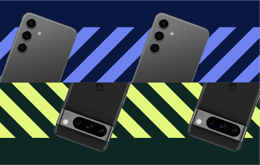


Google Pixel 9 • Unlocked vs OnePlus 10 Pro • Unlocked

Google Pixel 9 • Unlocked
Starting at

Refurbished price:$379.00

Versus $799.00 new

See options
OnePlus 10 Pro • Unlocked
Starting at

Refurbished price:$369.00

Versus $999.00 new

See options

Ratings

The Google Pixel 9, released in August 2024, and the OnePlus 10 Pro, launched in January 2022, represent different generations of Android smartphones. While both devices offer a premium experience, the Pixel 9 benefits from more recent hardware and a longer software support commitment, whereas the OnePlus 10 Pro provides a larger, higher-resolution display and exceptionally fast charging capabilities. Both operate on the Android ecosystem, offering a wide range of applications and customization.

Scores

Durability

The lifespan of a smartphone is influenced by its release date, software support, and physical resilience. These two devices show notable differences in these areas.

  • Release Timeline and Software Support: The Google Pixel 9, released in August 2024, is part of Google's commitment to providing seven years of OS and security updates, extending its support until at least August 2031. This offers a significantly longer period of official software longevity. In contrast, the OnePlus 10 Pro, launched in January 2022, received three major Android version upgrades and four years of security updates, with its last major OS update being Android 16 in February 2026. It is not expected to receive Android 17.
  • Physical Durability and Repairability: The Pixel 9 features Gorilla Glass Victus 2 on both its front and back, along with an IP68 rating for dust and water resistance, indicating a robust build. Its repairability score is noted as 5 out of 10 by iFixit, with a dual-entry design that aims to simplify some repairs, though battery removal can be challenging due to strong adhesive. The OnePlus 10 Pro, while also featuring a glass back, did not have an official IP rating in all regions. It received a repairability score of 6 out of 10 from PBKreviews and 8 out of 10 from other sources, with components like the battery and screen being accessible, but adhesive use can complicate repairs. Notably, the OnePlus 10 Pro faced criticism for structural integrity in some durability tests, where it was observed to snap in half under pressure.
  • Expected Practical Lifespan: Given its extended software support, the Pixel 9 is designed for a longer functional life, receiving updates for several more years than the OnePlus 10 Pro. The OnePlus 10 Pro, having reached its final major OS update, will continue to function but will not receive new Android versions, potentially limiting its compatibility with future applications and features.

Release Year

2024

2022

Last OS Compatibility

Yes

Yes

OS

Android

Android

Foldable

No

No

Performance

Performance in smartphones is determined by the core processing unit, memory, and storage, impacting how smoothly applications run and how efficiently the device handles multiple tasks.

  • Processor Capabilities: The Google Pixel 9 is powered by a current-generation processor designed by Google, which is optimized for the device's operating system and its advanced AI features. This allows for reliable daily performance and smooth handling of various tasks. The OnePlus 10 Pro utilizes a powerful processor from its release year, known for its ability to handle demanding applications and multitasking with fluidity.
  • System Responsiveness and Multitasking: The Pixel 9, with its optimized software and ample RAM, offers a responsive user experience, though some users have noted that animations can feel slightly less immediate compared to some other Android devices. The OnePlus 10 Pro is frequently praised for its exceptionally smooth operation and quick app loading, making multitasking a seamless experience.
  • Storage and Battery Behavior: Both devices offer various internal storage options, with the Pixel 9 typically starting with 128GB and the OnePlus 10 Pro offering up to 512GB in some configurations. The Pixel 9 features a 4700 mAh battery, providing good battery life that often lasts a full day for many users. The OnePlus 10 Pro comes with a larger 5000 mAh battery, and users generally report long-lasting power, often getting a full day of use even with moderate to heavy activity.

Memory (GB)

12 GB

12 GB

Screen quality

The display is a primary interface for smartphone interaction, with technology, resolution, and refresh rate significantly influencing the visual experience.

  • Display Technology and Resolution: The Google Pixel 9 features a 6.3-inch OLED display with a 1080x2424 pixel resolution, resulting in a pixel density of 422 pixels per inch. This provides clear and vibrant visuals for everyday use. The OnePlus 10 Pro boasts a larger 6.7-inch LTPO2 Fluid AMOLED display with a higher 1440x3216 pixel resolution, offering a sharper and more detailed viewing experience.
  • Brightness and Clarity: The Pixel 9's display can reach high brightness levels, with up to 1800 nits locally and 2700 nits at peak brightness, ensuring good visibility even in bright outdoor conditions. The OnePlus 10 Pro's display is also known for its brightness and clarity, providing an immersive viewing experience.
  • Refresh Rate and Viewing Experience: Both devices offer an adaptive refresh rate of up to 120Hz, contributing to smoother scrolling and more fluid animations. The Pixel 9's refresh rate adjusts between 60Hz and 120Hz, while the OnePlus 10 Pro's LTPO2 technology allows for a more dynamic adjustment, potentially down to 1Hz for power efficiency. The OnePlus 10 Pro also features a subtle curved display, which some users find enhances the immersive viewing experience.

Resolution

1080 x 2424

1440 x 3216

Screen type

OLED

LTPO2 Fluid AMOLED

Audiovisual

Camera systems are a key differentiator for modern smartphones, with capabilities varying across main, ultrawide, and telephoto lenses, as well as video recording features.

  • Rear Camera Systems: The Google Pixel 9 is equipped with a dual-lens rear camera setup, including a 50-megapixel main sensor with optical and electronic image stabilization, and a 48-megapixel ultrawide lens with a 123-degree field of view. It excels in computational photography, producing high-quality images in various conditions. The OnePlus 10 Pro features a triple-camera system co-developed with Hasselblad, comprising a 48-megapixel main sensor with optical image stabilization, a 50-megapixel ultrawide lens, and an 8-megapixel telephoto lens offering 3.3x optical zoom.
  • Photography Performance: The Pixel 9's main camera is praised for its overall quality, and its ultrawide lens is considered an upgrade over previous models. However, it lacks a dedicated telephoto lens, relying on digital zoom for distant subjects. The OnePlus 10 Pro's camera system is generally well-regarded for producing good pictures, with its dedicated telephoto lens providing optical zoom capabilities.
  • Video Recording and Audio: Both devices offer strong video recording capabilities, though the OnePlus 10 Pro has received some criticism for its front camera being limited to 1080p video and its ultrawide lens not supporting 8K video, unlike some contemporaries. The Pixel 9's front camera is 10.5-megapixel. Both phones offer stereo speakers and good microphone quality for calls and media consumption.

Main camera

50 megapixels

48 megapixels

Front camera

10.5 megapixels

32 megapixels

Miscellaneous

Beyond core features, several practical elements contribute to the overall user experience, including connectivity, physical design, and additional sensors.

  • Connectivity and Ports: The Google Pixel 9 supports Wi-Fi 7 + MIMO, Bluetooth 5.3, NFC, and 5G connectivity, utilizing a USB-C 3.2 port for charging and data transfer. The OnePlus 10 Pro also offers 5G, NFC, and USB-C connectivity, though its Wi-Fi and Bluetooth standards are from an earlier generation. Some variants of the OnePlus 10 Pro had limited 5G support in certain regions.
  • Sensors and Biometrics: Both smartphones include essential sensors such as a fingerprint reader for secure unlocking. The Pixel 9 features a fingerprint sensor and is expected to support face recognition, while the OnePlus 10 Pro uses an under-display optical fingerprint scanner.
  • Physical Design and Materials: The Pixel 9 has dimensions of 152.8 x 72.0 x 8.5mm and weighs 198g, featuring a frame made from 100% recycled aluminum and Gorilla Glass Victus 2 on both sides. The OnePlus 10 Pro is slightly larger and heavier at 163.0 x 73.9 x 8.55mm and 200.5g, with a glass back. The Pixel 9's design is noted for its compact size, making it suitable for one-handed use.

Weight

7 oz

7 oz

Screen size (inches)

6.3

6.7

Network

5G

5G

SIM card

Physical SIM + eSIM

Physical SIM

Carrier compatibility

Unlocked

Unlocked

The Google Pixel 9 and OnePlus 10 Pro cater to different user priorities, largely due to their generational gap and distinct design philosophies. Users frequently praise the Pixel 9 for its excellent camera capabilities, long-term software support, and comfortable, compact size. Common criticisms include its slower charging speeds compared to competitors and the absence of a dedicated telephoto lens. The OnePlus 10 Pro is often lauded for its vibrant, high-resolution display, exceptionally fast wired charging, and smooth overall performance. However, some users have noted concerns regarding its structural durability in bend tests and its shorter software update lifespan compared to newer devices.

Users prioritizing extended software longevity, a compact form factor, and advanced computational photography will find the Google Pixel 9 well-suited to their needs. Its seven years of updates ensure a prolonged period of new features and security patches. Conversely, individuals who value a larger, sharper display, rapid charging, and a dedicated telephoto camera may lean toward the OnePlus 10 Pro. While it has reached the end of its major OS updates, it still offers a capable hardware experience. Both devices are available as quality-assured refurbished options, providing an eco-friendly alternative for consumers.


See all articles

Our recent comparisons