Galaxy S25 • Unlocked vs Google Pixel 6a • Unlocked

Galaxy S25 • Unlocked
Starting at

Refurbished price:$423.00

Versus $799.00 new

See options
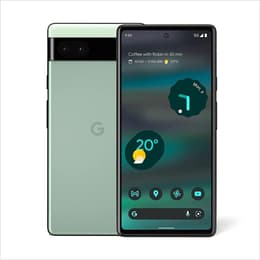
Google Pixel 6a • Unlocked
Starting at

Refurbished price:$141.00

Versus $399.00 new

See options

Ratings

The Samsung Galaxy S25, released in early 2025, and the Google Pixel 6A, launched in mid-2022, represent distinct offerings within the Android smartphone market. While both devices operate on the Android platform, the Galaxy S25 is a recent flagship model, featuring advanced hardware and extended software support, whereas the Pixel 6A is a mid-range device known for its camera capabilities and software experience at its release. The primary differences lie in their release timelines, processing power, display technology, and camera systems.

Scores

Durability

The expected practical lifespan and software support differ significantly between these two devices due to their respective release dates and manufacturer policies.

  • Release Timeline: The Galaxy S25 was released in February 2025, making it a current-generation device. The Google Pixel 6A, released in July 2022, is an older model.
  • OS and Security Updates: The Galaxy S25 is promised seven years of OS upgrades and seven years of security updates, extending its support until 2032. The Pixel 6A is scheduled to receive OS updates until at least July 2025 and security updates until at least July 2027. This means the Galaxy S25 offers a considerably longer period of guaranteed software longevity.
  • Physical Durability: The Galaxy S25 features IP68 dust and water resistance and is built with Gorilla Glass Victus 2 on both the front and back, along with an aluminum frame. The Pixel 6A has an IP67 water protection rating and uses Corning Gorilla Glass 3 for its display, with a plastic back and aluminum frame. The Galaxy S25 offers enhanced protection against environmental elements and impacts.

Release Year

2025

2022

Last OS Compatibility

Yes

Yes

OS

Android

Android

Foldable

No

No

Performance

The performance capabilities of these two smartphones are influenced by their internal components and optimization, leading to different user experiences in demanding tasks.

  • Processing Power: The Galaxy S25 is equipped with a current-generation processor, the Snapdragon 8 Elite for Galaxy, which is manufactured using a 3nm process. This allows for smooth handling of demanding applications, intensive multitasking, and advanced AI features. The Pixel 6A utilizes the Google Tensor chip, which was Google's first-generation custom silicon, providing capable performance for everyday tasks and Google's computational photography.
  • Multitasking and Storage: The Galaxy S25 comes with 12GB of RAM, facilitating seamless multitasking and efficient operation of numerous applications simultaneously. It offers storage options starting from 128GB, with a 256GB option also available for the base model. The Pixel 6A includes 6GB of RAM and 128GB of non-expandable internal storage.
  • System Responsiveness: Users of the Galaxy S25 can expect a highly responsive system, with quick app loading times and fluid navigation, benefiting from its powerful processor and ample RAM. The Pixel 6A also offers a responsive experience for its class, particularly optimized for Google's software ecosystem.

Memory (GB)

12 GB

6 GB

Screen quality

The visual experience on these devices differs due to variations in display technology, resolution, and refresh rates.

  • Display Technology and Clarity: The Galaxy S25 features a 6.2-inch Dynamic LTPO AMOLED 2X display, offering vibrant colors, deep blacks, and excellent contrast. It has a Full HD+ resolution of 2340 x 1080 pixels, resulting in sharp visuals. The Pixel 6A has a 6.1-inch OLED display with a 2400 x 1080 pixel resolution, providing clear images and good color reproduction.
  • Refresh Rate and Brightness: The Galaxy S25 boasts an adaptive 120Hz refresh rate, which contributes to smoother scrolling and more fluid animations, and can reach a peak brightness of 2600 nits, ensuring good visibility even in bright outdoor conditions. The Pixel 6A features a standard 60Hz refresh rate and supports HDR, offering a consistent viewing experience.
  • Viewing Experience: The Galaxy S25's higher refresh rate and superior peak brightness make it well-suited for users who prioritize a highly fluid visual experience and frequent outdoor use. The Pixel 6A provides a solid viewing experience for general media consumption and daily tasks.

Resolution

1080x2340

1080 x 2400

Screen type

Dynamic LTPO AMOLED 2X

OLED

Audiovisual

Both smartphones offer capable camera systems, but they approach photography with different hardware configurations and software optimizations.

  • Rear Camera System: The Galaxy S25 features a versatile triple-camera setup on the rear, including a 50MP wide-angle main camera with optical image stabilization (OIS), a 12MP ultra-wide camera with a 120-degree field of view, and a 10MP telephoto lens offering 3x optical zoom and OIS. The Pixel 6A comes with a dual-camera system, comprising a 12.2MP wide-angle main camera with OIS and a 12MP ultra-wide camera with a 114-degree field of view.
  • Photography Performance: The Galaxy S25's camera system is designed for detailed and vibrant photos across various scenarios, including improved low-light performance and advanced AI-powered editing tools. The Pixel 6A is known for its computational photography, which enhances image quality, particularly in everyday and low-light conditions, despite its lower megapixel count compared to some competitors.
  • Video Recording and Front Camera: The Galaxy S25 supports video recording at up to 8K resolution at 30 frames per second and has a 12MP front-facing camera. The Pixel 6A can record 4K video at 30 or 60 frames per second with its rear camera and features an 8MP front camera for selfies and video calls.

Miscellaneous

Beyond core performance and display, several practical elements contribute to the overall user experience and daily usability of these devices.

  • Connectivity and Ports: The Galaxy S25 supports 5G connectivity, Wi-Fi 7, and Bluetooth 5.4, offering advanced and future-proof wireless capabilities. It features a USB Type-C port for charging and data transfer. The Pixel 6A also supports 5G, along with Wi-Fi 6/6E and Bluetooth 5.2, providing reliable modern connectivity. It also uses a USB Type-C port.
  • Biometrics and Sensors: The Galaxy S25 incorporates an ultrasonic in-screen fingerprint sensor for secure unlocking. The Pixel 6A also features an in-display fingerprint sensor. Both devices include a standard array of sensors such as accelerometers, gyroscopes, and compasses.
  • Design and Handling: The Galaxy S25 has dimensions of 146.9 x 70.5 x 7.2 mm and weighs 162g, offering a relatively compact and lightweight design. The Pixel 6A measures 152.2 x 71.8 x 8.7 mm and weighs 178g, making it slightly larger and heavier. The Galaxy S25's design includes an aluminum frame and glass back, while the Pixel 6A has an aluminum frame with a plastic back.

Weight

6 oz

6 oz

Screen size (inches)

6.2

6.1

Network

5G

5G

SIM card

Physical SIM + eSIM

Physical SIM + eSIM

Carrier compatibility

Unlocked

Unlocked

The Samsung Galaxy S25 and Google Pixel 6A cater to different user priorities, largely due to their generational gap and positioning in the market. Users frequently praise the Galaxy S25 for its powerful performance, vibrant and smooth display, and comprehensive camera system with advanced features. Its extended software support is also a significant advantage, ensuring the device remains current for many years. Some users, however, note that while the battery life is generally good for a full day of mixed usage, faster charging speeds would be a welcome improvement.

The Google Pixel 6A, on the other hand, is often lauded for its excellent camera performance, particularly its computational photography capabilities, which deliver impressive results for its class. Users also appreciate its clean Android experience and the reliable performance provided by the Google Tensor chip for everyday tasks. Common concerns for the Pixel 6A include its 60Hz display, which offers a less fluid visual experience compared to higher refresh rate screens, and some reports of battery degradation over time, which Google has addressed with software updates to manage capacity.

Users prioritizing a cutting-edge smartphone with the latest processing power, a premium display, a versatile camera system, and the longest possible software support will find the Samsung Galaxy S25 well-suited to their needs. This device is ideal for professionals, power users, and those who value long-term device longevity. Conversely, users who prioritize a strong camera experience, a clean Android interface, and solid everyday performance without needing the absolute latest flagship features may lean toward the Google Pixel 6A. It remains a capable option for students or those seeking a reliable device for essential tasks. For those considering either device, exploring quality-assured refurbished options can provide an eco-friendly alternative.
See all articles

Our recent comparisons