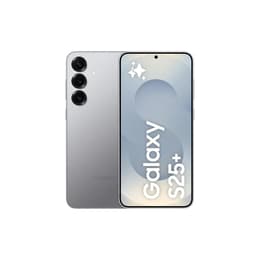


Galaxy S25+ • Unlocked vs Google Pixel 9 Pro • Unlocked

Galaxy S25+ • Unlocked
Starting at

Refurbished price:$570.79

Versus $999.99 new

See options
Google Pixel 9 Pro • Unlocked
Starting at

Refurbished price:$435.86

Versus $899.99 new

See options

Ratings

The Samsung Galaxy S25 Plus, released in February 2025, and the Google Pixel 9 Pro, launched in August 2024, represent two distinct approaches to high-end smartphone design and functionality. While both devices operate on the Android platform, they offer different user experiences through their respective software interfaces and hardware priorities. The Galaxy S25 Plus emphasizes a refined display and a versatile camera system, while the Pixel 9 Pro focuses on advanced computational photography and a compact form factor.

Scores

Durability

When considering the long-term usability of a smartphone, factors like software support and physical resilience are key. Both the Galaxy S25 Plus and the Pixel 9 Pro are designed with longevity in mind, though their release timelines place them at slightly different points in their support cycles.

  • Software Support: Both devices offer an extensive commitment to software longevity. The Galaxy S25 Plus, running Android 15 with One UI 7, is promised 7 years of OS and security updates, extending its support until 2032. The Google Pixel 9 Pro, which launched with Android 14 and is upgradable to Android 15, also guarantees 7 years of updates, ensuring support until Android 22.
  • Physical Durability: Both smartphones feature robust construction with an IP68 rating for dust and water resistance, meaning they can withstand submersion in water. The Galaxy S25 Plus utilizes an aluminum frame and Gorilla Glass Victus 2 on both the front and back. The Pixel 9 Pro also employs Gorilla Glass Victus 2 for its front and back panels.
  • Repairability: The Galaxy S25 Plus has shown improvements in repairability, achieving a higher score than its predecessor, partly due to an easier-to-replace battery. This focus on repairability can contribute to a longer practical lifespan for users who prefer to maintain their devices.

Release Year

2025

2024

Last OS Compatibility

No

Yes

OS

Android

Android

Foldable

No

No

Performance

The performance of a smartphone is central to its daily operation, influencing everything from app responsiveness to gaming experiences. Both the Galaxy S25 Plus and the Pixel 9 Pro are equipped with powerful internal components designed to handle demanding tasks efficiently.

  • Processing Power: The Galaxy S25 Plus is powered by a current-generation processor manufactured using a 3nm process, which is utilized uniformly across all global variants. This processor delivers substantial improvements in CPU performance and power efficiency compared to earlier generations, ensuring smooth operation for complex applications and multitasking. The Pixel 9 Pro features Google's Tensor G4 processor, which is optimized for AI tasks and overall system efficiency.
  • Memory and Storage: The Pixel 9 Pro offers a generous 16GB of RAM, providing ample capacity for extensive multitasking and keeping numerous applications open simultaneously without slowdowns. The Galaxy S25 Plus comes with 12GB of RAM, which is also well-suited for most user needs. Both devices offer various internal storage options, including 256GB and 512GB for the S25 Plus, and up to 1TB for the Pixel 9 Pro, though neither supports expandable storage.
  • Battery Performance: The Galaxy S25 Plus houses a 4900mAh battery, providing good endurance with some tests indicating over 16 to 19 hours of usage. The Pixel 9 Pro is equipped with a 4700mAh battery, also demonstrating strong battery life, with reports of over 13 to 17 hours in various tests. Both devices support fast wired charging, with the S25 Plus offering 45W and the Pixel 9 Pro supporting 27W, alongside wireless charging capabilities.

Memory (GB)

12 GB

16 GB

Screen quality

The display is a primary interface for smartphone interaction, and both the Galaxy S25 Plus and the Pixel 9 Pro offer high-quality viewing experiences with distinct characteristics.

  • Display Technology and Size: The Galaxy S25 Plus features a larger 6.7-inch Dynamic LTPO AMOLED 2X display, providing expansive screen real estate for media consumption and productivity. The Pixel 9 Pro comes with a more compact 6.3-inch LTPO OLED display, which some users may find easier for one-handed use.
  • Resolution and Clarity: The Galaxy S25 Plus boasts a QHD+ resolution of 3120x1440 pixels, delivering a very sharp and detailed image. The Pixel 9 Pro also offers a high resolution of 1280 x 2856 pixels, ensuring clear visuals. The S25 Plus includes ProScaler, an AI-based upscaling technology designed to enhance lower-resolution content for its high-resolution display.
  • Brightness and Smoothness: The Pixel 9 Pro's display can reach a peak brightness of up to 3000 nits, offering excellent visibility even in bright outdoor conditions. The Galaxy S25 Plus provides a peak brightness of up to 2600 nits, which is also very bright. Both phones feature an adaptive refresh rate of 1Hz to 120Hz, ensuring smooth scrolling and responsive visuals while optimizing power consumption.

Resolution

1440x3120

1280 x 2856

Screen type

Dynamic LTPO AMOLED 2X

LTPO OLED

Audiovisual

Both the Galaxy S25 Plus and the Pixel 9 Pro are equipped with advanced camera systems, each with its strengths in capturing photos and videos.

  • Rear Camera Systems: The Galaxy S25 Plus features a triple rear camera setup, including a 50MP wide-angle main camera with optical image stabilization (OIS), a 12MP ultra-wide camera, and a 10MP telephoto lens with 3x optical zoom and OIS. The Pixel 9 Pro also has a triple rear camera system, consisting of a 50MP main camera with OIS, a 48MP ultra-wide camera with autofocus for macro shots, and a 48MP telephoto lens offering 5x optical zoom with OIS.
  • Photography Features: The Pixel 9 Pro is renowned for its computational photography, offering features like Night Sight, Astrophotography, and advanced AI-driven editing tools such as Magic Editor with text prompting and Autoframe. The Galaxy S25 Plus benefits from Samsung's Pro Visual Engine, which enhances object recognition, color reproduction, and low-light performance through software. The Pixel 9 Pro's ultrawide camera includes macro focus, a capability not present on the S25 Plus's ultrawide.
  • Video Capabilities and Front Camera: Both devices are capable of high-quality video recording. The Galaxy S25 Plus supports 8K video recording at 30 frames per second and includes a Super Steady video mode. The Pixel 9 Pro records up to 4K at 60 frames per second and offers a unique Video Boost feature that uses cloud-based AI upscaling to 8K. For selfies and video calls, the Pixel 9 Pro features a 42MP front camera with autofocus, while the Galaxy S25 Plus has a 12MP front camera, also with autofocus.

Miscellaneous

Beyond core performance and camera capabilities, several practical features contribute to the overall user experience of these smartphones.

  • Connectivity and Ports: Both the Galaxy S25 Plus and the Pixel 9 Pro support 5G connectivity for fast mobile data. They also feature modern Wi-Fi standards, with the Pixel 9 Pro supporting Wi-Fi 7 and Bluetooth 5.3. Both devices utilize a USB Type-C port for charging and data transfer.
  • Biometric Security: For secure unlocking and authentication, both smartphones incorporate advanced biometric solutions. The Galaxy S25 Plus features an ultrasonic in-screen fingerprint sensor. The Pixel 9 Pro also includes an ultrasonic in-display fingerprint reader, complemented by facial recognition technology.
  • Design and Handling: The Galaxy S25 Plus has dimensions of 158.4 x 75.8 x 7.3 mm and weighs 190g, making it slightly thinner and lighter than its predecessor. The Pixel 9 Pro measures 152.8 x 72 x 8.5 mm and weighs 199g, offering a more compact form factor. Both phones feature stereo speakers, with the S25 Plus supporting Dolby Atmos for an enhanced audio experience.

Weight

7 oz

7 oz

Screen size (inches)

6.7

6.3

Network

5G

5G

SIM card

Physical SIM + eSIM

Physical SIM + eSIM

Carrier compatibility

Unlocked

Unlocked

The Samsung Galaxy S25 Plus and the Google Pixel 9 Pro each present a compelling package for users seeking a high-performance Android smartphone, though they cater to slightly different preferences. User feedback for the Galaxy S25 Plus often highlights its vibrant and expansive display, robust performance for everyday tasks, and a reliable battery life that can comfortably last through a full day of use. Some users appreciate the consistent software experience provided by Samsung's One UI. Criticisms, though few, sometimes point to the camera hardware being similar to previous generations, with many improvements coming from software rather than new sensors.

The Google Pixel 9 Pro receives praise for its exceptional camera capabilities, particularly its computational photography features that enhance image quality and offer unique editing tools. Users also frequently commend its long-lasting battery and the clean, intuitive Android experience. Some discussions around the Pixel 9 Pro have noted its slightly smaller screen size compared to other flagship devices, which can be a preference rather than a drawback depending on individual user needs. Both devices are recognized for their commitment to long-term software support, providing peace of mind for extended use.

Users prioritizing a larger, immersive display and a refined, feature-rich Android interface with a strong focus on hardware versatility may find the Galaxy S25 Plus well-suited to their needs. Conversely, individuals who place a premium on cutting-edge computational photography, a more compact design, and a pure Android experience with advanced AI integrations will likely lean towards the Google Pixel 9 Pro. Both devices offer a quality-assured refurbished option, providing an eco-friendly alternative for consumers looking to make a sustainable choice.


See all articles

Our recent comparisons