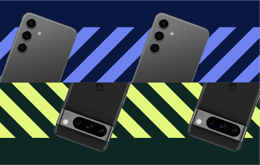
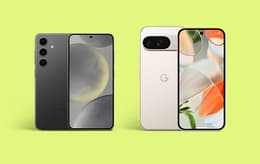
Google Pixel 9 Pro • Unlocked vs iPhone 15 • Unlocked

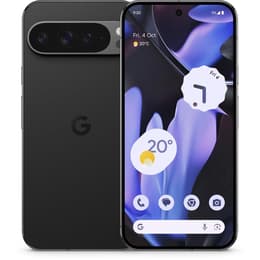
Google Pixel 9 Pro • Unlocked
Starting at

Refurbished price:$435.86

Versus $899.99 new

See options
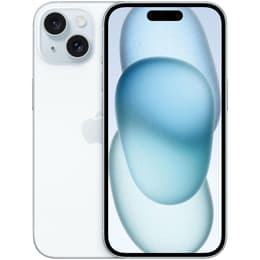
iPhone 15 • Unlocked
Starting at

Refurbished price:$376.00

Versus $729.00 new

See options

Ratings

The Google Pixel 9 Pro, released in late 2024, and the Apple iPhone 15, launched in late 2023, represent distinct approaches to the modern smartphone experience. While both devices offer advanced capabilities for communication and productivity, they differ notably in their display technology, camera philosophies, and long-term software commitments. The Pixel 9 Pro operates on Android, emphasizing Google's AI integrations, whereas the iPhone 15 runs on iOS, known for its integrated ecosystem.

Scores

Durability

When considering the longevity of these devices, both the Google Pixel 9 Pro and the iPhone 15 offer substantial support, though with differing timelines and approaches.

  • Software Support: The Google Pixel 9 Pro is designed to receive seven years of software updates, extending its functional lifespan significantly into the future. The iPhone 15, on the other hand, is guaranteed a minimum of five years of software support from its release, with Apple often providing updates beyond this stated period.
  • Build Durability: Both phones feature robust construction. The iPhone 15 incorporates a Ceramic Shield front and a color-infused glass back within an aluminum frame, offering notable resistance to drops and scratches. The Pixel 9 Pro utilizes Gorilla Glass Victus 2 for its display and boasts a premium build quality. Both devices carry an IP68 rating for dust and water resistance, indicating protection against immersion.
  • Practical Lifespan: Users can expect both smartphones to remain capable daily drivers for several years. The Pixel 9 Pro's extended software support suggests a longer period of receiving new features and security patches, potentially making it a more future-proof option for those prioritizing the latest software. The iPhone 15, while having a slightly shorter guaranteed update window, benefits from Apple's history of consistent performance and ecosystem integration over many years.

Release Year

2024

2023

Last OS Compatibility

Yes

Yes

OS

Android

iOS

Foldable

No

No

Performance

The performance of a smartphone is crucial for daily responsiveness and handling demanding applications. Both the Google Pixel 9 Pro and the iPhone 15 deliver smooth user experiences, though they achieve this through different hardware and software optimizations.

  • System Responsiveness: The iPhone 15, powered by its A16 Bionic chip, offers a fluid and responsive experience, handling demanding apps and multitasking with ease. The Pixel 9 Pro, featuring Google's Tensor G4 processor and 16GB of RAM, also provides snappy performance for everyday tasks.
  • Multitasking and App Handling: With 16GB of RAM, the Pixel 9 Pro is well-equipped for extensive multitasking and running numerous applications simultaneously without significant slowdowns. The iPhone 15, with 6GB of RAM, is optimized by iOS to manage applications efficiently, ensuring a smooth transition between tasks.
  • Battery Behavior: The Pixel 9 Pro generally demonstrates strong battery performance, with users reporting it can comfortably last a full day with moderate to heavy usage. Some tests indicate it offers better battery longevity compared to the iPhone 15. The iPhone 15, while providing sufficient power for most users, has received some feedback regarding more frequent charging for heavy users.

Memory (GB)

16 GB

6 GB

Screen quality

The visual experience on a smartphone is largely defined by its display, and both the Google Pixel 9 Pro and the iPhone 15 offer vibrant and clear screens, each with distinct characteristics.

  • Display Technology and Clarity: Both devices feature OLED displays, which provide deep blacks, high contrast, and vibrant colors. The Pixel 9 Pro has a 6.3-inch OLED display with a resolution of 2856 x 1280 pixels, resulting in a pixel density of 495 ppi, ensuring sharp visuals. The iPhone 15 features a 6.1-inch Super Retina XDR OLED display with a resolution of 2556 x 1179 pixels and a pixel density of 460 ppi, also delivering clear and detailed images.
  • Brightness and Refresh Rate: The Pixel 9 Pro's display offers a peak brightness of up to 3000 nits, making it highly visible even in bright outdoor conditions, and features an adaptive refresh rate that can dynamically adjust from 1Hz to 120Hz for smooth scrolling and power efficiency. The iPhone 15 reaches a peak outdoor brightness of 2000 nits and maintains a standard 60Hz refresh rate.
  • Viewing Experience: The Pixel 9 Pro's larger screen and higher adaptive refresh rate may appeal to users who prioritize a more expansive and fluid visual experience, particularly for gaming or media consumption. The iPhone 15's display, while smaller and at a fixed refresh rate, is praised for its color accuracy and overall visual quality, enhanced by features like the Dynamic Island.

Resolution

1280 x 2856

1179 x 2556

Screen type

LTPO OLED

Super Retina XDR OLED

Audiovisual

Both the Google Pixel 9 Pro and the iPhone 15 are equipped with advanced camera systems, each excelling in different aspects of photography and videography, catering to varied user preferences.

  • Rear Camera Systems: The Google Pixel 9 Pro features a versatile triple-lens setup, including a 50MP main sensor, a 48MP ultrawide lens with macro capabilities, and a 48MP 5x telephoto lens. This configuration allows for significant optical zoom and detailed wide-angle shots. The iPhone 15 utilizes a dual-camera system with a 48MP main sensor that enables 2x optical quality zoom through a quad-pixel sensor, alongside a 12MP ultrawide lens.
  • Photography Features and Quality: The Pixel 9 Pro is renowned for its computational photography, offering features like Night Sight, Astrophotography, and advanced AI-driven processing for natural-looking photos. It also includes 'Pro Controls' for manual adjustments. The iPhone 15 is praised for its consistent image quality, excellent portrait mode with Focus and Depth Control, and strong low-light performance, often favored for its reliable point-and-shoot capabilities.
  • Video Recording Capabilities: The Pixel 9 Pro offers advanced video features such as Video Boost for cloud-based 8K upscaling and Audio Magic Eraser, along with Cinematic blur and slo-mo up to 240fps. The iPhone 15 provides high-quality video recording with Cinematic mode up to 4K HDR at 30fps and Action mode for stabilized footage, with users often highlighting its superior video stabilization and seamless lens switching. Both devices feature capable front-facing cameras, with the Pixel 9 Pro offering a 42MP selfie camera compared to the iPhone 15's 12MP TrueDepth camera.

Main camera

50 megapixels

48 megapixels

Front camera

42 megapixels

12 megapixels

Miscellaneous

Beyond core performance and display, several practical elements contribute to the overall user experience of a smartphone. The Google Pixel 9 Pro and iPhone 15 offer distinct features in connectivity, physical design, and security.

  • Connectivity and Ports: Both devices support 5G connectivity, Wi-Fi 6, and Bluetooth 5.3 for modern wireless communication. A notable difference lies in their USB-C ports; while both use the universal standard, the iPhone 15's port is limited to USB 2.0 data transfer speeds, whereas the Pixel 9 Pro offers faster data transfer capabilities. The Pixel 9 Pro also includes a Satellite SOS feature for emergency communication in areas without cellular service.
  • Physical Design and Handling: The iPhone 15 features an aluminum design with rounded edges and a slightly curved display and back glass, contributing to a comfortable in-hand feel. It weighs 171 grams. The Pixel 9 Pro, with its flat-edged design, weighs 199 grams. Some users find the Pixel 9 Pro's weight distribution less comfortable for extended holding.
  • Security and Sensors: The iPhone 15 relies on Face ID for secure facial recognition. The Pixel 9 Pro incorporates an under-display ultrasonic fingerprint sensor for biometric authentication, alongside face recognition. Both devices include standard sensors like accelerometers, gyroscopes, and barometers.

Weight

7 oz

171 oz

Screen size (inches)

6.3

6.1

Network

5G

5G

SIM card

Physical SIM + eSIM

eSIM

Carrier compatibility

Unlocked

Unlocked

Connector

USB-C

USB-C (USB 2)

The Google Pixel 9 Pro and the iPhone 15 each present a compelling package, tailored to different user priorities. User sentiment for the Pixel 9 Pro often highlights its exceptional camera quality, particularly its AI-driven features and natural photo processing, along with its strong battery life. Some users, however, have noted concerns about occasional heating during light use or with the camera app, and some micro stutters during heavy multitasking. The iPhone 15 receives widespread praise for its overall performance, the vibrant OLED display with Dynamic Island, and its reliable camera system, especially for video recording and consistent results. Criticisms for the iPhone 15 sometimes point to its 60Hz refresh rate and the USB 2.0 data transfer speeds of its USB-C port.

Users who prioritize cutting-edge computational photography, an extended software update commitment, and a high refresh rate display may find the Google Pixel 9 Pro to be a more suitable choice. Its larger RAM capacity also benefits those who frequently multitask with many applications. Conversely, individuals who value a highly integrated ecosystem, consistent video performance, and a slightly lighter device with a proven track record of long-term support, albeit with a shorter guaranteed window, might lean towards the iPhone 15. Both devices offer a quality-assured refurbished option, providing an eco-friendly alternative for consumers seeking to make informed and sustainable choices.
See all articles

Our recent comparisons