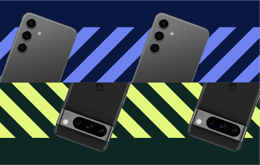

Google Pixel 9 Pro • Unlocked vs OnePlus 12 • Unlocked

Google Pixel 9 Pro • Unlocked
Starting at

Refurbished price:$435.86

Versus $899.99 new

See options
OnePlus 12 • Unlocked
Starting at

Refurbished price:$746.99

Versus $1,200.00 new

See options

Ratings

The Google Pixel 9 Pro, released in September 2024, and the OnePlus 12, launched globally in early 2024, represent two distinct approaches to high-end Android smartphones. While both devices offer robust performance and advanced camera systems, they differentiate themselves through software philosophies, display characteristics, and battery endurance. This comparison aims to highlight the practical distinctions to help users make an informed decision.

Scores

Durability

When considering the longevity of these devices, several factors come into play, including software support and physical resilience.

  • Software Support: The Google Pixel 9 Pro offers an extended software support period, promising seven years of operating system updates, ensuring it remains current with the latest Android features and security patches for a longer duration. The OnePlus 12, while providing a solid commitment, typically offers four major Android updates and five years of security updates.
  • Physical Durability: The Pixel 9 Pro features Gorilla Glass Victus 2 on both its front and back, coupled with an aluminum frame and an IP68 rating for dust and water resistance, indicating a high level of protection against environmental elements. The OnePlus 12 also utilizes Gorilla Glass Victus 2 for its display and has a glass back with an aluminum frame, but comes with an IP65 rating, offering good dust and water resistance, though slightly less immersion protection than the Pixel.
  • Practical Lifespan: Users seeking the absolute longest software longevity will find the Pixel 9 Pro's extended update policy beneficial. Both devices are built with quality materials, suggesting a durable physical lifespan, and choosing a quality-assured refurbished option can further extend the life cycle of either device.

Release Year

2024

2023

Last OS Compatibility

Yes

Yes

OS

Android

Android

Foldable

No

No

Performance

Both the Google Pixel 9 Pro and the OnePlus 12 are equipped with current-generation processors designed for demanding tasks, though their underlying architectures differ.

  • Processing Power: The Pixel 9 Pro is powered by Google's Tensor G4 chip, optimized for AI and machine learning tasks, contributing to smooth operation and efficient handling of complex computational photography. The OnePlus 12 features the Snapdragon 8 Gen 3, known for its raw processing power and graphical capabilities, which translates to fluid app loading, seamless multitasking, and high-performance gaming.
  • Multitasking and Storage: The Pixel 9 Pro typically comes with 16GB of RAM, providing ample capacity for running numerous applications simultaneously without slowdowns. The OnePlus 12 offers configurations with 12GB or 16GB of RAM, with some regional variants even featuring 24GB, ensuring robust multitasking performance. Both devices offer various storage options, from 128GB up to 1TB, utilizing fast storage technologies for quick data access.
  • Battery Behavior: The Pixel 9 Pro houses a 4700 mAh battery, with user experiences varying from solid all-day use to needing a mid-day top-up for heavy users. The OnePlus 12 includes a larger 5400 mAh battery, generally providing extended usage times, with many users reporting it can comfortably last through a full day, and sometimes even two, depending on usage patterns.

Memory (GB)

16 GB

16 GB

Screen quality

The visual experience on both smartphones is characterized by high-quality displays, each with distinct advantages in technology and brightness.

  • Display Technology and Clarity: The Pixel 9 Pro features a 6.3-inch LTPO OLED display with a resolution of 2856 x 1280 pixels, offering sharp images and vibrant colors. The OnePlus 12 boasts a larger 6.82-inch LTPO AMOLED ProXDR display with a 3168 x 1440 pixel resolution, providing exceptional clarity and detail. Both displays utilize LTPO technology for adaptive refresh rates, optimizing power consumption.
  • Brightness and Smoothness: The Pixel 9 Pro's display can reach a peak brightness of 3000 nits, with a typical high brightness mode of 2000 nits, ensuring good visibility in various lighting conditions. The OnePlus 12 sets a high standard with a peak brightness of 4500 nits and a high brightness mode of 1600 nits, making it exceptionally bright for outdoor use. Both phones offer a smooth 120Hz adaptive refresh rate, contributing to fluid scrolling and responsive interactions.
  • Viewing Experience: The Pixel 9 Pro offers a more compact display size, which some users may prefer for one-handed use. The OnePlus 12's larger screen provides an expansive canvas for media consumption and gaming, enhanced by its ProXDR technology for improved dynamic range in content.

Resolution

1280 x 2856

1440 x 3168

Screen type

LTPO OLED

LTPO AMOLED

Audiovisual

Both devices offer advanced camera systems, leveraging their respective strengths in hardware and software processing to capture high-quality images and videos.

  • Rear Camera Systems: The Pixel 9 Pro features a versatile triple-camera setup, including a 50MP main sensor, a 48MP ultrawide with macro autofocus, and a 48MP 5x optical telephoto lens. Google's computational photography excels in producing natural-looking photos with consistent quality across lenses. The OnePlus 12 also sports a triple-camera system, co-developed with Hasselblad, comprising a 50MP main sensor, a 48MP ultrawide, and a 64MP 3x optical periscope telephoto lens capable of 6x in-sensor zoom.
  • Photography Performance: The Pixel 9 Pro is renowned for its AI-driven features like Night Sight, Astrophotography, and Real Tone, which enhance low-light performance and accurate skin tone representation. Its Pro Controls offer greater manual adjustment for experienced photographers. The OnePlus 12, with Hasselblad Color Calibration, aims for natural color reproduction and offers strong telephoto performance.
  • Video Capabilities and Front Camera: The Pixel 9 Pro supports 4K 60fps video recording and features Video Boost for cloud-based 8K upscaling and 30MP stills from video. Its 42MP front camera provides sharp selfies and improved low-light performance. The OnePlus 12 can record 8K video at 24fps and 4K at 30/60fps, and has a 32MP front camera capable of 4K 30fps video.

Main camera

50 megapixels

50 megapixels

Front camera

42 megapixels

32 megapixels

Miscellaneous

Beyond core performance and display, several practical features contribute to the overall user experience of these smartphones.

  • Connectivity and Ports: Both the Pixel 9 Pro and OnePlus 12 support the latest wireless standards, including 5G and Wi-Fi 7, ensuring fast and reliable network connections. Both devices feature a USB-C port for charging and data transfer. The OnePlus 12 additionally includes an IR blaster, allowing it to function as a universal remote control for various electronics.
  • Biometrics and Audio: For security, both phones incorporate in-display fingerprint sensors. The Pixel 9 Pro uses an ultrasonic sensor, while the OnePlus 12 features an optical one. Both offer stereo speakers, with the OnePlus 12 supporting Dolby Atmos for an enhanced audio experience. Neither device includes a traditional 3.5mm headphone jack.
  • Design and Handling: The Pixel 9 Pro has dimensions of 152.8 x 72 x 8.5 mm and weighs 199g, offering a more compact and lighter feel. The OnePlus 12 is larger and slightly heavier at 164.3 x 75.8 x 9.15 mm and 220g. The Pixel's design is often praised for its premium build and comfortable handling, while the OnePlus 12's larger size caters to users who prefer a more expansive screen.

Weight

7 oz

8 oz

Screen size (inches)

6.3

6.82

Network

5G

5G

SIM card

Physical SIM + eSIM

Physical SIM

Carrier compatibility

Unlocked

Unlocked

Connector

USB-C

USB-C

The Google Pixel 9 Pro and the OnePlus 12 each present a compelling package for different user priorities. The Pixel 9 Pro is frequently praised for its exceptional camera capabilities, particularly its AI-driven computational photography and extended software support, which ensures long-term relevance. Users often highlight its fluid Android experience and premium build quality. Some criticisms have occasionally surfaced regarding battery consistency for very heavy users, though many report excellent endurance.

The OnePlus 12 garners acclaim for its impressive battery life, rapid charging speeds, and a vibrant, exceptionally bright display. Its powerful processor delivers a consistently smooth and responsive user experience, especially for gaming and demanding applications. While its camera system is generally strong, particularly the telephoto lens, some users note that the ultrawide and selfie camera performance in low light could be further refined.

Users prioritizing a compact form factor, cutting-edge AI camera features, and the longest possible software update cycle may find the Google Pixel 9 Pro to be a more suitable choice. Conversely, those who value maximum battery endurance, ultra-fast charging, a larger and brighter display, and raw processing power for gaming and intensive tasks might lean towards the OnePlus 12. Both devices are available as quality-assured refurbished options, providing an eco-friendly alternative for consumers.


See all articles

Our recent comparisons