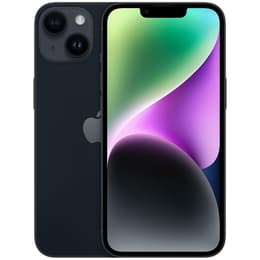
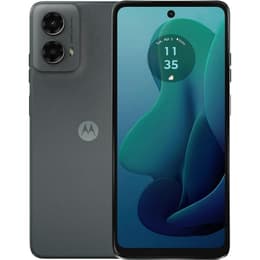
iPhone 14 • Locked Verizon vs Motorola Moto G (2024) • Unlocked

iPhone 14 • Locked Verizon
Starting at

Refurbished price:$299.00

Versus $599.00 new

See options
Motorola Moto G (2024) • Unlocked
Starting at

Refurbished price:$107.00

Versus $186.99 new

See options

Ratings

The iPhone 14, released in September 2022, operates on Apple's iOS platform, offering a premium smartphone experience. In contrast, the Motorola Moto G 2024, launched in March 2024, runs on the Android operating system, aiming to provide a balanced feature set. These devices cater to different user preferences, with the iPhone 14 focusing on a refined ecosystem and advanced features, while the Moto G 2024 emphasizes a more recent Android experience and practical functionality.

Scores

Durability

When considering the long-term usability of these devices, their release timelines and software support are key factors.

  • Release Timeline: The iPhone 14 was introduced in September 2022, making it an earlier model compared to the Motorola Moto G 2024, which became available in March 2024. This difference in launch dates means the Moto G 2024 benefits from more recent hardware and software at its release.
  • OS Support and Longevity: Apple typically provides iOS updates for its devices for approximately 5-6 years from their release, suggesting the iPhone 14 will receive software support for several more years. The Motorola Moto G 2024 launched with Android 14, and while Motorola's update policy can vary, it generally offers fewer major OS updates than Apple.
  • Repairability: The iPhone 14 initially received a favorable repairability score from iFixit due to its internal redesign, which made components like the back glass more accessible. However, this score was later downgraded due to Apple's parts pairing requirements, which can complicate unauthorized repairs. Information on the Moto G 2024's specific repairability score is less widely available, but Android devices in this segment often offer more straightforward component replacement.

Release Year

2022

2024

Last OS Compatibility

Yes

Yes

OS

iOS

Android

Foldable

No

No

Performance

The performance of a smartphone is influenced by its internal components, affecting how smoothly applications run and how efficiently it manages power.

  • Processing Power: The iPhone 14 is equipped with a powerful processor that handles demanding applications and multitasking with fluidity. This allows for responsive navigation and smooth operation even with graphically intensive tasks. The Motorola Moto G 2024 features a processor designed for everyday tasks, providing adequate performance for general use and lighter applications.
  • Multitasking and Storage: The iPhone 14 includes 6 GB of RAM, contributing to its ability to manage multiple applications simultaneously without significant slowdowns. It offers storage options up to 512GB. The Moto G 2024 comes with 4 GB of RAM, which is suitable for typical smartphone usage but may show limitations when running numerous apps concurrently or engaging in heavy gaming. It provides 128 GB of internal storage, which can be expanded using a microSD card.
  • Battery Behavior: The iPhone 14's battery is designed to last a full day for most users, with real-world tests indicating around 9 hours and 28 minutes of web surfing. The Motorola Moto G 2024 features a larger battery capacity, often resulting in extended usage times that can comfortably last through a full day or more for many users.

Memory (GB)

6 GB

4 GB

Screen quality

The visual experience on a smartphone is largely determined by its display technology and specifications.

  • Display Technology and Clarity: The iPhone 14 features a 6.1-inch Super Retina XDR OLED display, offering deep blacks, vibrant colors, and a high resolution of 2532 x 1170 pixels at 460 pixels per inch (ppi). This results in sharp text and detailed images. The Motorola Moto G 2024 has a larger 6.6-inch IPS LCD screen with a resolution of 720 x 1612 pixels, resulting in a pixel density of approximately 267 ppi.
  • Brightness and Refresh Rate: The iPhone 14's display can reach 800 nits of typical brightness and a peak of 1200 nits for HDR content, providing good visibility in various lighting conditions. It operates at a standard 60Hz refresh rate. The Moto G 2024 offers a 120Hz refresh rate, which contributes to smoother scrolling and a more fluid visual experience, though its typical brightness is lower, potentially impacting outdoor visibility.
  • Viewing Experience: The OLED technology of the iPhone 14 provides superior contrast and color accuracy, enhancing the viewing of photos and videos. The larger screen of the Moto G 2024 offers more screen real estate, which can be beneficial for media consumption and general browsing, despite the lower resolution.

Resolution

1170 x 2532

720 x 1612

Screen type

Super Retina XDR OLED

IPS LCD

Audiovisual

The camera systems on both devices offer different capabilities for capturing photos and videos.

  • Rear Camera System: The iPhone 14 features a dual 12-megapixel camera system, including a main wide-angle lens with a wide aperture and sensor-shift optical image stabilization, alongside an ultra-wide lens with a 120-degree field of view. This setup is designed for detailed photos and improved low-light performance through features like Photonic Engine and Deep Fusion. The Motorola Moto G 2024 is equipped with a dual-camera setup featuring a 50-megapixel main sensor and a 2-megapixel macro lens.
  • Front Camera and Video Quality: The iPhone 14 includes a 12-megapixel TrueDepth front camera with autofocus, capable of recording 4K Dolby Vision HDR video at up to 60 frames per second, and offers Cinematic mode for video. The Moto G 2024 has an 8-megapixel front camera and supports 1080p video recording at 30 frames per second.
  • Audio Experience: The iPhone 14 provides a robust audio experience for media consumption and calls. The Moto G 2024 also offers a good audio output, with some models in the Moto G series featuring Dolby Atmos tuning for an immersive sound experience.

Main camera

12 megapixels

50 megapixels

Front camera

12 megapixels

8 megapixels

Miscellaneous

Beyond core features, several practical elements contribute to the overall user experience of a smartphone.

  • Connectivity: Both devices support 5G connectivity, enabling faster mobile data speeds. The iPhone 14 supports Wi-Fi 6 and Bluetooth 5.3. The Motorola Moto G 2024 supports Wi-Fi 5 (802.11 a/b/g/n/ac) and Bluetooth 5.1. Both include NFC for contactless payments.
  • Ports and Sensors: The iPhone 14 utilizes a Lightning port for charging and data transfer. It features Face ID for secure authentication. The Moto G 2024 includes a USB Type-C 2.0 port and retains a 3.5mm headphone jack. It offers a side-mounted fingerprint sensor for biometric security.
  • Physical Design: The iPhone 14 has a Ceramic Shield front and an aluminum design, weighing 172 grams and measuring 146.7 x 71.5 x 7.80 mm. It has an IP68 rating for water and dust resistance. The Moto G 2024 features a water-repellent design and a vegan leather back, weighing 194 grams and measuring 164.4 x 75 x 8.2 mm.

Weight

6 oz

7 oz

Screen size (inches)

6.1

6.6

Network

5G

5G

SIM card

eSIM

Physical SIM

Carrier compatibility

Verizon

Unlocked

Connector

Lightning

USB-C

User feedback for the iPhone 14 often highlights its consistent performance, vibrant display, and reliable camera system as strong points. Many appreciate the seamless integration within the Apple ecosystem and the long-term software support. However, some users have noted concerns regarding battery health degradation over time and, for some, a perceived lack of significant upgrades compared to its direct predecessor. The camera module on some units has also been reported to show discoloration.

For the Motorola Moto G 2024, common praise centers on its extended battery life, the inclusion of a 120Hz display, and a clean Android operating system experience. Users often find it a practical device for everyday tasks. Criticisms frequently point to its performance limitations, particularly when handling multiple demanding applications or graphically intensive games, and the camera quality is generally considered adequate but not exceptional. Some users have also reported occasional lag and issues with basic functions.

Users prioritizing a highly fluid user experience, a premium camera for photos and videos, and long-term software updates within a well-established ecosystem may find the iPhone 14 well-suited to their needs. Those who value a larger display, extended battery life, expandable storage, and a more recent Android version for general use might lean toward the Motorola Moto G 2024. Both devices offer distinct advantages, and considering quality-assured refurbished options can provide an eco-friendly alternative for either model, extending their lifecycle and offering a sustainable choice.

See all articles

Our recent comparisons