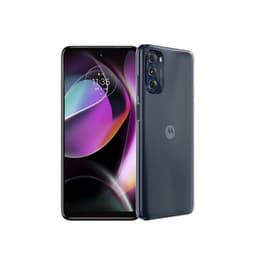
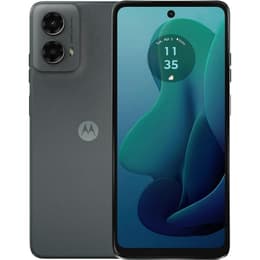
Motorola Moto G (2022) • Unlocked vs Motorola Moto G (2024) • Unlocked

Motorola Moto G (2022) • Unlocked
See options
Motorola Moto G (2024) • Unlocked
Starting at

Refurbished price:$107.00

Versus $186.99 new

See options

Ratings

The Motorola Moto G 5G (2022) and the Motorola Moto G 5G (2024) are two smartphones from Motorola's popular Moto G series, released two years apart. While both devices aim to provide a balanced user experience, the 2024 model introduces updates to its internal components, display technology, and charging capabilities. Both run on the Android operating system, offering a near-stock Android experience with Motorola's custom enhancements.

Scores

Durability

The practical lifespan of a smartphone is influenced by its release timeline, software support, and physical resilience. These two Moto G models, separated by two years, offer different expectations in these areas.

  • Release Timeline and OS Support: The Moto G 5G (2022) launched with Android 12 and was upgradable to Android 13, receiving approximately three years of security updates from its April 2022 release. The Moto G 5G (2024), released in March 2024, ships with Android 14 and is expected to receive one major OS upgrade and three years of security updates, offering a longer period of current software support.
  • Software Longevity: Users prioritizing the latest Android features and security patches for an extended period will find the Moto G 5G (2024) more aligned with their needs due to its newer release and starting OS version. The 2022 model will reach its end-of-life for major OS updates sooner.
  • Build and Practical Lifespan: Both devices feature a water-repellent design, contributing to their durability against splashes and light rain. The Moto G 5G (2024) introduces a silicone polymer back with an eco-leather finish, which some users may find offers a more tactile and potentially more resilient surface against minor scuffs compared to the plastic back of the 2022 model.

Release Year

2022

2024

OS

Android

Android

Foldable

No

No

Performance

Performance in daily use is a key consideration for any smartphone, impacting how smoothly applications run and how efficiently tasks are handled. Both Moto G models are designed for everyday usage, but they differ in their underlying processing power and memory configurations.

  • Processing Capabilities: The Moto G 5G (2022) is powered by a MediaTek Dimensity 700 processor, which capably handles general tasks like web browsing, social media, and light gaming. The Moto G 5G (2024) features a Qualcomm Snapdragon 4 Gen 1 processor, which offers a modest improvement in overall speed and efficiency, leading to slightly quicker app launches and smoother transitions in the user interface.
  • Multitasking and Responsiveness: The 2022 model typically comes with 4GB or 6GB of RAM, while the 2024 model generally offers 4GB of RAM, though some configurations might include virtual RAM expansion. For users who frequently switch between multiple applications, the higher physical RAM in some 2022 configurations could offer a marginally smoother multitasking experience. However, the 2024 model's optimized software and newer processor help maintain good responsiveness for typical daily activities.
  • Storage Options and Battery Behavior: Both devices offer internal storage options, with the 2024 model commonly featuring 128GB, and the 2022 model available in 64GB, 128GB, or 256GB variants. Both support expandable storage via a microSD card. Both phones are equipped with a 5000 mAh battery, providing ample power for a full day of use for most users. The Moto G 5G (2024) supports faster 18W wired charging, compared to the 10W charging of the 2022 model, meaning it can replenish its battery more quickly.

Memory (GB)

4 GB

4 GB

Screen quality

The display is a primary interface for smartphone interaction, and its quality significantly impacts the viewing experience. Both Moto G models feature large IPS LCD screens, but the newer iteration brings enhancements to smoothness and overall visual fluidity.

  • Display Technology and Resolution: Both the Moto G 5G (2022) and Moto G 5G (2024) utilize IPS LCD panels, which provide consistent color reproduction and good viewing angles. They both feature HD+ resolutions, with the 2022 model at 720 x 1600 pixels on a 6.5-inch screen and the 2024 model at 720 x 1612 pixels on a slightly larger 6.6-inch screen. This resolution is suitable for general content consumption, though fine details might appear less sharp compared to higher-resolution displays.
  • Refresh Rate and Smoothness: A notable difference lies in the refresh rate. The Moto G 5G (2022) offers a 90Hz refresh rate, providing a smoother scrolling experience than standard 60Hz displays. The Moto G 5G (2024) elevates this to a 120Hz refresh rate, resulting in even more fluid animations and a more responsive feel during navigation and gaming.
  • Brightness and Viewing Experience: For outdoor visibility, the Moto G 5G (2024) has been noted to reach around 430 nits of peak brightness, which can be challenging under direct sunlight. While specific brightness figures for the 2022 model are less consistently reported, both IPS LCD panels at this resolution are generally well-suited for indoor use and casual media consumption.

Resolution

720 x 1600

720 x 1612

Audiovisual

Camera capabilities are often a deciding factor for smartphone users, influencing how everyday moments are captured. Both Moto G models offer multi-camera setups, but their performance and specific sensor configurations present some distinctions.

  • Rear Camera System: The Moto G 5G (2022) features a triple camera setup, including a 50MP main sensor, a 2MP macro lens, and a 2MP depth sensor. The Moto G 5G (2024) simplifies this to a dual-camera system, retaining a 50MP main sensor and a 2MP macro lens, omitting the dedicated depth sensor. Both 50MP main sensors are capable of capturing adequate photos in good lighting conditions, with images often pixel-binned down for better light sensitivity.
  • Low-Light and Everyday Photography: User feedback for both models suggests that while daylight photos are generally acceptable, low-light performance can be a challenge, often resulting in increased noise and less detail. The 2MP macro lenses on both devices are present for close-up shots, though their utility can be limited by resolution and detail.
  • Front Camera and Video Recording: The Moto G 5G (2022) is equipped with a 13MP front-facing camera, which tends to produce more detailed selfies compared to the 8MP front camera on the Moto G 5G (2024). Both devices support video recording at 1080p resolution at 30 frames per second. For audio, both models include a 3.5mm headphone jack and offer a decent speaker output for media consumption.

Miscellaneous

Beyond core specifications, several practical elements contribute to the overall user experience, from how a device connects to other hardware to its physical design and security features.

  • Connectivity and Ports: Both the Moto G 5G (2022) and Moto G 5G (2024) support 5G cellular connectivity, Wi-Fi 802.11 a/b/g/n/ac (dual-band), and Bluetooth 5.1. The 2024 model also includes NFC for contactless payments, a feature that was not consistently present in all regional variants of the 2022 model. Both devices feature a USB-C 2.0 port for charging and data transfer, and importantly, both retain a 3.5mm headphone jack.
  • Physical Design and Handling: The Moto G 5G (2022) measures approximately 165.4 x 75.8 x 9.44 mm and weighs around 204 grams. The Moto G 5G (2024) is slightly more compact and lighter at 164.4 x 75 x 8.2 mm and 194 grams. The 2024 model also features a silicone polymer back with an eco-leather finish, which provides a distinct tactile feel and can offer better grip compared to the plastic back of the 2022 model.
  • Security and Sensors: Both smartphones incorporate a side-mounted fingerprint sensor for secure unlocking and authentication. They also include a standard array of sensors such as an accelerometer, gyroscope, proximity sensor, and compass, providing functionality for various applications and features.

Weight

7 oz

7 oz

Screen size (inches)

6.5

6.6

Network

5G

5G

SIM card

Physical SIM

Physical SIM

Carrier compatibility

Unlocked

Unlocked

Connector

USB-C

USB-C

The Motorola Moto G 5G (2022) and Moto G 5G (2024) both offer compelling features for users seeking a reliable Android smartphone. The 2022 model, with its MediaTek Dimensity 700 processor and 90Hz display, was praised by users for its solid battery life and ample storage options, often available with 6GB of RAM. However, some users noted its camera performance could be underwhelming, particularly in challenging lighting, and its 10W charging speed was considered slow.

The newer Moto G 5G (2024) addresses some of these points, featuring a slightly more efficient Snapdragon 4 Gen 1 processor and a smoother 120Hz display. Its 18W fast charging is a welcome upgrade, and the eco-leather back provides a more refined in-hand feel. User feedback for the 2024 model highlights its strong battery life and improved design. However, some criticisms point to its cameras still being inconsistent, especially the 8MP front camera, and the display's brightness being limited for outdoor use.

Users prioritizing a slightly more responsive experience, faster charging, and a more modern design with a longer software support window will find the Moto G 5G (2024) well-suited to their needs. Its 120Hz display and Android 14 out-of-the-box offer a more current experience. Conversely, users who might find a 13MP front camera more appealing or who can find a 2022 model with 6GB of RAM for potentially better multitasking might lean towards the Moto G 5G (2022). Both devices represent a practical choice for everyday communication, media consumption, and light productivity. For those considering either model, exploring quality-assured refurbished options can provide an eco-friendly alternative to extend the life cycle of these devices.

See all articles

Our recent comparisons