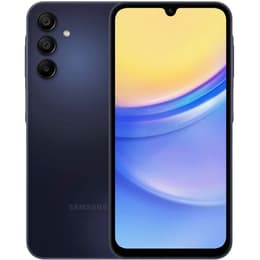
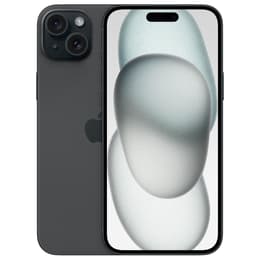

Galaxy A15 5G • Unlocked vs iPhone 15 Plus • Unlocked

Galaxy A15 5G • Unlocked
Starting at

Refurbished price:$108.00

Versus $207.99 new

See options
iPhone 15 Plus • Unlocked
Starting at

Refurbished price:$389.99

Versus $829.00 new

See options

Ratings

The Samsung Galaxy A15 5G, released in December 2023, and the Apple iPhone 15 Plus, launched in September 2023, represent distinct approaches to smartphone design and functionality. While both offer modern connectivity and capable performance, they cater to different user expectations, primarily differing in their operating systems and overall ecosystem integration.

Scores

Durability

When considering the long-term usability of these devices, their release timelines and software support policies are key factors.

  • Release Timeline: The iPhone 15 Plus was released in September 2023, while the Galaxy A15 5G followed in December 2023. This means the iPhone 15 Plus has a slightly longer time in the market, but both are relatively recent models.
  • OS Support Duration: Apple typically provides 5-7 years of major iOS updates for its iPhones, with the iPhone 15 Plus expected to receive updates until at least 2028, and potentially longer for security patches. The Galaxy A15 5G is promised four major Android OS upgrades and five years of security updates, extending its support until around 2028-2029.
  • Repairability: While specific repairability scores can vary, both devices are designed with modern smartphone construction. The Galaxy A15 5G has components like its screen that can be replaced by repair services. The iPhone 15 Plus features a design that has seen improvements in repairability compared to older iPhone models.

Release Year

2023

2023

Last OS Compatibility

Yes

Yes

OS

Android

iOS

Foldable

No

No

Performance

The performance of a smartphone is crucial for daily tasks, from app usage to multitasking and gaming.

  • Storage Options: The iPhone 15 Plus offers storage configurations of 128GB, 256GB, and 512GB, providing ample space for most users. The Galaxy A15 5G comes with options including 128GB and 256GB, with some variants offering 4GB, 6GB, or 8GB of RAM, and also supports expandable storage via microSD up to 1TB.
  • Battery Behavior: The iPhone 15 Plus is noted for its extended battery life, often lasting a full day of heavy use and sometimes into a second day for lighter users, with a 4383 mAh battery. The Galaxy A15 5G features a larger 5000 mAh battery, which users report provides excellent endurance, often lasting two days on a single charge.
  • System Responsiveness: The iPhone 15 Plus delivers smooth and efficient performance, handling demanding applications and multitasking with ease, ensuring a fluid user experience. The Galaxy A15 5G provides reliable performance for everyday tasks, though some users note it can be slightly slower when loading more intensive applications compared to higher-end devices.

Memory (GB)

4 GB

6 GB

Screen quality

The display is a primary interface for any smartphone, influencing media consumption and overall user interaction.

  • Display Technology: The iPhone 15 Plus features a Super Retina XDR OLED display, known for its deep blacks, vibrant colors, and high contrast. The Galaxy A15 5G utilizes a Super AMOLED display, which also offers rich colors and good contrast.
  • Resolution and Clarity: The iPhone 15 Plus has a 6.7-inch display with a resolution of 2796x1290 pixels, resulting in a pixel density of approximately 460 PPI, providing sharp and detailed visuals. The Galaxy A15 5G has a 6.5-inch display with a 2340x1080 pixel resolution, offering a pixel density of about 396 PPI, which is clear for general viewing.
  • Brightness and Refresh Rate: The iPhone 15 Plus offers impressive peak brightness of up to 2000 nits for outdoor use, ensuring visibility in bright conditions, but maintains a standard 60Hz refresh rate. The Galaxy A15 5G reaches up to 800 nits of brightness in high brightness mode and features a smoother 90Hz refresh rate, which enhances scrolling and animations.

Resolution

1080 x 2340

1290 x 2796

Screen type

Super AMOLED

Super Retina XDR OLED

Audiovisual

Camera capabilities are a significant consideration for many users, impacting how they capture and share moments.

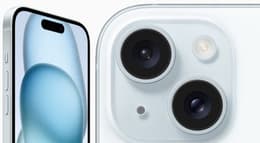
  • Camera System Capabilities: The iPhone 15 Plus features an advanced dual-camera system with a 48MP main sensor and a 12MP ultrawide lens, also offering a 2x telephoto option enabled by the main sensor. The Galaxy A15 5G comes with a triple camera setup, including a 50MP main camera, a 5MP ultrawide, and a 2MP macro lens.
  • Photography Performance: The iPhone 15 Plus excels in capturing detailed and vibrant photos in various conditions, including improved low-light performance and advanced portrait features. The Galaxy A15 5G's 50MP main camera performs well in good lighting, producing naturalistic colors, though the ultrawide and macro lenses are considered less capable by some users.
  • Video Recording and Audio: The iPhone 15 Plus offers high-quality video recording with advanced stabilization and features. Both devices provide standard microphone quality for calls and recording, and their speakers offer a suitable experience for media consumption.

Main camera

50 megapixels

48 megapixels

Front camera

13 megapixels

12 megapixels

Miscellaneous

Beyond core features, several practical elements contribute to the overall user experience and device utility.

  • Connectivity Options: Both devices support 5G connectivity for fast mobile data. The iPhone 15 Plus includes Wi-Fi 6 and Bluetooth 5.3. The Galaxy A15 5G supports Wi-Fi 5 and Bluetooth 5.3.
  • Port Types: The iPhone 15 Plus has adopted a USB-C port for charging and data transfer. The Galaxy A15 5G also features a USB-C 2.0 port and retains a 3.5mm headphone jack.
  • Build Materials and Durability: The iPhone 15 Plus features an aluminum design with a Ceramic Shield front and color-infused glass back, offering IP68 water and dust resistance. The Galaxy A15 5G has a plastic body with a glass front. The iPhone 15 Plus is slightly heavier at 201 grams compared to the Galaxy A15 5G at 200 grams, with similar dimensions.

Weight

7 oz

201 oz

Screen size (inches)

6.5

6.7

Network

5G

5G

SIM card

Physical SIM

eSIM

Carrier compatibility

Unlocked

Unlocked

Connector

USB-C

USB-C (USB 2)

The Samsung Galaxy A15 5G and the iPhone 15 Plus cater to different user priorities, each offering a compelling set of features within their respective ecosystems.

Users often praise the iPhone 15 Plus for its exceptional battery life, vibrant OLED display with high peak brightness, and robust camera system that consistently produces high-quality photos and videos. The integration of the Dynamic Island and the shift to USB-C are also frequently highlighted as positive advancements. Some common criticisms, however, include the 60Hz refresh rate, which some users find less fluid compared to devices with higher refresh rates, and the absence of a dedicated telephoto lens.

Conversely, the Galaxy A15 5G receives commendation for its impressive two-day battery life, smooth 90Hz Super AMOLED display, and Samsung's commitment to four years of OS updates. Users appreciate its solid main camera performance for everyday shots and the inclusion of expandable storage. A frequent concern noted by users is that its overall performance can feel less responsive for demanding tasks compared to more powerful devices, and the utility of its secondary camera lenses is sometimes questioned.

Users prioritizing a large, bright display, a highly capable camera for diverse scenarios, and a long-lasting battery within the Apple ecosystem will find the iPhone 15 Plus well-suited to their needs. Those who value extended battery life, a smoother display refresh rate, expandable storage, and the flexibility of the Android operating system may lean toward the Galaxy A15 5G. Both devices offer a quality-assured refurbished option, providing a sustainable choice for consumers looking to make an informed decision.
See all articles

Our recent comparisons