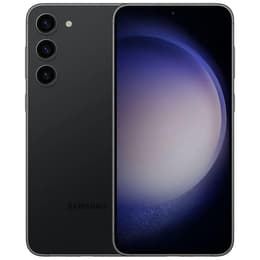
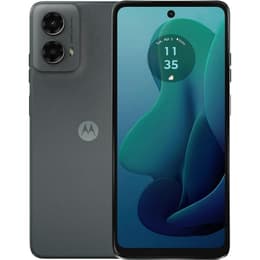

Galaxy S23+ • Unlocked vs Motorola Moto G (2024) • Unlocked

Galaxy S23+ • Unlocked
Starting at

Refurbished price:$259.99

Versus $999.99 new

See options
Motorola Moto G (2024) • Unlocked
Starting at

Refurbished price:$107.00

Versus $186.99 new

See options

Ratings

The Samsung Galaxy S23 Plus, released in February 2023, and the Motorola Moto G 2024, launched in March 2024, represent distinct approaches to smartphone design and functionality. While both devices offer a large screen experience, they cater to different user expectations regarding performance, display quality, and camera capabilities. The Galaxy S23 Plus operates on Samsung's One UI based on Android, offering a feature-rich experience, whereas the Moto G 2024 runs a cleaner version of Android 14.

Scores

Durability

When considering the long-term usability of these devices, their release timelines and software support policies are key differentiators.

  • Release Timeline: The Samsung Galaxy S23 Plus was released in February 2023, making it a more established device in the market. The Motorola Moto G 2024, as its name suggests, is a newer model, launched in March 2024.
  • Software Longevity: Samsung typically provides four years of major Android operating system updates and five years of security updates for its flagship devices like the Galaxy S23 Plus. In contrast, the Motorola Moto G 2024 is expected to receive only one major Android operating system update. This means the Galaxy S23 Plus offers a significantly longer period of up-to-date software and security support.
  • Build Durability: The Galaxy S23 Plus features Gorilla Glass Victus 2 on both its front and back, along with an Armor Aluminum frame, contributing to its robust build and IP68 rating for dust and water resistance. The Moto G 2024 utilizes a glass front, a silicone polymer (eco-leather) back, and a plastic frame, with a water-repellent design.

Release Year

2023

2024

Last OS Compatibility

Yes

Yes

OS

Android

Android

Foldable

No

No

Performance

The performance of a smartphone impacts daily responsiveness, from launching applications to handling demanding tasks.

  • Processing Power: The Galaxy S23 Plus is equipped with a powerful, optimized processor designed for high-end performance, enabling smooth operation for demanding applications and multitasking. The Moto G 2024 features a processor that handles everyday tasks, but users may experience occasional delays when opening apps or switching between multiple applications, particularly with heavy usage.
  • Multitasking and Storage: The Galaxy S23 Plus comes with 8GB of RAM and offers internal storage options of 256GB or 512GB, utilizing faster storage technology for quicker data access. The Moto G 2024 includes 4GB of RAM and 128GB of internal storage, which can be expanded via a microSD card.
  • Battery Behavior: The Galaxy S23 Plus houses a 4700 mAh battery, which, combined with its efficient processor and display, often provides excellent endurance, frequently lasting through a full day and sometimes into a second day for moderate users. The Moto G 2024 features a larger 5000 mAh battery, known for its strong battery life, often extending to a day and a half or more on a single charge.

Memory (GB)

8 GB

4 GB

Screen quality

The display is a primary interface for smartphone interaction, and both devices offer different visual experiences.

  • Display Technology and Resolution: The Galaxy S23 Plus features a 6.6-inch Dynamic AMOLED 2X display with a Full HD+ resolution (2340 x 1080 pixels), providing vibrant colors and deep blacks. The Moto G 2024 has a 6.6-inch IPS LCD screen with an HD+ resolution (1612 x 720 pixels).
  • Brightness and Clarity: The Galaxy S23 Plus offers a high peak brightness of 1750 nits, ensuring excellent visibility even in bright outdoor conditions. The Moto G 2024's display is generally considered less bright, which can impact outdoor readability. The higher pixel density of the S23 Plus results in sharper images and text.
  • Refresh Rate: Both phones feature a 120Hz refresh rate, contributing to smoother scrolling and more fluid animations. The Galaxy S23 Plus has an adaptive refresh rate that can scale down to 48Hz to conserve battery.

Resolution

1080 x 2340

720 x 1612

Screen type

Dynamic AMOLED 2X

IPS LCD

Audiovisual

The camera systems on these smartphones offer varying capabilities for capturing photos and videos.

  • Rear Camera System: The Galaxy S23 Plus boasts a versatile triple-camera setup, including a 50MP main sensor with optical image stabilization (OIS), a 12MP ultrawide lens, and a 10MP telephoto lens with 3x optical zoom. The Moto G 2024 features a dual-camera system with a 50MP main sensor and a 2MP macro lens.
  • Photography Performance: The Galaxy S23 Plus delivers strong photography performance across various conditions, including good low-light capabilities and improved video stabilization. Its telephoto lens allows for clear zoomed-in shots. The Moto G 2024's camera performance is generally considered below average, struggling with detail, clarity, and low-light conditions, with photos sometimes appearing washed out.
  • Video Recording and Front Camera: The Galaxy S23 Plus can record video at up to 8K resolution at 30 frames per second and features a 12MP front camera. The Moto G 2024 records video at 1080p and has an 8MP front camera.

Main camera

50 megapixels

50 megapixels

Front camera

12 megapixels

8 megapixels

Miscellaneous

Beyond core features, several practical elements contribute to the overall user experience of these devices.

  • Connectivity and Ports: Both devices support 5G connectivity. The Galaxy S23 Plus offers Wi-Fi 6E and Bluetooth 5.3, along with a USB-C 3.2 port. The Moto G 2024 supports Wi-Fi (a/b/g/n/ac), Bluetooth 5.1, NFC, and includes a USB-C 2.0 port and a 3.5mm headphone jack.
  • Biometric Security: The Galaxy S23 Plus features an ultrasonic in-screen fingerprint sensor for secure unlocking. The Moto G 2024 has a side-mounted fingerprint sensor.
  • Design and Handling: The Galaxy S23 Plus measures 157.8 x 76.2 x 7.6 mm and weighs 196g, offering a sleek and premium feel. The Moto G 2024 measures 164.4 x 75 x 8.2 mm and weighs 194g, featuring a slightly larger and thicker profile.

Weight

7 oz

7 oz

Screen size (inches)

6.6

6.6

Network

5G

5G

SIM card

Physical SIM + eSIM

Physical SIM

Carrier compatibility

Unlocked

Unlocked

User feedback for the Samsung Galaxy S23 Plus frequently highlights its strong performance, vibrant display, and impressive battery life as key strengths. Many users appreciate its balanced feature set, often considering it a 'sweet spot' in Samsung's S23 lineup, offering flagship-level experience without the larger size or specialized features of the Ultra model. Some common criticisms, though less frequent, point out that while its camera is very capable, it might not always match the absolute top-tier performance of some competitors in specific scenarios, such as extreme low light or highly detailed zoom.

For the Motorola Moto G 2024, users consistently praise its exceptional battery life, often noting it can comfortably last a day and a half or more. However, frequent concerns revolve around its display, which is often described as dim and lower resolution, and its camera system, which is generally considered to be below average, especially in challenging lighting conditions. Performance is also noted as being adequate for basic tasks but can be sluggish with more demanding use.

Users prioritizing a premium experience with robust performance, a high-quality display, and a versatile camera system, along with extended software support, may find the Samsung Galaxy S23 Plus well-suited to their needs. Conversely, users whose primary concern is long battery life and who engage mainly in basic smartphone functions, and who do not prioritize a high-resolution display or advanced camera capabilities, might lean towards the Motorola Moto G 2024. Both devices are available as quality-assured refurbished options, providing an eco-friendly alternative for consumers.


See all articles

Our recent comparisons