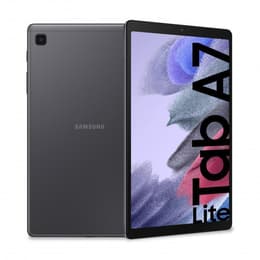

Galaxy Tab A7 Lite (8.7", 2021) vs Galaxy Tab S8+ (12.4", 2022)

Galaxy Tab A7 Lite (8.7", 2021)
Starting at

Refurbished price:$71.00

Versus $219.00 new

See options
Galaxy Tab S8+ (12.4", 2022)
Starting at

Refurbished price:$321.99

Versus $999.99 new

See options

Ratings

The Samsung Galaxy Tab A7 Lite, released in May 2021, and the Samsung Galaxy Tab S8+, launched in February 2022, are two Android tablets from Samsung's diverse lineup. While both operate on the Android ecosystem, they cater to distinctly different user needs, primarily differentiated by their size, processing power, and display technology. The Tab A7 Lite is designed for portability and essential tasks, whereas the Tab S8+ offers a premium experience for demanding applications and creative work.

Scores

Durability

When considering the longevity of these tablets, their release timelines and Samsung's software support policies are key factors. The Galaxy Tab A7 Lite, released in 2021, typically receives software updates for approximately four years from its launch, with some reports indicating support up to Android 14 with One UI 6.1. The Galaxy Tab S8+, being a 2022 model, benefits from a longer support window, generally receiving updates for five years, extending its practical lifespan for newer features and security patches.

  • Software Updates: The Tab S8+ is expected to receive software updates for a longer duration than the Tab A7 Lite, providing extended access to new Android versions and security enhancements.
  • Build Quality: The Tab A7 Lite features a sturdy aluminum metal body with some plastic components, offering a durable feel for its category. The Tab S8+ boasts an Armor Aluminum frame, contributing to its robust and premium construction.
  • Repairability: While specific repairability scores can vary, the more complex internal components and sealed design of the premium Tab S8+ might present greater challenges for repair compared to the more straightforward construction of the Tab A7 Lite.

Release Year

2021

2022

Compatible with latest Update

Yes

Yes

OS

Android

Android

Performance

The performance capabilities of these two tablets vary significantly, reflecting their intended uses. The Galaxy Tab A7 Lite is equipped for everyday tasks, while the Galaxy Tab S8+ is built for high-demand activities.

  • Everyday Responsiveness: The Tab A7 Lite handles basic tasks like web browsing, video streaming, and light applications adequately. Users may experience some slowdown or stuttering when running multiple apps simultaneously or engaging in more demanding mobile games.
  • Multitasking and Demanding Apps: The Tab S8+ offers robust performance, allowing for smooth multitasking with several applications open in split-screen mode and efficient handling of intensive tasks such as video editing or graphic design.
  • Gaming Experience: Less intensive games run acceptably on the Tab A7 Lite, though graphically demanding titles may struggle even at lower settings. The Tab S8+ provides a very smooth gaming experience, even with high-fidelity games at elevated settings, maintaining stable performance under load.
  • Storage and RAM: The Tab A7 Lite typically comes with 3GB or 4GB of RAM and 32GB or 64GB of internal storage. The Tab S8+ offers more generous configurations, starting with 8GB of RAM and 128GB of storage, with options for up to 16GB of RAM and 512GB of storage, all expandable via microSD.

Memory (GB)

3 GB

8 GB

Processor

Mediatek MT8768T Helio P22T

Qualcomm SM8450 Snapdragon 8 Gen 1

Screen quality

The visual experience on these tablets is a major differentiator, with distinct display technologies and sizes impacting clarity and vibrancy.

  • Display Technology and Size: The Galaxy Tab A7 Lite features an 8.7-inch TFT LCD display, which is suitable for casual viewing. The Galaxy Tab S8+ boasts a larger 12.4-inch Super AMOLED display, known for its vibrant colors and deep blacks.
  • Resolution and Clarity: The Tab A7 Lite has a resolution of 1340 x 800 pixels, resulting in a pixel density of approximately 179 PPI. This resolution is sufficient for general content but may show less sharpness with small text or fine details. The Tab S8+ offers a higher resolution of 2800 x 1752 pixels, providing a sharper and more detailed image with a pixel density of around 266 PPI.
  • Brightness and Outdoor Visibility: The Tab A7 Lite reaches a maximum brightness of about 315-360 nits, which can be challenging for outdoor use in bright sunlight due to reflections. The Tab S8+ provides ample brightness, making content viewable even under direct sunlight, despite not reaching the peak brightness levels of some other AMOLED screens.
  • Refresh Rate: The Tab A7 Lite has a standard 60Hz refresh rate. The Tab S8+ features a 120Hz refresh rate, contributing to smoother scrolling and a more fluid visual experience, particularly noticeable during fast-paced content or navigation.

Resolution

800 x 1340

1752 x 2800

Screen type

TFT LCD

Super AMOLED

Pixel density

180ppp

270ppp

Audiovisual

Tablet cameras are generally designed for utility rather than high-end photography, and this holds true for both models, though with clear differences in capability.

  • Rear Camera System: The Galaxy Tab A7 Lite includes an 8MP rear camera, capable of capturing decent photos in good lighting conditions and recording 1080p video at 30fps. The Galaxy Tab S8+ features a dual-camera setup on the rear, with a 13MP main lens and a 6MP ultrawide lens, offering more versatility for photography.
  • Front Camera for Video Calls: For video conferencing, the Tab A7 Lite has a 2MP front-facing camera, which is acceptable for basic video calls but may produce washed-out or blurry images. The Tab S8+ significantly upgrades this with a 12MP ultrawide front camera, providing clearer video and a wider field of view, which is beneficial for group calls.
  • Video Recording Quality: Both tablets can record video, with the Tab A7 Lite offering 1080p at 30fps. The Tab S8+ also records high-quality video, with its improved sensors contributing to better detail and color reproduction.
  • Audio Experience: Both tablets feature stereo speakers with Dolby Atmos support, enhancing the audio experience for media consumption. The Tab S8+ speakers are noted for being crisp and loud.

Miscellaneous

Beyond core performance and display, several practical features contribute to the overall user experience and suitability for different lifestyles.

  • Connectivity Options: The Galaxy Tab A7 Lite supports Wi-Fi 5 and Bluetooth 5.0, with an optional LTE model available for mobile connectivity. The Galaxy Tab S8+ offers more advanced connectivity with Wi-Fi 6E and Bluetooth 5.2, and also includes optional 5G support for faster mobile data speeds.
  • Ports and Sensors: Both tablets include a USB-C port for charging and data transfer, and a 3.5mm headphone jack. The Tab A7 Lite relies on facial recognition for unlocking, while the Tab S8+ incorporates an in-display fingerprint sensor for secure and convenient access.
  • Dimensions and Portability: The Tab A7 Lite is a compact device, weighing around 366g and measuring 8.0mm thick, making it easy to hold with one hand and highly portable. The Tab S8+ is a larger tablet, weighing 567g and being notably thinner at 5.7mm, offering a more expansive screen experience but less single-handed portability.
  • Stylus Support: A key feature of the Tab S8+ is its included S Pen, which offers low-latency input for note-taking, drawing, and precise navigation. The Tab A7 Lite does not support an active stylus like the S Pen.

Weight

12 oz

1 oz

Screen size (inches)

8.7

12.4

Network

Wi-Fi + 4G

Wi-Fi + 5G

Carrier compatibility

Unlocked

Unlocked

Connector

USB Type-C

USB Type-C

The Samsung Galaxy Tab A7 Lite and Galaxy Tab S8+ serve distinct segments of the tablet market, each excelling in its own right. User feedback for the Tab A7 Lite often praises its compact size, ease of use, and decent battery life for casual media consumption and light tasks. However, common criticisms point to its performance limitations when multitasking and the modest camera quality. Conversely, the Tab S8+ is frequently lauded for its stunning AMOLED display, powerful performance for demanding applications, and the versatility offered by the included S Pen. Some users note that while its battery life is acceptable, it may not be as long-lasting as some might expect for its size, and the Android tablet software experience, while improved, still has areas for refinement.

Users prioritizing a highly portable device for basic web browsing, video streaming, and e-reading will find the Galaxy Tab A7 Lite well-suited to their needs. Its smaller form factor makes it ideal for travel or for children. On the other hand, individuals who require a powerful tablet for productivity, creative work, or immersive entertainment, and who value a large, high-quality display and stylus input, will likely prefer the Galaxy Tab S8+. This device is particularly beneficial for professionals, students, or artists who can leverage its advanced capabilities. Both tablets offer a gateway into the Android ecosystem, and for those seeking a quality-assured refurbished option, both models are available, providing an eco-friendly alternative to new purchases.


See all articles

Our recent comparisons