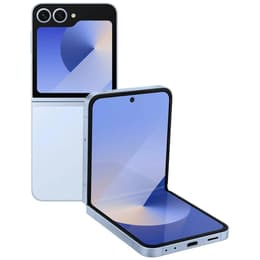
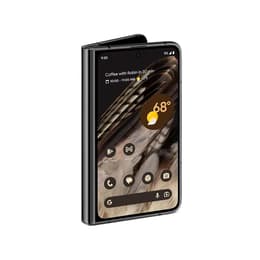

Galaxy Z Flip6 • Unlocked vs Google Pixel Fold • Unlocked

Galaxy Z Flip6 • Unlocked
Starting at

Refurbished price:$339.99

Versus $1,099.00 new

See options
Google Pixel Fold • Unlocked
Starting at

Refurbished price:$591.00

Versus $1,799.00 new

See options

Ratings

The Samsung Galaxy Z Flip6 (released July 2024) and the Google Pixel Fold (released June 2023) represent distinct approaches to foldable smartphone design. While both operate on the Android platform, they cater to different user preferences through their unique form factors and software philosophies. The Z Flip6 offers a compact, clamshell design that folds vertically, emphasizing portability, whereas the Pixel Fold presents a book-style design that unfolds horizontally, prioritizing a larger tablet-like display experience.

Scores

Durability

The longevity of a smartphone is influenced by its physical resilience and the duration of software support it receives. These two foldable devices offer different timelines for updates and varying levels of physical robustness.

  • Software Support: The Galaxy Z Flip6 is designed to receive seven years of operating system and security updates, offering an extended period of current software features and protection. The Google Pixel Fold, released a year earlier, is slated for five years of OS and security updates, with support expected until June 2028.
  • Physical Durability: The Galaxy Z Flip6 features an enhanced Armour Aluminum frame and Gorilla Glass Victus 2 protection on its cover screen and back panel, contributing to its overall resilience. It also carries an IP48 rating, indicating protection against both water and dust intrusion up to 1mm particles. The Pixel Fold has an IPX8 water resistance rating, meaning it can withstand submersion in water but does not officially specify dust resistance. Both devices, being foldables, have inner screens that are more susceptible to scratches than traditional smartphone displays.
  • Expected Lifespan: Users can anticipate a longer period of official software support with the Galaxy Z Flip6, potentially extending its functional lifespan for those who prioritize the latest software features and security patches. The Pixel Fold, while offering substantial support, will reach its end-of-life for major OS updates sooner.

Release Year

2024

2023

Last OS Compatibility

Yes

Yes

OS

Android

Android

Foldable

Yes

Yes

Performance

Performance in foldable smartphones is crucial for handling demanding applications and ensuring a smooth user experience across different screen configurations. Both devices are equipped with capable processors and ample memory to manage daily tasks.

  • Processing Power: The Galaxy Z Flip6 is powered by a current-generation processor, which allows it to handle demanding applications and multitasking smoothly. This results in quick app loading times and fluid navigation. The Google Pixel Fold utilizes a previous-generation processor, which still provides a responsive experience for most everyday tasks and applications.
  • Multitasking and Responsiveness: Both devices come with 12 GB of RAM, enabling efficient multitasking and quick switching between applications without significant slowdowns. The Z Flip6's newer processor may offer a slight edge in sustained performance during intensive gaming or complex productivity tasks.
  • Storage Options: Both the Galaxy Z Flip6 and the Google Pixel Fold are available with either 256 GB or 512 GB of internal storage, providing ample space for applications, media, and documents.

Memory (GB)

12 GB

12 GB

Screen quality

The display experience is a primary differentiator for foldable phones, with both the main internal screen and the external cover screen playing significant roles in daily interaction.

  • Display Technology and Clarity: The Galaxy Z Flip6 features a 6.7-inch Dynamic AMOLED 2X main display and a 3.4-inch Super AMOLED cover display, both offering vibrant colors and deep blacks. The Pixel Fold has a 7.6-inch OLED main display and a 5.8-inch OLED cover display, also known for rich colors and contrast. The larger cover screen on the Pixel Fold provides a more expansive view for quick interactions without unfolding.
  • Refresh Rate and Smoothness: Both devices offer a 120 Hz variable refresh rate on their main displays, contributing to smooth scrolling and fluid animations. This high refresh rate enhances the visual experience, especially during gaming or browsing content with motion.
  • Crease Visibility and Brightness: The Galaxy Z Flip6 has made improvements in minimizing the visibility of the crease on its foldable display compared to its predecessors. Both devices offer sufficient brightness levels for comfortable viewing in various lighting conditions, including outdoor use.

Resolution

1080 x 2640

1840 x 2208

Screen type

Foldable Dynamic LTPO AMOLED 2X

Foldable OLED

Audiovisual

The camera systems on these foldable phones offer different strengths, influenced by their hardware and computational photography capabilities.

  • Rear Camera Systems: The Galaxy Z Flip6 is equipped with a dual-camera setup, featuring a 50 MP wide-angle main lens and a 12 MP ultra-wide-angle lens. The Pixel Fold boasts a more versatile triple-camera system on the rear, including a 48 MP wide main lens, a 10.8 MP ultrawide lens, and a 10.8 MP telephoto lens with 5x optical zoom.
  • Photography Performance: The Z Flip6 offers improved camera performance over its predecessor, capturing good detail in bright environments and producing pleasing skin tones, making it suitable for selfies using the cover screen. The Pixel Fold is recognized for its strong computational photography, delivering balanced colors and effective portrait modes. Its 5x optical zoom is a notable advantage for capturing distant subjects.
  • Video Recording and Audio: Both devices are capable of recording high-quality video. The Pixel Fold's video capabilities are largely similar to other Pixel flagship phones, offering good stabilization and tonality. Microphone quality on both is generally suitable for calls and recording, and speaker output provides a decent media consumption experience.

Main camera

50 megapixels

48 megapixels

Front camera

10 megapixels

8 megapixels

Miscellaneous

Beyond core specifications, several practical elements contribute to the overall user experience and daily usability of these foldable smartphones.

  • Connectivity and Ports: Both the Galaxy Z Flip6 and the Google Pixel Fold support 5G connectivity for fast mobile data. The Z Flip6 features Wi-Fi 6 and Bluetooth 5.3, along with a USB-C 3.2 port. The Pixel Fold also includes modern Wi-Fi and Bluetooth standards, and a USB-C port.
  • Biometric Security: For secure unlocking and authentication, the Galaxy Z Flip6 incorporates a fingerprint sensor. The Pixel Fold also includes a fingerprint sensor for convenient access.
  • Design and Handling: The Galaxy Z Flip6, with its clamshell design, is compact and lightweight when folded, making it easy to carry in a pocket or small bag. It weighs 187 g. The Pixel Fold, with its book-style design, is heavier at 283 g and has a wider profile, offering a more expansive screen when unfolded but a bulkier feel when closed. The Z Flip6's cover screen supports interactive widgets, allowing for more functionality without unfolding the device.

Weight

7 oz

7 oz

Screen size (inches)

6.7

7.6

Network

5G

5G

SIM card

Physical SIM + eSIM

Physical SIM + eSIM

Carrier compatibility

Unlocked

Unlocked

Connector

USB-C

USB-C

Choosing between the Samsung Galaxy Z Flip6 and the Google Pixel Fold largely depends on individual priorities regarding form factor, software experience, and camera capabilities. Users frequently praise the Galaxy Z Flip6 for its compact design when folded, making it highly portable, and its improved battery life compared to previous generations. Some users, however, note that while its camera has improved, it may not match the versatility of non-foldable flagship phones.

The Google Pixel Fold is often lauded for its robust camera system, particularly its 5x optical zoom, and the clean, intuitive Android experience it offers. Criticisms sometimes point to its heavier and wider build compared to other foldables, and some early reports mentioned concerns about inner display durability.

Users prioritizing a highly portable device that easily fits into smaller spaces, along with an extended software support timeline, may find the Galaxy Z Flip6 well-suited to their needs. Its clamshell design and enhanced durability features make it a practical choice for those seeking a modern flip phone experience. Conversely, users who value a larger, tablet-like display for productivity and media consumption, coupled with a powerful and versatile camera system, may lean towards the Google Pixel Fold. Its book-style form factor is ideal for those who frequently multitask or consume content on a larger screen.

Both devices offer unique advantages, and considering a quality-assured refurbished option for either model can provide an eco-friendly alternative for consumers.
See all articles

Our recent comparisons