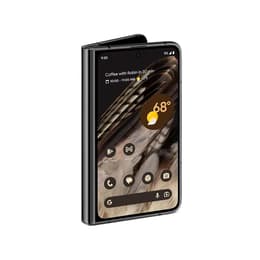
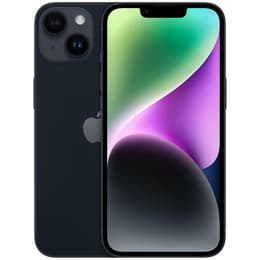
Google Pixel Fold • Unlocked vs iPhone 14 • Locked T-Mobile

Google Pixel Fold • Unlocked
Starting at

Refurbished price:$590.00

Versus $1,799.00 new

See options
iPhone 14 • Locked T-Mobile
Starting at

Refurbished price:$269.00

Versus $599.00 new

See options

Ratings

The Google Pixel Fold (2023) and the iPhone 14 (2022) represent distinct approaches to smartphone design and functionality. While the Pixel Fold offers an innovative foldable form factor with a large internal display, the iPhone 14 maintains a traditional slab design. These devices operate on different ecosystems, with the Pixel Fold running Android and the iPhone 14 powered by iOS, influencing user experience and app availability.

Scores

Durability

Evaluating the practical lifespan of a smartphone involves considering its release timeline, software support, and physical construction.

  • Release Timeline: The Google Pixel Fold was released in June 2023, making it a more recent device compared to the iPhone 14, which launched in September 2022. This difference in release dates can impact the duration of future software support.
  • Software Longevity: Google typically provides several years of major Android updates and security patches for its Pixel devices, often extending to five years for security updates. The iPhone 14, running iOS, generally receives major operating system updates for five to six years from its release date. This suggests both devices offer substantial software support, with the iPhone 14 potentially having a slightly longer update cycle due to Apple's historical support patterns.
  • Physical Durability: The iPhone 14 features a Ceramic Shield front cover and an aluminum frame, contributing to its overall resilience against drops and scratches. It also boasts an IP68 rating for water and dust resistance, allowing submersion up to 6 meters for 30 minutes. The Google Pixel Fold, while also offering IPX8 water resistance, presents a different durability profile due to its folding screen. The outer display is protected by Gorilla Glass Victus, but the internal folding screen typically features a more flexible, plastic-based protective layer, which can be more susceptible to impressions or scratches. The folding mechanism itself introduces a moving part that can be a point of concern for long-term mechanical integrity.

Release Year

2023

2022

Last OS Compatibility

Yes

Yes

OS

Android

iOS

Foldable

Yes

No

Performance

The performance of these devices is shaped by their internal components, influencing how smoothly they handle daily tasks and demanding applications.

  • Processing Power: The Google Pixel Fold is equipped with a processor designed to manage complex tasks and multitasking efficiently, providing a responsive experience for various applications and gaming. The iPhone 14 features a chip that delivers strong performance for everyday use, gaming, and video editing, ensuring smooth operation across the iOS ecosystem.
  • Multitasking and Storage: The Pixel Fold comes with 12GB of RAM, which supports extensive multitasking and keeps numerous applications open in the background without significant slowdowns. Storage options for the Pixel Fold include 256GB and 512GB. The iPhone 14 includes 6GB of RAM, which is optimized for iOS to provide fluid performance, and is available with 128GB, 256GB, or 512GB of internal storage.
  • Battery Behavior: The Google Pixel Fold houses a 4821 mAh battery, designed to power its dual-screen setup and provide a full day of use for many users. The iPhone 14 is equipped with a 3279 mAh battery, which, combined with iOS's power management, typically offers reliable battery life for a full day under moderate usage.

Memory (GB)

12 GB

6 GB

Screen quality

The visual experience on these smartphones differs significantly due to their display technologies and form factors.

  • Display Technology and Clarity: The Google Pixel Fold features two OLED displays. The internal folding screen measures 7.6 inches with a resolution of 1840 x 2208 pixels, offering a pixel density of 380 PPI. The external cover screen is 5.8 inches with a resolution of 1080 x 2092 pixels, resulting in a pixel density of 408 PPI. Both displays provide deep blacks and vibrant colors characteristic of OLED technology. The iPhone 14 utilizes a 6.1-inch Super Retina XDR OLED display with a resolution of 2532 x 1170 pixels, yielding a pixel density of 460 PPI. This display also delivers excellent contrast and color accuracy.
  • Brightness and Smoothness: The Pixel Fold's internal display reaches a peak brightness of 1450 nits, while its cover screen can achieve 1550 nits of peak brightness, ensuring good visibility in various lighting conditions. Both screens on the Pixel Fold support a 120Hz refresh rate, providing smooth scrolling and fluid animations. The iPhone 14 offers a typical brightness of 800 nits and a peak HDR brightness of 1200 nits. Its display operates at a standard 60Hz refresh rate.
  • Viewing Experience: The Pixel Fold's large, foldable internal screen offers an expansive canvas for media consumption, reading, and multitasking, transforming from a compact phone to a small tablet. The iPhone 14 provides a consistent, high-quality viewing experience on its single, traditional display, suitable for everyday media and app usage.

Resolution

1840 x 2208

1170 x 2532

Screen type

Foldable OLED

Super Retina XDR OLED

Audiovisual

Both devices offer capable camera systems, though their configurations and computational photography approaches differ.

  • Rear Camera Systems: The Google Pixel Fold features a triple rear camera setup, including a 48MP main sensor with optical image stabilization (OIS) and an f/1.7 aperture, a 10.8MP ultrawide sensor with a 121.1-degree field of view and an f/2.2 aperture, and a 10.8MP telephoto lens offering 5x optical zoom with an f/3.05 aperture. This system benefits from Google's advanced computational photography for detailed and well-exposed images. The iPhone 14 is equipped with a dual 12MP rear camera system, comprising a main sensor with OIS and an f/1.5 aperture, and an ultrawide sensor with a 120-degree field of view and an f/2.4 aperture. It utilizes the Photonic Engine for improved low-light performance.
  • Front and Inner Cameras: For selfies and video calls, the Pixel Fold has a 9.5MP camera on its cover screen and an 8MP camera on the internal folding display. The iPhone 14 features a 12MP TrueDepth front camera with autofocus and an f/1.9 aperture.
  • Video Capabilities: The Pixel Fold can record video at up to 4K resolution at 60 frames per second. The iPhone 14 supports 4K Dolby Vision HDR video recording at up to 60 frames per second, offers a Cinematic mode for shallow depth-of-field effects at up to 4K HDR at 30 frames per second, and includes an Action mode for enhanced video stabilization at up to 2.8K at 60 frames per second.

Main camera

48 megapixels

12 megapixels

Front camera

8 megapixels

12 megapixels

Miscellaneous

Beyond core performance and display, several practical elements contribute to the overall user experience of these devices.

  • Connectivity and Ports: The Google Pixel Fold supports 5G networks, Wi-Fi 6E, and Bluetooth 5.2. It features a USB-C 3.2 Gen 2 port for charging and data transfer. The iPhone 14 also supports 5G connectivity (both sub-6 GHz and mmWave), Wi-Fi 6, and Bluetooth 5.3. It uses Apple's proprietary Lightning port.
  • Biometrics and Sensors: The Pixel Fold incorporates a side-mounted fingerprint sensor for secure unlocking. The iPhone 14 relies on Face ID, Apple's facial recognition system, for biometric authentication. Both devices include a standard array of sensors such as accelerometers, gyroscopes, proximity sensors, compasses, and barometers. The iPhone 14 also includes an Ultra Wideband chip for spatial awareness.
  • Physical Design and Handling: When folded, the Google Pixel Fold measures 139.7 x 79.5 x 12.1mm and weighs 283 grams. Unfolded, its dimensions are 139.7 x 158.7 x 5.8mm. This design allows for a compact form factor when closed and an expansive screen when open. The iPhone 14 has dimensions of 146.7 x 71.5 x 7.8mm and weighs 172 grams, offering a more traditional smartphone feel. The iPhone 14's frame is made from aerospace-grade aluminum, with a Ceramic Shield front and glass back.

Weight

7 oz

6 oz

Screen size (inches)

7.6

6.1

Network

5G

5G

SIM card

Physical SIM + eSIM

eSIM

Carrier compatibility

Unlocked

T-Mobile

Connector

USB-C

Lightning

User feedback often highlights the Google Pixel Fold's innovative design and its large, immersive internal display as key strengths, particularly for those who value a tablet-like experience in a pocketable form factor. Its camera system, powered by Google's computational photography, also receives praise for producing consistent and high-quality images. However, some users express concerns regarding the device's thickness and weight when folded, as well as the long-term durability of the folding screen and the visible crease.

The iPhone 14 is frequently lauded for its reliable performance, user-friendly iOS ecosystem, and its capable camera system that excels in both photography and video recording. Users appreciate its consistent software updates and robust build quality. Common criticisms include the retention of the Lightning port instead of a more universal USB-C, and the standard 60Hz refresh rate of its display, which some users find less fluid compared to devices with higher refresh rates.

Users prioritizing a versatile device with a large, adaptable screen for productivity, media consumption, and a distinct Android experience may find the Google Pixel Fold well-suited to their needs. Conversely, users seeking a dependable, high-performing traditional smartphone with a strong camera, long-term software support, and the integrated iOS ecosystem will likely lean toward the iPhone 14. Both devices offer distinct advantages, catering to different user preferences and usage patterns. For those considering either of these devices, exploring quality-assured refurbished options can provide an eco-friendly alternative.


See all articles

Our recent comparisons