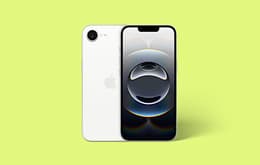
iPhone 16e • Unlocked vs Motorola Moto G (2024) • Unlocked

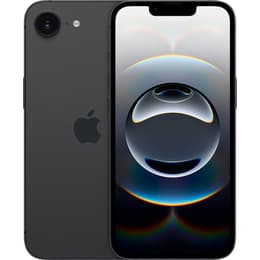
iPhone 16e • Unlocked
Starting at

Refurbished price:$362.00

Versus $599.00 new

See options
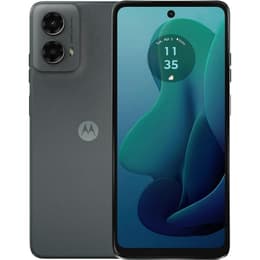
Motorola Moto G (2024) • Unlocked
Starting at

Refurbished price:$104.00

Versus $186.99 new

See options

Ratings

The iPhone 16E, released in February 2025, and the Motorola Moto G 2024, launched in March 2024, are smartphones designed for different user experiences and ecosystems. While the iPhone 16E operates on Apple's iOS, offering a streamlined and integrated environment, the Moto G 2024 runs on Android, providing a more open and customizable platform. Key differentiators between these two devices include their display technology, camera capabilities, and overall performance, catering to distinct user priorities.

Scores

Durability

When considering the long-term usability of a smartphone, factors like software support, physical resilience, and repairability play a significant role. The iPhone 16E and Motorola Moto G 2024 offer different propositions in these areas.

  • Software Longevity: The iPhone 16E, running on iOS, typically receives major software updates for an extended period, often 5-6 years or more from its release date, with its original operating system being iOS 18.3 and current support extending to iOS 26.4. This provides a longer window for new features and security enhancements. In contrast, the Motorola Moto G 2024, which launched with Android 14, generally receives fewer major Android version updates, typically one, along with around three years of security updates.
  • Physical Durability: The iPhone 16E features an aluminum frame, a glass front with Ceramic Shield protection, and a matte finished back glass, contributing to its robust build. It also boasts an IP68 rating for water and dust resistance, allowing it to withstand submersion up to 6 meters for 30 minutes. User tests indicate good resistance to scratches and bending. The Motorola Moto G 2024 has a glass front, a silicone polymer back, and a plastic frame, with a water-repellent design, though it lacks an official IP rating for dust and water resistance.
  • Practical Lifespan: The iPhone 16E's longer software support and premium build materials suggest a potentially longer practical lifespan for users who prioritize keeping their device updated and protected. The Moto G 2024, while offering a solid build for its category, may see its software support conclude sooner, which could influence its perceived longevity for some users.

Release Year

2025

2024

OS

iOS

Android

Foldable

No

No

Performance

The performance of a smartphone dictates its responsiveness and ability to handle various applications, from everyday tasks to more demanding operations. The iPhone 16E and Motorola Moto G 2024 approach this with different hardware philosophies.

  • Processing Power: The iPhone 16E is equipped with a powerful current-generation Apple processor, featuring a 4-core GPU. This hardware configuration allows it to handle demanding applications, complex multitasking, and graphics-intensive games with fluidity and speed. Benchmarks suggest it performs very well, sometimes even surpassing other models in its series. The Motorola Moto G 2024 utilizes a Qualcomm Snapdragon 4 Gen 1 processor, which is designed for efficient everyday performance. It capably manages common tasks like web browsing, social media, and light gaming.
  • Multitasking and Storage: The iPhone 16E comes with 8GB of RAM and offers storage options up to 512GB, providing ample space and memory for numerous applications to run simultaneously without significant slowdowns. The Moto G 2024 includes 4GB of RAM and 128GB of internal storage, with the flexibility to expand storage up to 1TB via a microSD card. While sufficient for most users, heavy multitasking or very large applications might occasionally experience slight delays.
  • Overall Responsiveness: Users generally report the iPhone 16E to be consistently quick and responsive across all functions, from launching apps to navigating the interface. The Moto G 2024 provides a smooth experience for typical usage, though some users have noted occasional minor delays when switching between many open applications.

Memory (GB)

8 GB

4 GB

Screen quality

The display is a primary interface for smartphone interaction, and its quality significantly impacts the viewing experience. The iPhone 16E and Motorola Moto G 2024 offer distinct display technologies and characteristics.

  • Display Technology and Resolution: The iPhone 16E features a 6.1-inch Super Retina XDR OLED display with a resolution of 2532 x 1170 pixels, resulting in a sharp 460 pixels per inch. This OLED technology delivers deep blacks, vibrant colors, and excellent contrast, supporting HDR content. The Motorola Moto G 2024 comes with a 6.6-inch IPS LCD display, offering a resolution of 720 x 1612 pixels, which translates to a pixel density of 267 PPI. This provides a clear viewing experience for general use.
  • Brightness and Refresh Rate: The iPhone 16E's display achieves a typical maximum brightness of 800 nits and a peak HDR brightness of 1200 nits, ensuring good visibility even in bright outdoor conditions. It operates at a standard 60Hz refresh rate. The Moto G 2024's display has a brightness of around 430 nits, which can be challenging to view under direct sunlight, but it offers a smoother 120Hz refresh rate, enhancing the fluidity of scrolling and animations.
  • Viewing Experience: The iPhone 16E provides a premium visual experience with its high-resolution OLED panel, making it well-suited for consuming high-quality media and detailed content. The Moto G 2024's larger screen and higher refresh rate contribute to a more expansive and fluid browsing experience, though its lower resolution and brightness may be noticeable in certain scenarios.

Resolution

2532x1170

720 x 1612

Screen type

Super Retina XDR

IPS LCD

Audiovisual

For many users, the camera system is a crucial aspect of a smartphone, influencing how they capture and share moments. The iPhone 16E and Motorola Moto G 2024 offer different camera configurations and capabilities.

  • Rear Camera System: The iPhone 16E features a single 48-megapixel main camera with optical image stabilization and an f/1.6 aperture. It utilizes a 'Fusion' technology to deliver high-resolution photos and offers an optical-quality 2x zoom by cropping the sensor. It supports features like Smart HDR 5, Photonic Engine, Deep Fusion, and Night Mode. The Motorola Moto G 2024 is equipped with a dual-camera setup, including a 50-megapixel main sensor with an f/1.8 aperture and a 2-megapixel macro camera. The main camera often bins down to 12.5-megapixel images.
  • Photography Performance: The iPhone 16E is noted for producing clean, in-focus photos with accurate colors, performing well in everyday conditions. While it lacks a dedicated ultra-wide or telephoto lens, its image processing and features contribute to strong overall photo quality. The Moto G 2024's main camera performs adequately in well-lit environments, but some users report that images can lack detail, appear noisy, or have somewhat muted colors, particularly in low-light situations. It does not feature optical image stabilization.
  • Video and Front Camera: Both devices offer video recording capabilities. The iPhone 16E can record 4K video at up to 60 frames per second and includes a 12-megapixel TrueDepth front camera. The Moto G 2024 records video at 1080p and features an 8-megapixel front-facing camera. The iPhone 16E also includes advanced video features like spatial audio recording, though it omits Cinematic Mode and Action Mode found on higher-end iPhones.

Main camera

48MP

50 megapixels

Front camera

TrueDepth 12MP

8 megapixels

Miscellaneous

Beyond core performance and display, several practical features contribute to the overall user experience and daily convenience of a smartphone. The iPhone 16E and Motorola Moto G 2024 present different sets of these elements.

  • Connectivity and Ports: Both devices support 5G connectivity. The iPhone 16E includes Wi-Fi 6 and Bluetooth 5.3, and notably features a USB-C port for charging and data transfer. The Motorola Moto G 2024 supports Wi-Fi (802.11a/b/g/n/ac) and Bluetooth 5.1, also utilizing a USB Type-C 2.0 port. The Moto G 2024 additionally retains a traditional headphone jack, which is absent on the iPhone 16E.
  • Biometrics and User Interaction: The iPhone 16E relies on Face ID for secure authentication and includes an Action Button, which is customizable for quick access to various functions. The Moto G 2024 features a side-mounted fingerprint sensor for unlocking and security. The iPhone 16E also supports Qi wireless charging, a feature not universally present on all Moto G 2024 variants.
  • Design and Handling: The iPhone 16E has dimensions of 146.7 x 71.5 x 7.8 mm and weighs 167 grams, offering a compact and relatively lightweight feel. Its build materials include aluminum and glass. The Motorola Moto G 2024 measures 164.4 x 75 x 8.2 mm and weighs 194 grams, providing a larger form factor. Its construction involves a glass front, silicone polymer back, and a plastic frame.

Weight

167 oz

7 oz

Screen size (inches)

6.1

6.6

Network

5G

5G

SIM card

eSIM

Physical SIM

Carrier compatibility

Unlocked

Unlocked

Connector

USB-C

USB-C

The iPhone 16E and Motorola Moto G 2024 cater to different segments of the smartphone market, each with its own strengths and user appeal. User feedback for the iPhone 16E often highlights its excellent battery life, with many reporting it comfortably lasts a full day or even a day and a half with heavy use, and its powerful performance for a non-Pro iPhone. Its camera is generally praised for producing good quality photos, and the inclusion of USB-C and the Action Button are seen as practical improvements. Some common criticisms include the 60Hz display and the absence of MagSafe.

For the Motorola Moto G 2024, users frequently commend its exceptional battery life, often extending to a day and a half or two days on a single charge, and its large display with a 120Hz refresh rate for smooth scrolling. However, common concerns revolve around its camera performance, which can struggle with detail and color accuracy, especially in challenging lighting, and its display's lower resolution and brightness. The limited software update policy is also a point of consideration for some.

Users prioritizing a highly integrated ecosystem, long-term software support, robust build quality, and consistent camera performance may find the iPhone 16E well-suited to their needs. Its powerful processing capabilities make it ideal for demanding applications and a smooth overall experience. Conversely, users who value a larger display with a high refresh rate, extensive battery endurance, expandable storage, and the flexibility of the Android operating system might lean towards the Motorola Moto G 2024. This device is particularly appealing for those who engage in frequent media consumption or require a phone that can last extended periods without charging.

Both devices offer compelling features for their respective audiences. For those considering a more sustainable and budget-conscious approach, exploring quality-assured refurbished options for either model can provide an excellent way to access these technologies while contributing to a circular economy.
See all articles

Our recent comparisons