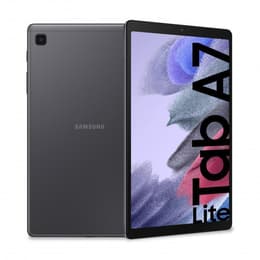

Galaxy Tab A7 Lite (8.7", 2021) vs Galaxy Tab S9 FE (10.9", 2023)

Galaxy Tab A7 Lite (8.7", 2021)
Starting at

Refurbished price:$71.00

Versus $219.00 new

See options
Galaxy Tab S9 FE (10.9", 2023)
Starting at

Refurbished price:$245.28

Versus $549.00 new

See options

Ratings

The Samsung Galaxy Tab A7 Lite, released in 2021, and the Samsung Galaxy Tab S9 FE, launched in 2023, are Android tablets from different generations, each designed to cater to distinct user needs. While both run on the Android operating system with Samsung's One UI, the Tab S9 FE introduces significant advancements in display technology, processing power, and overall durability compared to its predecessor.

Scores

Durability

The longevity and ongoing support for a tablet are crucial for long-term usability. These two devices offer different timelines for software updates and physical resilience.

  • Release Timeline and OS Support: The Galaxy Tab A7 Lite, released in June 2021, launched with Android 11 and received three major OS updates, concluding its official software support with Android 14 (One UI 6.1) around June 2025. It also received four years of security patches. In contrast, the Galaxy Tab S9 FE, launched in October 2023 with Android 13 (One UI 5.1.1), is promised four generations of Android updates, extending its support to Android 17, and five years of security patches, expected until 2028. This means the Tab S9 FE offers a considerably longer period of official software and security updates.
  • Durability and Repairability: The Tab A7 Lite features a body primarily constructed from aluminum metal with some plastic components, offering a sturdy feel for its class. Repair guides are available for common issues like screen and battery replacement. The Tab S9 FE boasts a more premium design and includes an IP68 rating for water and dust resistance, enhancing its resilience against environmental factors.
  • Expected Practical Lifespan: Users of the Tab A7 Lite may find its performance and compatibility with newer applications diminishing as its software support has concluded. The Tab S9 FE, with its extended update policy and more robust build, is designed for a longer practical lifespan, ensuring it remains capable and secure for several more years.

Release Year

2021

2023

Compatible with latest Update

Yes

Yes

OS

Android

Android

Performance

The performance of a tablet dictates its responsiveness and ability to handle various tasks, from simple browsing to more demanding applications.

  • Processor Capabilities: The Galaxy Tab A7 Lite is equipped with an octa-core processor that handles everyday tasks like web browsing, video streaming, and light gaming adequately. However, users may experience slowdowns and hitches when running multiple applications simultaneously or engaging in more graphically intensive games. The Galaxy Tab S9 FE features a more capable octa-core processor, providing a smoother experience for daily use, social media, and casual gaming. While it performs well for most tasks, demanding games or extensive multitasking can still push its limits, leading to noticeable lag.
  • Storage and RAM: The Tab A7 Lite typically comes with 3GB or 4GB of RAM and 32GB or 64GB of internal storage, all expandable via microSD. The Tab S9 FE offers more generous configurations, starting with 6GB or 8GB of RAM and 128GB or 256GB of internal storage, also expandable up to 1TB with a microSD card. The increased RAM in the Tab S9 FE contributes to better multitasking and overall system responsiveness.
  • Battery Behavior: The Tab A7 Lite houses a 5100 mAh battery, generally providing 10-12 hours of screen-on time for typical usage like watching movies or browsing. Charging can take around four hours with a 15W charger. The Tab S9 FE is powered by a larger 8000 mAh battery, offering extended usage, with some reports indicating up to 10-12 hours for browsing and videos, and even longer for specific tasks. It supports 45W fast charging, significantly reducing charging times to about 1.5 hours, though the charger is sold separately.

Memory (GB)

3 GB

6 GB

Processor

Mediatek MT8768T Helio P22T

Exynos 1380

Screen quality

The display is a primary interaction point for tablets, influencing everything from media consumption to productivity.

  • Display Technology and Resolution: The Galaxy Tab A7 Lite features an 8.7-inch TFT LCD with a resolution of 1340 x 800 pixels, resulting in a pixel density of approximately 179 PPI. This resolution can make small fonts appear less sharp, especially when held closer to the face. The Galaxy Tab S9 FE sports a larger 10.9-inch IPS LCD with a higher resolution of 2304 x 1440 pixels (WUXGA+), offering a sharper image with around 249 PPI.
  • Brightness and Refresh Rate: The Tab A7 Lite's display reaches a maximum brightness of about 315-332 nits, which can be challenging for outdoor visibility. It operates at a standard 60Hz refresh rate. The Tab S9 FE's display, while not as bright as premium OLED panels, is generally sufficient for indoor use and offers a smoother visual experience with its 90Hz refresh rate.
  • Viewing Experience: The Tab A7 Lite provides decent colors for media consumption, but some blurring in dark or fast-moving scenes has been noted due to its lower pixel density. The Tab S9 FE delivers vibrant colors and a more fluid viewing experience, making it well-suited for watching videos and casual gaming, though it may not offer the deep blacks and contrast of OLED screens.

Resolution

800 x 1340

1440 x 2304

Screen type

TFT LCD

IPS LCD

Pixel density

180ppp

250ppp

Audiovisual

While tablets are not typically primary photography devices, their cameras are important for video calls and occasional captures.

  • Camera System Capabilities: The Galaxy Tab A7 Lite includes an 8MP autofocus rear camera capable of 1080p video recording and a 2MP front camera. The Galaxy Tab S9 FE features an 8MP rear camera that records FHD video and a more advanced 12MP front camera capable of 4K video recording.
  • Photography Performance: The Tab A7 Lite's cameras are generally considered "good enough" for video calls but produce images that can appear washed out, blurry, or lacking in detail, especially in challenging lighting conditions. The Tab S9 FE's rear camera is described as acceptable for basic snapshots, but its front-facing camera is notably better, providing clearer images for video conferencing.
  • Audio and Media Consumption: Both tablets feature dual speakers with Dolby Atmos support, enhancing the audio experience for media consumption. The Tab S9 FE's speakers are AKG-tuned, suggesting a focus on audio quality. The microphone quality on both devices is suitable for video calls, with the Tab S9 FE's 12MP front camera particularly benefiting this use case.

Miscellaneous

Beyond core features, several practical elements contribute to the overall user experience and device utility.

  • Connectivity Options: The Galaxy Tab A7 Lite supports Wi-Fi 5 (802.11 a/b/g/n/ac) and Bluetooth 5.0, with optional LTE models available. The Galaxy Tab S9 FE offers more modern connectivity with Wi-Fi 6 (802.11 a/b/g/n/ac/ax) and Bluetooth 5.3, also with optional 5G connectivity. This provides faster and more stable wireless connections for the newer model.
  • Ports and Sensors: Both tablets include a USB-C 2.0 port for charging and data transfer. The Tab A7 Lite retains a 3.5mm headphone jack, which is absent on the Tab S9 FE. The Tab S9 FE integrates a power button with a fingerprint sensor for secure unlocking, a feature not present on the Tab A7 Lite.
  • Physical Characteristics: The Tab A7 Lite is a compact device, weighing around 366g (Wi-Fi) or 371g (LTE) with dimensions of 212.5 x 124.7 x 8.0mm. The Tab S9 FE is larger and heavier at 523g, with dimensions of 165.8 x 254.3 x 6.5mm, offering a larger screen but less portability. The Tab S9 FE also comes with an included S Pen stylus, enhancing its utility for note-taking and creative tasks.

Weight

12 oz

15 oz

Screen size (inches)

8.7

10.9

Network

Wi-Fi + 4G

Wi-Fi

Carrier compatibility

Unlocked

Without SIM Port

Connector

USB Type-C

USB Type-C

User feedback for the Galaxy Tab A7 Lite often highlights its portability, decent battery life for its size, and suitability for basic media consumption and light tasks. Common criticisms include its less-than-sharp display, limited performance for demanding applications, and weak camera quality. It is generally seen as a functional, compact tablet for casual use.

The Galaxy Tab S9 FE receives praise for its premium design, improved display with a higher refresh rate, longer software support, and the inclusion of the S Pen. Its IP68 rating for water and dust resistance is also a significant advantage. However, some users note that its performance, while better than the A7 Lite, can still struggle with very demanding games or heavy multitasking, and its cameras are not a strong point.

Users prioritizing a highly portable, compact device for basic web browsing, e-reading, and casual video watching may find the Galaxy Tab A7 Lite sufficient for their needs. Its smaller size makes it easy to handle with one hand and carry on the go. Conversely, those seeking a more modern experience with a larger, sharper, and smoother display, better overall performance for a wider range of applications, and a longer commitment to software updates will find the Galaxy Tab S9 FE better suited. The included S Pen also makes it a strong contender for students or professionals who value note-taking and creative input. For consumers looking for an eco-friendly, quality-assured refurbished option, both models are available, offering a sustainable choice for different budgets and performance requirements.

See all articles

Our recent comparisons