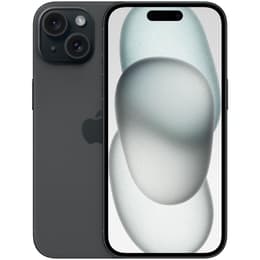
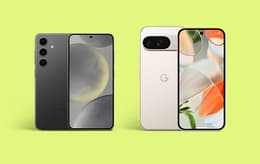
Google Pixel 6a • Unlocked vs iPhone 15 • Locked AT&T

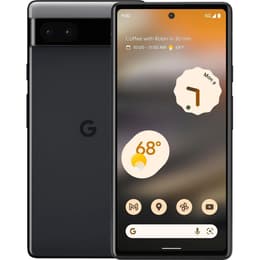
Google Pixel 6a • Unlocked
Starting at

Refurbished price:$141.00

Versus $399.00 new

See options
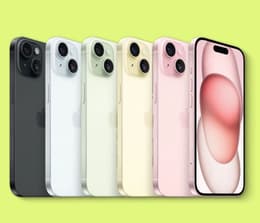
iPhone 15 • Locked AT&T
Starting at

Refurbished price:$349.43

Versus $729.00 new

See options

Ratings

The Google Pixel 6A, released in July 2022, and the iPhone 15, launched in September 2023, represent distinct approaches to smartphone design and functionality. While both are compact devices, they offer different operating systems and user experiences. The Pixel 6A operates on Android, emphasizing Google's software intelligence and computational photography, whereas the iPhone 15 runs on iOS, focusing on a cohesive ecosystem, advanced camera hardware, and a brighter display.

Scores

Durability

When considering the long-term usability of these devices, their release timelines and software support policies are key factors.

  • Release Timeline & OS Support: The Google Pixel 6A, launched in July 2022, was initially promised OS updates until at least July 2025 and security updates until July 2027. Some sources indicate an extension, potentially bringing OS updates up to Android 17. The iPhone 15, released in September 2023, typically benefits from Apple's longer software support, often receiving major iOS updates for five to seven years from its launch.
  • Physical Durability: The Pixel 6A features Gorilla Glass 3 on its front and an aluminum frame with a plastic back, offering an IP67 rating for dust and water resistance. The iPhone 15 incorporates a Ceramic Shield front, a color-infused glass back, and an aluminum design, providing an IP68 rating, allowing for submersion in up to 6 meters of water for 30 minutes.
  • Expected Lifespan: Users prioritizing extended software longevity will find the iPhone 15's typical update cycle advantageous. Both devices offer robust build quality for daily use, with the iPhone 15 providing slightly enhanced water resistance.

Release Year

2022

2023

Last OS Compatibility

Yes

Yes

OS

Android

iOS

Foldable

No

No

Performance

The performance of a smartphone is crucial for daily tasks, app usage, and multitasking. Both devices offer capable performance, though they achieve it through different hardware and software optimizations.

  • Processing Power: The Google Pixel 6A is powered by Google's Tensor chip, which is designed to efficiently handle everyday applications and Google's advanced AI features, ensuring a responsive user experience. The iPhone 15 utilizes a more recent-generation processor, which provides substantial power for demanding applications, graphic-intensive games, and smooth multitasking, offering considerable performance headroom for future software.
  • Memory and Storage: The Pixel 6A comes with 6GB of RAM and 128GB of internal storage, which is not expandable. The iPhone 15 also features 6GB of RAM and offers more flexible storage options, including 128GB, 256GB, and 512GB.
  • Battery Behavior: The Pixel 6A houses a 4410 mAh battery, with users often reporting a full day of use and good endurance, sometimes extending to a day and a half with moderate usage. The iPhone 15, with a 3349 mAh battery, is optimized for efficiency by its processor and iOS, typically providing all-day power for most users.

Memory (GB)

6 GB

6 GB

Screen quality

The visual experience is a primary interaction point with any smartphone, and both the Pixel 6A and iPhone 15 offer quality displays with distinct characteristics.

  • Display Technology and Resolution: Both devices feature 6.1-inch OLED displays, known for their vibrant colors and deep blacks. The Pixel 6A has a resolution of 1080 x 2400 pixels, resulting in approximately 429 pixels per inch. The iPhone 15 offers a Super Retina XDR OLED display with a higher resolution of 2556 x 1179 pixels, providing a slightly sharper image at around 460 pixels per inch.
  • Brightness and Clarity: The iPhone 15's display stands out with significantly higher brightness levels, reaching up to 1000 nits typical brightness and a peak outdoor brightness of 2000 nits, which enhances visibility in bright sunlight. The Pixel 6A's display also supports HDR for improved contrast.
  • Refresh Rate and Features: Both the Pixel 6A and the iPhone 15 feature a standard 60Hz refresh rate, which provides a smooth experience for general navigation. The iPhone 15 also integrates the Dynamic Island, a dynamic area around the front camera that displays alerts and background activities.

Resolution

1080 x 2400

1179 x 2556

Screen type

OLED

Super Retina XDR OLED

Audiovisual

Camera capabilities are a significant consideration for many users, and both smartphones excel in different aspects of photography and videography.

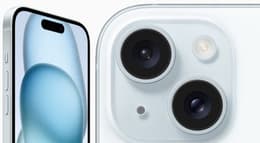
  • Rear Camera Systems: The Google Pixel 6A features a dual-camera setup with a 12.2 MP wide lens (f/1.7, with optical image stabilization) and a 12 MP ultrawide lens (f/2.2, 114° field of view). The iPhone 15 boasts an advanced dual-camera system, including a 48 MP main camera (f/1.6, with sensor-shift optical image stabilization) and a 12 MP ultrawide lens (f/2.4, 120° field of view). The iPhone 15's main camera typically outputs 24MP photos by default, with an option for full 48MP images, and includes a 2x telephoto option enabled by its quad-pixel sensor.
  • Photography Performance: The Pixel 6A is renowned for its computational photography, consistently producing detailed, color-accurate photos with excellent dynamic range, even in challenging conditions, and strong low-light performance through its Night Sight feature. The iPhone 15 offers improved HDR and strong low-light capabilities, with its higher resolution main sensor capturing more detail.
  • Video Recording and Front Camera: Both devices are capable of recording 4K video at 60 frames per second. The Pixel 6A has an 8 MP front camera, while the iPhone 15 features a 12 MP front camera.

Main camera

12.2 megapixels

48 megapixels

Front camera

8 megapixels

12 megapixels

Miscellaneous

Beyond core features, several practical elements contribute to the overall user experience and daily convenience of these devices.

  • Connectivity and Ports: The Google Pixel 6A supports Wi-Fi 6E and Bluetooth 5.2, and includes a USB-C 3.1 port for data transfer and charging. The iPhone 15 supports Wi-Fi 6 and Bluetooth 5.3, and features a USB-C 2.0 port.
  • Biometric Security: For unlocking and secure authentication, the Pixel 6A utilizes an under-display fingerprint sensor. The iPhone 15 employs Face ID, Apple's facial recognition system.
  • Design and Handling: The Pixel 6A weighs 178 grams and measures 152.2 x 71.8 x 8.9 mm. The iPhone 15 is slightly lighter at 171 grams and has dimensions of 147.6 x 71.6 x 7.8 mm, making it marginally thinner and lighter. The iPhone 15 also integrates the Dynamic Island for interactive notifications and activities.

Weight

6 oz

171 oz

Screen size (inches)

6.1

6.1

Network

5G

5G

SIM card

Physical SIM + eSIM

eSIM

Carrier compatibility

Unlocked

AT&T

User feedback for the Google Pixel 6A frequently highlights its exceptional camera quality, particularly its computational photography, and its reliable battery life as strong advantages. Users also appreciate the clean Android experience. Common criticisms sometimes point to its 60Hz display and the absence of wireless charging.

The iPhone 15 generally receives praise for its significantly upgraded camera system, bright display, and the overall smooth and integrated iOS experience. However, some users have expressed disappointment with the continued 60Hz refresh rate and, in some instances, reported battery degradation or heating concerns, though these can be influenced by usage patterns and software versions.

Users prioritizing a pure Android experience with a focus on computational photography and a slightly faster USB-C data transfer speed may find the Google Pixel 6A well-suited to their needs. It's also a strong contender for those who prefer fingerprint authentication. Conversely, users seeking a powerful device within the Apple ecosystem, featuring a brighter display, a more versatile camera system with a higher resolution main sensor, and Face ID, might lean towards the iPhone 15. Both devices are available as quality-assured refurbished options, offering a sustainable choice for consumers.

See all articles

Our recent comparisons