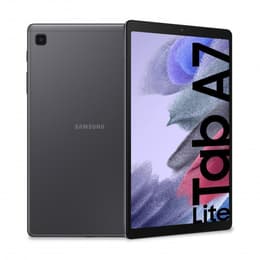

Galaxy Tab A7 Lite (8.7", 2021) vs Galaxy Tab S8 (11.0", 2022)

Galaxy Tab A7 Lite (8.7", 2021)
Starting at

Refurbished price:$61.00

Versus $169.00 new

See options
Galaxy Tab S8 (11.0", 2022)
Starting at

Refurbished price:$309.00

Versus $655.00 new

See options

Ratings

The Samsung Galaxy Tab A7 Lite, released in 2021, and the Samsung Galaxy Tab S8, launched in 2022, represent distinct tiers within Samsung's tablet lineup. While both operate on the Android platform, they cater to different user needs through their specifications and design. The Tab A7 Lite focuses on portability and essential functionality, whereas the Tab S8 offers a more robust and feature-rich experience with enhanced performance and display capabilities.

Scores

Durability

When considering the long-term usability of a tablet, software support and physical durability are key factors. The Galaxy Tab A7 Lite and Tab S8 offer different expectations in these areas.

  • Software Updates: The Galaxy Tab A7 Lite, initially running Android 11, received major OS upgrades up to Android 14 with One UI 6.1. However, it is no longer eligible for further major Android OS updates, and security updates concluded in June 2025. In contrast, the Galaxy Tab S8, launched with Android 12, is part of Samsung's policy to provide four major Android OS updates and five years of security patches. This means the Tab S8 is expected to receive OS updates until 2026 (potentially Android 16) and security patches until 2027, offering a significantly longer period of official software support.
  • Physical Durability: The Tab A7 Lite features a glass front with an aluminum back and frame, providing a solid build for its category. The Galaxy Tab S8 also boasts a glass front and an aluminum frame, specifically using Armor Aluminum for enhanced resilience. While both are designed to withstand daily use, the Tab S8's construction and larger size may offer a perception of greater robustness. Repairability for the Tab S8 has been rated around 5.5 out of 10, indicating some challenges in self-repair due to adhesive use, particularly with the battery.
  • Practical Lifespan: Users of the Tab A7 Lite can expect continued functionality for basic tasks even after official software support ends, though app compatibility and security might become concerns over time. The Tab S8, with its extended update cycle and more powerful hardware, is designed for a longer practical lifespan, capable of handling more demanding applications for several years.

Release Year

2021

2022

Compatible with latest Update

Yes

Yes

OS

Android

Android

Performance

The performance capabilities of these two tablets vary considerably, impacting their suitability for different tasks and user demands.

  • Processor Capabilities: The Galaxy Tab A7 Lite is powered by an octa-core MediaTek Helio P22T processor, designed for basic tasks such as web browsing, video playback, and light applications. Users report that it handles everyday usage reasonably well but can experience sluggishness when many apps are open simultaneously or with demanding games. The Galaxy Tab S8, on the other hand, features a current-generation, high-performance processor. This allows it to handle demanding apps, multitasking, and graphic-intensive games smoothly, providing a responsive and fluid user experience.
  • RAM and Storage: The Tab A7 Lite comes with 2GB, 3GB, or 4GB of RAM and 32GB or 64GB of internal storage, expandable via microSD. The Tab S8 offers more substantial configurations, typically with 8GB or 12GB of RAM and 128GB or 256GB of internal storage, also expandable with a microSD card. The higher RAM in the Tab S8 significantly improves multitasking efficiency, allowing users to switch between applications without noticeable delays.
  • Battery Behavior: The Tab A7 Lite has a 5100mAh battery, providing around 10 hours of web surfing or 5-7 hours of typical use. Heavy users might see around 4.5-5 hours of screen time. The Tab S8 is equipped with an 8000mAh battery, offering excellent battery life, with tests showing nearly 13 hours of web surfing or around 7.5 hours of video streaming at full brightness. It is designed to last through a full day of consistent use.

Memory (GB)

3 GB

8 GB

Processor

Mediatek MT8768T Helio P22T

Qualcomm SM8450 Snapdragon 8 Gen 1

Screen quality

The visual experience is a primary differentiator between these two tablets, with significant variations in display technology, size, and clarity.

  • Display Technology and Size: The Galaxy Tab A7 Lite features an 8.7-inch TFT LCD display. This compact size makes it comfortable for one-handed holding and media consumption. The Galaxy Tab S8 comes with a larger 11-inch LTPS TFT LCD panel. While not an AMOLED display like some of its larger siblings, it still offers a vibrant viewing experience.
  • Resolution and Clarity: The Tab A7 Lite has a resolution of 1340x800 pixels, resulting in a pixel density of approximately 179 ppi. This resolution is considered modest, sufficient for streaming videos and general browsing, but text and images may lack sharpness, especially when viewed closely. The Tab S8 offers a significantly higher resolution of 2560 x 1600 pixels (274 ppi), providing a much clearer and sharper image, which is beneficial for detailed work, reading, and high-definition content.
  • Brightness and Refresh Rate: The Tab A7 Lite's display reaches a maximum brightness of around 315 nits, which is adequate for indoor use but may struggle in bright outdoor conditions. It operates at a standard refresh rate. The Tab S8's display is brighter, rated at 500 nits, and features a 120Hz refresh rate. This higher refresh rate contributes to smoother scrolling and a more fluid visual experience, particularly noticeable in gaming and fast-paced content.

Resolution

800 x 1340

1600 x 2560

Screen type

TFT LCD

TFT LCD

Pixel density

180ppp

280ppp

Audiovisual

Tablet cameras are often secondary to smartphone cameras, but they serve important functions, particularly for video calls and casual photography. The camera systems on these two devices reflect their different market positions.

  • Rear Camera System: The Galaxy Tab A7 Lite is equipped with an 8-megapixel autofocus rear camera. This camera is generally considered serviceable for basic tasks like document scanning or occasional photos in good lighting, but it may produce muted colors and lack fine detail. The Galaxy Tab S8 features a dual-camera setup on the rear, consisting of a 13-megapixel wide-angle lens and a 6-megapixel ultra-wide-angle lens. This system is capable of capturing cleaner images with more detail in decent lighting conditions.
  • Front Camera and Video: For video calls and selfies, the Tab A7 Lite has a 2-megapixel front camera. While acceptable for video calls, its quality is not high, often resulting in washed-out or blurry images. Both front and rear cameras can record video at 1080p at 30 frames per second. The Tab S8 significantly upgrades the front camera to a 12-megapixel ultra-wide lens, which is well-suited for video conferencing and includes features like auto-framing to keep the user centered. The Tab S8's cameras can record video at up to 4K resolution at 30/60 frames per second for the rear and 4K at 30 frames per second for the front.
  • Audio Experience: The Tab A7 Lite includes stereo speakers, which provide a decent audio experience for media consumption. The Tab S8 elevates this with quad AKG speakers and Dolby Atmos support, delivering a richer and more immersive sound experience for movies, music, and video calls. Both tablets retain a 3.5mm headphone jack.

Miscellaneous

Beyond core performance and display, several practical features contribute to the overall user experience and differentiate these two Samsung tablets.

  • Connectivity Options: The Galaxy Tab A7 Lite supports Wi-Fi 5 (802.11 a/b/g/n/ac) and Bluetooth 5.0, with an optional LTE variant for mobile data. The Galaxy Tab S8 offers more advanced connectivity, including Wi-Fi 6E and Bluetooth 5.2, providing faster and more stable wireless connections. While the base Tab S8 does not include 5G, it is available in other models within the S8 series.
  • Ports and Sensors: Both tablets feature a USB Type-C port, though the Tab A7 Lite uses USB 2.0, while the Tab S8 utilizes the faster USB 3.2 standard. The Tab A7 Lite includes an accelerometer and an ambient light sensor, with a compass/magnetometer on the LTE model. The Tab S8 integrates a side-mounted fingerprint sensor for secure and convenient unlocking, a feature absent on the Tab A7 Lite which relies on facial recognition.
  • Design and Handling: The Tab A7 Lite is compact and lightweight, measuring 212.5 x 124.7 x 8.0 mm and weighing around 366g, making it easy to hold in one hand. Its build combines a glass front with an aluminum back and frame. The Tab S8 is larger and slightly heavier at 253.8 x 165.3 x 6.3 mm and 503g, featuring a premium aluminum frame. Its thinner profile (6.3mm vs 8.0mm) contributes to a sleek feel despite the larger footprint.
  • Additional Features: A significant differentiator for the Tab S8 is the inclusion of the S Pen stylus, offering precise input for note-taking, drawing, and navigation. It also supports Samsung's DeX mode, which provides a desktop-like interface for enhanced productivity. These features are not present on the Tab A7 Lite.

Weight

22 oz

18 oz

Screen size (inches)

8.7

11.0

Network

Wi-Fi

Wi-Fi

Carrier compatibility

Unlocked

Without SIM Port

Connector

USB Type-C

USB Type-C

User feedback for the Galaxy Tab A7 Lite often highlights its portability and suitability for basic media consumption and web browsing. Many users appreciate its compact size for reading and casual use, noting that it performs adequately for these less demanding tasks. However, common criticisms revolve around its performance limitations, with reports of sluggishness when multitasking or running more intensive applications. The screen resolution is also frequently mentioned as a drawback, particularly for those accustomed to sharper displays.

Conversely, the Galaxy Tab S8 receives praise for its powerful performance, smooth 120Hz display, and excellent battery life, making it a strong contender for productivity and entertainment. Users frequently commend the included S Pen and the versatility offered by DeX mode. Some users note that while the LCD display is good, it doesn't offer the same deep blacks and contrast as AMOLED panels found in higher-end models. Occasional reports of the device warming up during intensive sessions have also been noted.

For users prioritizing a highly portable device primarily for casual browsing, e-reading, and video streaming, the Galaxy Tab A7 Lite may be a suitable option, especially if their usage patterns do not involve demanding applications. Those who require a tablet for more intensive tasks such as gaming, advanced multitasking, digital art, or professional productivity will find the Galaxy Tab S8 better suited to their needs, offering a more premium and responsive experience with longer software support. Both tablets, when considering a refurbished option, provide an eco-friendly and quality-assured alternative for making an informed choice.

See all articles

Our recent comparisons